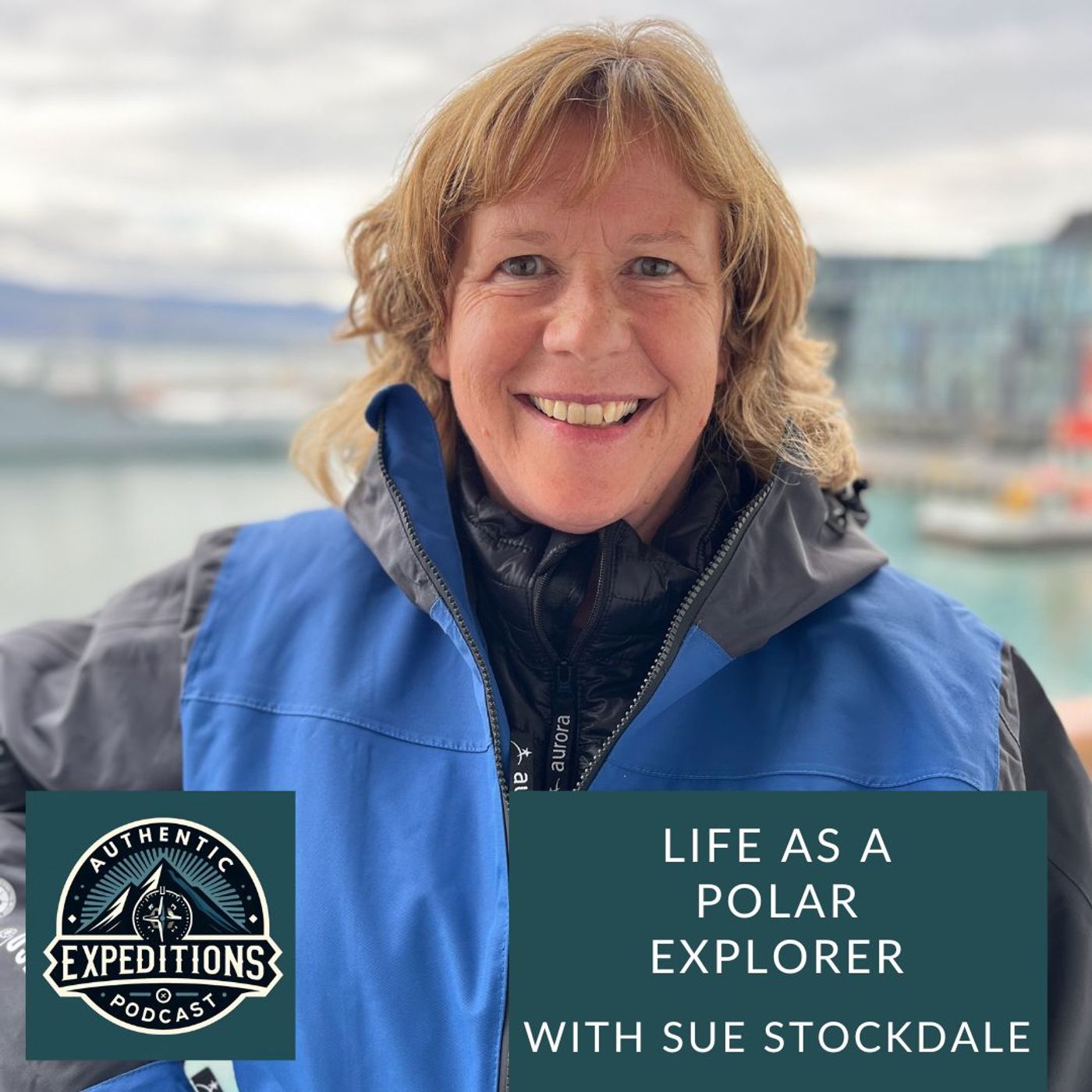
03. Walking on thin ice: Life as a polar explorer with Sue Stockdale
(00:01:37) Sue Stockdale's Arctic Adventures
(00:03:55) Facing Challenges and Building Resilience
(00:06:02) Embracing the Expedition Mindset
(00:08:31) Dealing with Fears and Team Dynamics
(00:10:21) Lessons from the Arctic
(00:13:40) The Magic of Silence and Expedition Cruising
(00:16:41) Environmental Responsibility and Expedition Cruising
(00:19:48) Advice for Future Adventurers
(00:24:31) Conclusion and Special Offer
Clive Steeper interviews Sue Stockdale, the first UK woman to reach the Magnetic North Pole. Sue shares her journey from curiosity-driven novice explorer to seasoned adventurer, discussing the challenges, fears, and life lessons she gained from Arctic expeditions. She highlights the importance of mindset in adventure, breaking challenges into manageable steps, and embracing uncertainty. Sue also discusses expedition cruising, offering insights into how it provides an authentic, immersive experience in remote environments.
Featured Cruise: Exploring the Realm of the Ice Bear - led by polar explorer Sue Stockdale
Plan your next cruising adventure with Authentic Travel company
Producer: Sue Stockdale
Sound Editor: Matias de Ezcurra
Featured Cruises To find out more about expedition cruises contact Jane Middleton on +44 (0)7971 568155 or [email protected]
Plan your next cruising adventure with Authentic Travel company
Producer: Sue Stockdale
Sound Editor: Matias de Ezcurra
Welcome to the Authentic Expeditions podcast. I'm Clive Steeper at your host for this episode and I'd like to thank the Authentic Expedition team for this opportunity. Now today is special. We have a truly fantastic guest, Sue Stockdale. Now for those of you who don't know, Sue is no stranger to adventure. As the first UK woman to reach the magnetic North pole, she's tackled some of the planet's most extreme environments and come away with incredible achievements. Now I've had the privilege of traveling with Sue to the Arctic on several occasions, camping out on the ice in sub-zero temperatures.
I've seen how she can thrive in those cold environments and we were dog slain with inuets so I can assure you it was sub-zero temperatures. I've also though witnessed the raw beauty of the frozen wilderness and it's like nothing I've seen before. And experiencing the contrast of adventure from the comfort of an expeditionship is something I have also enjoyed and I know which I'd prefer. Who better to talk to us about exploration, the thrill of the unknown and the excitement of expedition cruising?
Welcome to the podcast Sue Stockdale. Hello Clive, thanks very much for hosting the episode today. It's lovely to speak to you. Let's get started with some questions and let's go back perhaps to the beginning. Now you made history as the first UK woman to reach the magnetic North pole and I think that also includes the accolade of being the second woman in the world to reach magnetic North pole. What first inspired you to take on such a challenge? Oh yeah that was back in 1996 and it really is curiosity led because I saw an advert in the newspaper and it said wanted ten novice arctic explorers and I wondered what it's like to survive in cold temperatures in the art tech.
They said it was going to be a month in duration this expedition and it was curiosity that led me to apply but would you believe when the brochure came back Clive on the front it said are you man enough for the ultimate challenge and it was all pictures of men will that got me motivated to apply? I'm sure that fired your intention absolutely and so before setting foot in the arctic again you've just expressed there how interested you were. What was your perception of the environment and how did it change once you were there?
I hadn't really thought about what it was going to be like and yes it's cold and white but I hadn't really bargained for how that expands is just all consuming no matter which way you look once you're out on the ice all you see is white there are no humans around it is very little wildlife it does make you realise how reliant you are not only on your own resilience and where with all but the team around you that are there helping one another to survive and that's what came home to me so starkly this is a place that wants you dead and if you survive then you're lucky.
I would certainly add that with my experience there and I think whilst that sat in the background the other thing was the inspiring nature of the scenery it's so vast and the shapes are so different than what we see in our normal lives for me there was also such a wonderment but again as you say one should never lose sight of the dangers that are there and other nature can be quite brutal now for many people the dream of an adventure might seem too far and they'll hesitate to take the leap what would you say to someone in that position who wants to take an adventure but not quite sure about taking the first step?
Well I think you're absolutely right Clive it doesn't have to be a leap a step is sufficient something is about one's mindset think about the step as an experiment often experiments don't work out as expected things go wrong and we accept that that's whole part of the journey of learning and developing when we're experimenting so that would be the first thing you go on with open mindedness to accept that probably things might be different from how you perceive they will be so I'd say choose your adventure wisely something that's going to give you confidence to enjoy the experience and then want to do another adventure in future that maybe is a little bit more challenging.
If we were for a moment to just focus on being on an authentic expeditions cruise people will have the opportunity to do things that they've never done before so in that sense they have the chance to adventure what message would you leave in their ear for them to say I'll have a go. One to consider is how often will I get this opportunity again? It's probably a trip of a lifetime for many people it's a really unique and amazing landscape and the team on board and expeditionship those people are highly experienced and it's about putting our trust in the team that they're there to support and help you have a really amazing adventure experience.
I had to do that in my first expedition as a novice I had to trust in the leaders who done many expeditions to the Arctic before that's how I learned and got more confident to do other things in future so I'd say think about how often you might ever get an opportunity to do this sort of experience again and why not? Why not just take that opportunity and maybe your surprise yourself at what you are capable of? I think it would be a wonderful surprise and just underpinning that can you describe one of the most physically or mentally challenging moments of the expedition that you were on to get to the North Pole?
I mean how did you push through? What did you learn about yourself? Because I imagine that those sort of experiences would be ones that many of the crew who would be helping everybody on the expedition would have so again it's a level of if I'm right it's reassurance. Yes it is and on our North Pole expedition and I've experienced this on many other expeditions since then is you physically and mentally challenged. I was physically exhausted a lot of the time. Dragging a heavy sledge probably you would say the weight of an average person 8, 9, even 10 hours a day non-stop.
Only stopping for a few moments 5 minutes every hour and sometimes I would think wow I don't think I can get through the next hour. All I would say to myself is well let's get through the next 5 minutes. See how I get on then and then I'll make a decision as to what to do or how I tackle the next 5 minutes and then lo and behold I would get through the next 5 minutes and then it would be the next and the next and it's taking the big seemingly impossible challenge which it was to me at that time breaking it down into the smallest element that does then seem achievable because that's what builds confidence.
If you can take that small step that we've spoken about a few moments ago then we can take the next bigger step and so on an expedition cruise for example there are many opportunities to go on Zodiac cruises or to hike on land even to kayak depending on what arrangement you've made before joining the ship. So all of these things for some people might seem quite challenging and difficult. I would just say break it down into the smallest element that's possible and just try that and see what happens.
Interesting, interesting and so you described earlier the Arctic is an unforgiving place and I can imagine that to survive knowing that you're going to be carrying fears and it would be interesting obviously to know about some of those fears but also as you've just started to describe how did you manage and deal with the uncomfortable? Dealing with fears, well yeah we can all have fears can't wait at different times in our lives depending on what we're doing, fear of the unknown or what might happen if.
One of the things we did as our team and I think this is an important thing it wasn't just me individually that everybody has fears in our group because it could be a family group or a companion or a colleague or friend that one might be travelling within an expedition cruise we did a what if list. Now we made this a fun exercise each of us wrote down, headed the page on a piece of paper what if and then we wrote down our greatest fears of going on the expedition, when if we meet a polar bear, what if we fall through the ice, what if somebody gets injured, what if I just can't stand the people I'm sharing a tent with so from the big to the very mundane and then we shared those fears together that we'd all written down.
Now what that revealed was that most people have very similar fears and once they're out of your head and voiced, somehow we were able to examine them dispassionately and for many of those things we were able to work out some sort of solution or plan as to how we would deal with it. What happens when of course a fear is in our mind it can get extrapolated, it can become bigger than it actually is in reality so my advice to them would to be first of all write down those fears and if you're travelling with somebody else maybe share those fears together and you'll be surprised at how common many of these things are and there's lots of practical advice out there guides about what to plan on expeditions, average and unexpedition mindset guide, all these things you can go and look for resources and ways to help you allay your fears whether it's about what to pack, what the ship will be like, how many people will be on the ship, all those small things that might make you a bit nervous.
So tackle those fears head on. Very good, very good. Moving on, what did the Arctic teach you about yourself, your resilience, how you interact with other people and of those things because that's a fairly extreme environment you're in, what of those have stayed with you through these years that you still use today and finally as a third part of that question, what do you think would be the sort of things that guests on an expeditions ship are likely to learn? Well, it's quite a lot in that question isn't there, there are, I'll be lucky to remember all those parts."
Well, perhaps it won't be a surprise for you to hear given that this is the authentic expeditions podcast. Is it one of the things I learned in the Arctic was to be authentic? I realised we're actually so insignificant as human beings on this planet when you're faced with such a vast landscape and knowing that Mother Nature is really in control, it may think that we're really very insignificant, so there's nowhere to hide behind either. Metaphorically and practically, when we have to have a comfort break, there's never a nice burr for you to hide behind that's close by, so you have to just be very authentic.
And what that taught me is it doesn't matter how much money you have, what your job title is, how important you are in your local community, at the end of the day in the Arctic, you're just a human being and that's enough. Authentic is enough, hence why I love being part of this authentic expeditions podcast because that authenticity is really important for me. And I think that the guests travelling and expedition cruisies can also get a sense of that. Going in with what I would call a tourist mindset where we are disassociated and judging the landscapes that we're travelling in, for me a traveler or an adventurer mindset is that we're integrated into that environment, we work with the nature, the landscape, and if the weather is bad and we can't get into a particular location, we accept that on that day we can't do that, but maybe the next day we'll get to do something different.
I've heard so many stories from people on chips in the past that their itinerary has changed and they've absolutely loved what they have experienced, unexpected lights have materialised that weren't written on the original plan. So it's always that sense of working with the landscape, the environment as opposed to having so many predetermined ideas or expectations. I don't know if that answers any parts of your question. It does, story, and I hesitated because you reminded me when on the expedition ship I was on, we did have a day where we couldn't do the activities that were planned and the expedition leader arranged for a number of the key expedition crew to give presentations of their background and suddenly we all got to realise how much more there was to this collective team that we just never knew.
We saw them as either the person who ran the rib boats or they were dealing with getting us on and off the ship, but we had no appreciation of the other things that they'd achieved. And kind of with that theme, I wonder if you could just take us further into being on an expedition ship up in the Arctic region. All of our senses I imagine are you getting heightened? And what particular thing did you really notice? I would say that regardless of being on land dragging my sledge skiing to the North Pole or on an expedition ship sailing by the coast of East Greenland, the stark silence and the vast landscapes, big skies, so there was a visual sense of the drama of the environment.
Well, the silence is really what gets me rarely in our busy lives today. Do we ever get an opportunity or take an opportunity to experience complete silence? And there you are, leaning on the rail of the expedition ship looking over the side or being on land on a hike and looking out to sea and there's just no noise. There's no wind, there's nothing. It's very calming for the mind, I think. So much so that on the, a recent expedition cruise that I did, I really enjoyed it in the Zodiac. When, of course, people are excited, they're chattering, they're taking photographs, but there had been moments of silence.
So everybody had opportunities to suggest what particular nuances, different things we could do as activities. I said, well, why don't we have a silent Zodiac? So that those that do want to just appreciate the silence and are willing to keep quiet for the duration of that voyage can go into that Zodiac. And I joined the group and we had a think six rate of us in the boat together. And that was magical because you have the camaraderie, you can feel that you're not there on your own, you've got security and safety with those around you and our wonderful guide, but yet we could just appreciate this wonderful picture in front of us.
So you probably even get a sense of my enthusiasm as I'm describing this, but silence to me is such a precious experience to behold. Drifting on the calm waters in between icebergs and the different shapes and then the light shining through the icebergs is the photographers heaven. Actually, I seem to recall on that particular journey you did that some people with their cameras were asked to put them on silence, so you didn't even get the click of the camera. Now, you've experienced the Arctic in the rawest form.
How do you feel about the rise of expedition cruising as a way for people to explore these remote places? It's certainly more comfortable to travel by ship than it is to go on to land and have to drive your own sledge, for example. Absolutely. So again, back to my point about working with nature. Nature needs to be protected. We do need to think about the environment and that's why places like Spalbard, Greenland and Antarctica have strict protocols for any ship travelling into those areas. For example, in Greenland and along the coast, they have to travel at, I think it's five knots and are inside some of the fjords.
So I think these things are really important. We've to ensure that these environments are going to be there for generations to come and that people can see them. We do have to respect the frameworks and guidelines that are in place for our own good as well as nature's good. So we're working with nature for us all to appreciate it. Would I be right to assume that in protecting nature, you mean nature both above the surface and below. In other words, a ship going very slowly with a propeller turning very slowly is making less disruption of everything that is going on under the water.
Well, I certainly believe, yes, that it's appreciation for nature, whatever it is and taking care of it. In Antarctica, there are strict protocols and controls on the number of ships that can make landings at any location, on any given day and time. Those things I think will need to be introduced into more places that become popular with travelers by expedition ships. Smaller ships can get into locations that bigger ships and craft can't. Hence they are becoming more attractive to people. There are more expeditionships around now, but therefore we all have to play our part in maintaining those places for everyone to be able to appreciate.
And with these protocols, we've begun to outline some of the impacts that has on companies running the ships, running these expeditions. What though for the passengers are on board? What are their responsibilities? Yes, most expedition-cruise companies are really great at giving guidance to guests before they join the ship as to what to expect. So I love that simple phrase, but yet very important one, take only photographs, leave only footprints. So we don't want to leave anything else when we're on land and we need to just be mindful of that.
That's a great way to experience that nature. From an expedition ship, people can get up onto kayaks. So you can be really up close and personal on the water's edge, exploring the fjords or the icebergs wherever you're traveling around. As I mentioned earlier, Zodiac cruises, that's an important part of expedition cruising, where you can get out again in small groups traveling in and out the different areas and then get on to land and then do hikes and explore the environment there. So it's not just leaning on the rail and watching the nature pass you by.
You're actually up close and personal with it, which is absolutely fantastic. I love that. It is a very special experience. What do you think some of the misconceptions that people might have about going on on expedition cruise? Well, maybe they'll think that the expedition cruise ships are uncomfortable. These days, there are many luxurious comfortable expedition ships. So that is wonderful. Of course, I really appreciated meeting new people. The ship I was on, I think it had a few of the 80 guests on board.
I dined with different people on many of the evenings, got to know them, made some great friends. So it's a wonderful way to have time for conversation. And there's so many expert people on board that can share your knowledge you mentioned describing them earlier on. Clive, there's a lot to do and one can travel with comfort and of course, I love the food, too. I can hear that excitement. And if someone was considering their first expedition cruise, what advice would you give them to make the most of the experience?
If they have been on a cruise before, on a larger cruise ship, I would say forget about your experience that you've had. Expedition cruising is completely different because it is heading into the unknown. We have to bring an explorer's mindset to it. And that's what I would offer as advice is what I call the explorer's mindset, an acceptance of uncertainty that plans will change the weather will dictate where we go and just fall into the arms of the expedition crew. They're there to give you a fantastic experience, trust in them and they will reward that trust by giving you a fantastic experience on board.
So to just replay then some of it is try not to shape your trip but to be flexible and go with the flow of the expedition. Looking back, what's one piece of wisdom from your Arctic expeditions that applies to life in general? All the expeditions I've done and I've done many to many remote parts of the world. It's really caused me to reflect on the world differently and are place in it which has given me an increased level of passion to want to conserve the world for other people to appreciate in the future and that's what really I've learned.
Just thinking about this modern world, most of us will have smartphones. Do you think that a smartphone is something that's good to have with you on an expedition ship? Oh, there's a great question. I always take my smartphone because it takes fantastic pictures. So I use the camera function, I leave the rest behind. I like to disconnect from the world and just be in the moment be present. That's not for everybody. Many people like to share their experiences as they're going with their family or friends in other locations.
It's whatever works for you. I think there's something to be said for being present in the environment that we're in. Yes, we'll be ashamed to go on such a journey and miss a sight because you're busy filling in something for Facebook. What did you say? Some people really like to do that. So if you were to go on only one more epic adventure, where would it be? Well I have to say it's what was mentioned in a narrow episode by Jane Middleton. I'd love to go to the Northwest Passage, I think following in Ammonson's footsteps on his journey.
That for me has a degree of romance in my head and to finish up in Alaska just as he did having completed that voyage successfully, I think that would be a wonderful experience. So I hope I can do that some stage in the future. Good. And everybody may want a final question just thinking about Amundsen. When one gets to see the attire, the clothing that they wore in those days and how hard they must have been, is there any advice that you would give to someone thinking of coming on an expedition ship adventure about clothing, what clothing they should or shouldn't bring any thoughts on that?
Yes, I think it's lear up. Is that sensible? If you've got a number of layers, you can adjust how many layers you put on. I think it's often the extremities, hands, for example, that people will start to feel the cold in most of all. So I'd say invest in some good quality gloves. And yes, I think just come prepared and probably you may expect that the temperatures may be a little bit warmer than you imagine. Well, listen as what an incredible and inspiring conversation. Thank you so much, Sue Stockdalel, for sharing your incredible Arctic expedition experiences and your insights into the world of expedition closing.
You've taken us from the challenges of trekking across the ice, pulling a sled that's probably some 80-odd kilograms and taking us into the unique perspective that comes from exploring those remote regions and just given us a taste of some of the sites that we might see from the ship. It's clear that adventures take many forms, but importantly, they very often have a significant impact on us. They leave a lasting memory. And I think Sue, you've done that for us on this podcast. So thank you very, very much for that.
Thank you, Clive. If today's conversation has sparked your wonderlust listeners, then we've got something special for you. Our cruise offer of the month from Authentic Travel Company, Sue, tell us what's in store. Well, I have to say it's exploring the realm of the ice bear, Clive in 2026. I'm going to be leading an exclusive group on board the Greg Mortimer, which is a purpose built expedition ship for a seven-day voyage to Spitzberg. An authentic travel company have created a special itinerary and we have included some pre-cruise webinars.
So just as I've alluded to today, helping guests prepare for an expedition cruise help deepen their understanding of the Arctic. And then we also have an exclusive pre-cruise dinner in Oslo prior to flying off to join the ship. So I can't wait to share the wonders of the Arctic, just like I've shared with you today with our guests on board that cruise. What kind of wildlife can you expect to see if you're visiting Spitzberg and in June? What a great question, Clive. June is honestly one of the best times to visit Spitsbergen and if you're keen on wildlife.
I mean, you're just stepping into the Arctic as the world is waking up from its deep freeze and the landscape is absolutely bursting with life. I mean, let's start with the big one first, polar bears. It is their domain. And while sightings can't be guaranteed, I think June gives you a real shot. As the sea ice begins to melt and retreat. The polar bears are often spotted patrolling the coastlines or drifting on ice flows hunting for sails. Speaking of which, I think sails as well, especially ringed and bearded sails, are pretty common at this time of the year.
They're often hauled out on the remaining sea ice soaking up the daylight and they are the primary food source for those roaming bears. Now, if we're lucky, you might also spot whales because June marks a return of these migratory species like Minke, Humpback and even the Blue Whale. And of course, Beluga's loves the cold Arctic fjords too. Well, I also must talk about sea birds and they're like nature's version of Glastonbury. Hundreds and thousands of birds nest along the cliffs in Spitzbergen, little locks, kittiwakes, guillemots and even the odd puffin.
I found it to be loud, chaotic and completely mesmerising. So there's lots to see and of course one needs binoculars and a good telephoto lens if you're into photography. It's just a fantastic place to visit. Wow, that sounds like an unforgettable experience. So to learn more or secure your spot, head to Authentic Travels website, AuthenticTravelCompany.com or check out the show notes for all of those details. As always, a big thank you to you, our listeners, for tuning in to the Authentic Expedition podcast.
If you've enjoyed this episode, don't forget to subscribe, leave us a review and share it with a fellow adventurer. Until the next time, keep exploring, keep discovering and stay authentic. [Music] [music]
 Apple Podcasts
 Castbox
 Castro
 Goodpods
 Moon FM
 Overcast
 Pocket Casts
 Podbean
 Podcast Addict
 Podcast Republic
 Spotify