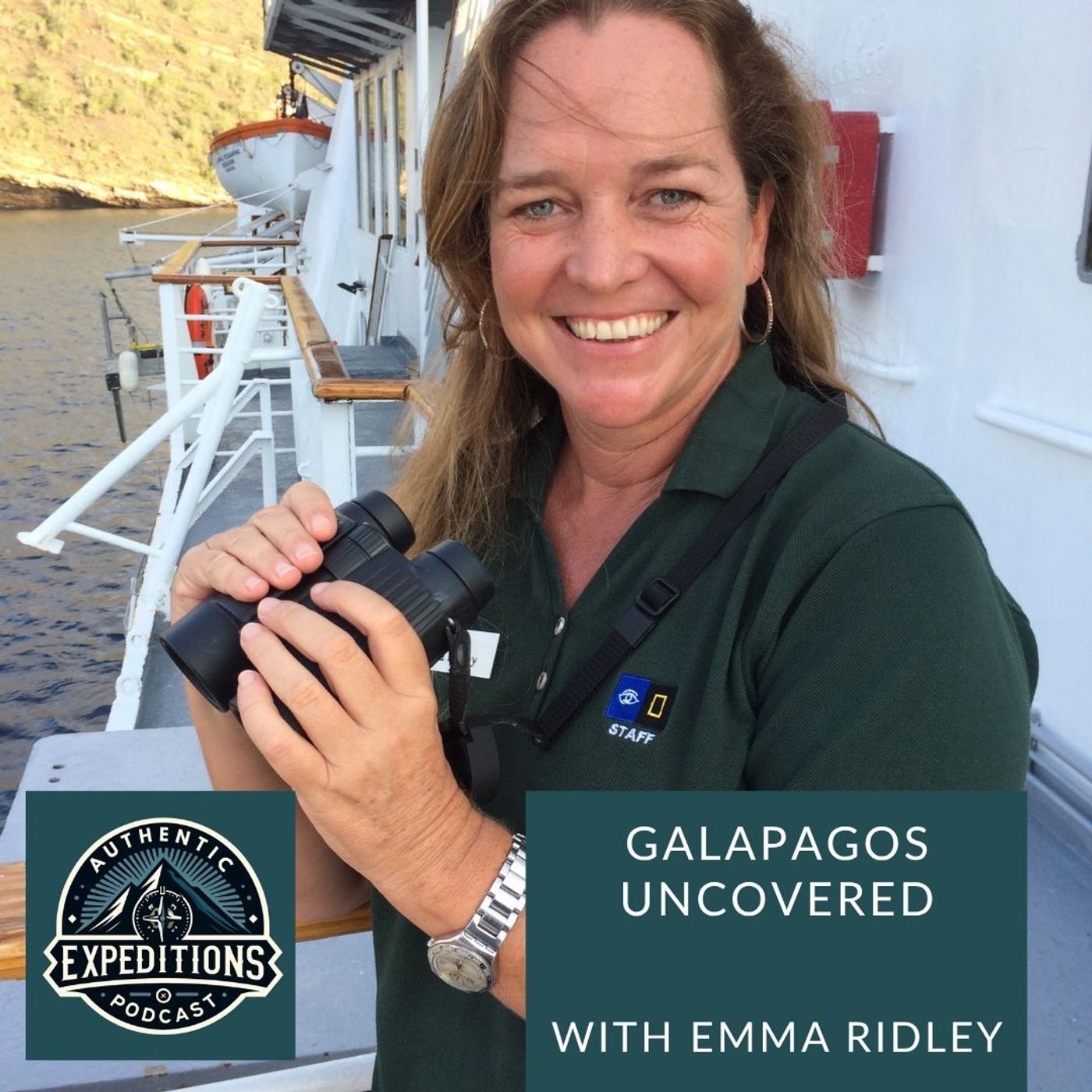
05. Galapagos Uncovered with Emma Ridley
Featured Cruise: Galapagos Adventure with National Geographic - Lindblad Expeditions
Plan your next cruising adventure with Authentic Travel company
Producer: Sue Stockdale
Sound Editor: Matias de Ezcurra
Featured Cruises To find out more about expedition cruises contact Jane Middleton on +44 (0)7971 568155 or [email protected]
Plan your next cruising adventure with Authentic Travel company
Producer: Sue Stockdale
Sound Editor: Matias de Ezcurra
Welcome to Episode 5 of Authentic Expeditions, the podcast where we go beyond the surface of expedition cruising to uncover the people, places and principles, shaping responsible travel around the world. I'm your host, Sue Stockdale. And in this episode we're diving into the enchanted islands of the Galapagos, with someone who knows them like the back of her hand, Emma Ridley, with over 25 years of experience living and working in the Galapagos. Emma brings a unique insider perspective on what it truly means to lead, protect and share this extraordinary ecosystem.
From sea line encounters to the inner workings of sustainable tourism, you'll hear how expedition cruising is evolving and why it's one of the most immersive ways to experience the magic of the Galapagos. Welcome to the podcast, Emma Ridley. It's lovely to speak to you today. Hi Sue, thank you so much for having me. It's great to meet you and I'm very happy to be here as well. I'm delighted to speak to somebody who actually lives on the Galapagos because I've never been there and I have a great sense in my mind what these islands are like, but tell a listener.
What is it like to live in the Galapagos? Well it's an absolutely amazing place. I never really thought I would end up living there. I went out there straight out of university for a two-year contract. This was in '95 and so it's been quite a long time and I just completely fell in love with the islands. They're absolutely magical. The most amazing thing is the contact with nature. It's how the species coexist relatively harmoniously. It's an amazing experience. Animals that have evolved for millions of years in the complete absence of predators so when you're wandering around the islands they completely ignore you.
They're oblivious to your presence. They just continue doing what they're doing both in and out of the water. It's an amazing experience. It's hard to describe the feeling. And to get to the Galapagos in the first place, the islands are west of Ecuador. Is that right? Yes, that's right. It's a group of oceanic islands. It's an archipelago of about 19 large islands and over 200 rocks and islands and it's located right on the equator about 600 nautical miles to the west of the country of Ecuador. So for most people that are traveling there to visit the islands are they flying in and then sailing on a ship or how do most people get there?
So nowadays the way to get to the islands the only way is to fly in. So you fly into Ecuador. You can choose to fly either into Keto which is up in the Highlands of Ecuador or to Guayakil which is the large coastal city which is closer and generally it's one plane. So the plane leaves from Quito, and then Guayaquil half an hour later, refuels and then flies out to Galapagos. It's about an hour and a half flight. And in Galapagos you can also choose which island you'd like to land and there are two islands that have airports.
We have Baltra just to the north of the central island of center crews. And the San Cristóbal which is a large island to the east of the archipelago. So those are the two options for flying in. And then we'd expedition crew ships leave from either of those locations. Exactly. So when you do fly into the islands you'll typically come out, your naturalists will be expecting you and they'll take you for a short bus ride to where the ship is waiting. You then board what we call pangas which are smaller boats that take you from ship to shore because in the islands there's no where the ships can actually pull up alongside.
So you always use these pangas in many cases, zodiacs. So you board these, they take you to your ship and then you will sail around visiting the islands according to a predetermined itinerary that has been settled with the National Park Service. So now I love it. We're getting right into the detail of the reality of going on a journey of voyage to visit the Galapagos. Your role I understand is expedition development and field manager for Lindblad expeditions. What does that involve Emma? Yeah, so I've worked with the Lindblad expeditions for a long time now since 97 and I work in expedition development which means I work very closely with the National Park in selecting the sites that we would like to include in an itinerary.
The park has got certain regulations. You can visit one given visit a site once every 15 days and so we have these 15 day itineraries that you can either visit eight day segments, five day segments or you could just stay 15 days if you like and do them all. So I'm very involved in that. I have also worked as expedition leader for a long time so leading the actual expeditions on board and in charge of the field staff. So the naturalist, undersea specialist, photo instructors, expedition leaders that work on our ships.
Now one of the things you've mentioned there is the restrictions and quite rightly so that the National Park place on how often people can be visiting these different locations. Sustainability, conservation, of course these things are top of mind for many travelers. Is that why these regulations are introduced? Yeah, so many many years ago when the tourism started increasing in the 70s or so the Ecuadorian government set up a series of rules to regulate the visitors to the islands. So when you're actually in the National Park which is about 97% of the total surface area of Galapagos is National Park you have to follow these rules such as there are fixed trails that you have to follow only maximum 16 people per naturalist you have to go ashore with a licensed Galapagos naturalist.
You're not allowed to touch the wildlife you have to remain a certain distance and what they also do which is excellent is that they manage the itineraries of the different ships. Close to a hundred different cruise ships that sail around the islands none of them larger than a hundred passengers and they have itineraries that are made so that you don't have too many people on one island at one time. So if you're sail on a larger ship the 96 passenger for example such as the National Geographic Endeavour 2 you will tend to have the sight to yourself because you are the carrying capacity of that site whereas if you're on smaller vessels there are 48 passengers a lot of 16 passenger vessels you will have maybe three or four other ships there with you as long as that carrying capacity is met.
So it's very important this way they manage to protect the island so if you follow the rules there are too many people short at the same time they determine what you can do in each different site as well so this is a snorkel site you can kayak here so it's not a few four it's very well controlled well managed and it's worked incredibly well at keeping the Galapagos in a pristine state. And from your experience Emma what are some of those jaw dropping moments that you have had living and operating around the Galapagos?
A well life encounter that has had you just take a breath and go wow. Yes well I always grew up reading all these books about nature interaction with wild animals and this was something I've always dreamed about and when I first moved to Galapagos I remember early on I was snorkeling in a place called Bartolome and a young sea line came up and this young sea line they definitely steal the show on every visit but this young sea line was carrying a sand dollar in its mouth and it was dropping it and then I would catch it and then I would drop it and it would catch it.
We had this kind of give and take this interaction in the water for about 45 minutes we were playing and that was something that I never thought I'd get to experience in real life and yet there it was. So I think that's when the Galapagos really stole my heart that moment when I had this real interaction with an animal in the wild and the water. There have been many many more experiences assuming with penguins coming right up to you, scuba diving with hammerheads and whale sharks or even just going on a walk on shore and sitting down and watching these incredible courtship dances of the Blueford and Boobe's or the Wave D'Albertrosses just going about their business six feet or so away from you as if you weren't even this.
These are all the kind of things that make cave visit to Galapagos special and which is why I couldn't leave. I just never get bored. Twenty seven years of leading people throughout the islands and you still see something new every day, you still see new behavior and you still enjoy watching and sharing with as much as the first day. Well you're stealing my heart in your description there Emma. Thank you me once again for coming visit the Galapagos as well. Of course there's the nature that you're just describing to us so vividly.
Wasn't like actually on the islands so far normal life if you like not for people that are tourists. Oh you mean actually in the town we do have only three percent of the total service air of Galapagos is inhabited by humans and these are areas that were already inhabited prior to 1959 which is when the islands were declared a national park. So we're kind of all crammed in there. It's quite crowded though. The population has increased quite dramatically. It went from maybe 2000 people in 1974 to over 30,000 in 2004 which is why back in 1998 the Ecuadorian government created a special law for Galapagos.
So even though the Galapagos islands are a province of Ecuador they are governed by regulations that are different. Anyone living in the islands prior to 98 became what has turned a permanent resident. Anyone else wanting to come into the islands you can't you can stay as a tourist and then you have to leave and this is regardless of nationality so it includes Ecuadorians even though it is a province of Ecuador so it was quite an important step which was taken to try and protect the islands from this overcrowding of from being overtaken by people.
So it does feel quite crowded in the towns. They have grown very fast. They're still very picturesque and there's a lot going on in terms of sustainability programs with the local population now. It's kind of settled. There are people living there who maybe they would like to pass on the islands to their children, to the grandchildren. They're looking at ways of making the whole life in Galapagos a lot more sustainable. For example before we used to bring everything over from the mainland all the food that was on the ships and eaten locally was all from the mainland.
But more and more they're working to develop sustainable agriculture, farming, we do have a small fishing fleet and rather than sending out of Galapagos they're going to provide the local tourism and so on. So it's getting to be a much more sustainable place in many ways. And just from your experience not only of the Galapagos but of the world and traveling I'm just wondering whether that's a model other countries that start to potentially be threatened by overtourism could be adopting. The idea of more stricter controls and considering how things are done in the Galapagos.
I think it does need to happen. I mean just my personal experience when I went out to Galapagos this whole permanent resident didn't exist. The tour companies every year they would just look for PhD students or masters or biologists from outside. Bring them in. You'd be paid a bit and but who cared? You're working in the Galapagos for a year and then you'd go and they'd bring the next bunch in. And that's how I came in. And then when I first arrived in Galapagos there was a lot of unrest. There were a lot of political unrest.
They wanted to change this scenario. And now looking back it's a good thing because now all the guides that work on board these ships are locals. The education system has been developing or sometimes they go out of Galapagos and then come back. But it sustains itself. It sustains the local tourism. Only locals can buy the land so they're not being priced out of housing which is something that we're seeing a lot in certain parts of Europe for example. It's the locals that get to work in the industry in this waiters, mariners, guides and so on.
So even though it's far from perfect I think that it is a good model. I think it's a model which is offering many many experiences that could teach the rest of the world. Yes so I do agree with that. Now on this subject of sustainability and limb-blad expeditions of course is known. For its commitment to sustainable travel. What are some of the key initiatives that are put in place by limb-blad to protect the Galapagos if a guest is traveling to visit? Yes well of course we're very responsible minded.
We make sure that all the local regulations are followed which is what most our companies do there. But one of the things that I really love about limb-blad expeditions is that early on back in 97 when we bought our first ship. Sven limb-blad had the vision that these people who are coming to Galapagos experience in this magical place would somehow like an easy way to give back to the islands. So they started what was then called the Galapagos Conservation Fund and we started supporting conservation work done by the National Park Service and the Charles Darwin Foundation by raising funds on board with the incentives for the money donated on board you'd get credits of future Lindblad trips.
It was a very clever system that worked very very well. But then became into an alliance with National Geographic they formed the limb-blood National Geographic Fund which supports conservation programs worldwide in all the places that we operated. But it all started from this original program in Galapagos so we support very very many worthwhile conservation programs. The science done, the management work, other foundations like the Skolesia Foundation which is a foundation that works in education on the island.
It runs a small school but also does teacher training throughout the archipelago. And also by supporting the local farmers for example most of our food is bought locally which is something that we spearheaded and we have also done artisan training and in our shops on board we sell a lot of handicrafts that were made locally by artisans that received training in certain areas from us. There really are many many different ways to help the Galapagos become more sustainable both by focusing on the conservation but also livelihoods for the local people that are not too extractive that do not harm the islands.
So many many different ways. That sounds really wonderful and an opportunity for travelers to give back as well as enjoy the experience of being on the islands when they're there. When you're waiting your expedition leader Hat Emma and you're taking a group out and wondering what are some of the challenges that you may face? I'm imagining there might be unexpected things happen. What things spring to your mind from the experiences you've had? Oh well Galapagos can be a challenge for a visitor so we have two very distinct seasons.
We have a hot humid season which we're in right now where I guess and you're going ashore you can get a little bit overwhelmed by the heat by the humidity so helping people deal with that sometimes can be a challenge or in our cooler season in August September we have waters that can be as cold as 16-17 degrees and so dealing with that's also can be able to have a challenge for people to get a little bit cold. But I guess dealing with the life on the equator which is not always easy could be one of the most challenging aspects of my job.
Otherwise to be honest the Galapagos make it easy both for a naturalist and an expedition leader because the wildlife is right there right in front of you. You don't have people coming back saying oh I really wanted to see lions tigers and bears and there wasn't anything because they're all right there in front of you so. In that sense it's a very rewarding place to work. So you have the wildlife right on tap in front of you? Oh yes it's right on tap. I mean I have friends that work in much more challenging places like tropical rainforests and things so you really have to search for the wildlife and they always say oh you guys are fake naturalists it's all right there you don't do any search.
It says like a wonderful place for somebody who's interested in photography to visit. Oh it's a spectacular photography and in fact one of the great things about this alliance with National Geographic is that we quite often have National Geographic Photographers on board. There are very specific photo expeditions which are focused on photography and you'll have a Nat Geo Photographer once again and some other photo experts. But also just on a regular trip every week we do have a team of naturalists that have been trained in photography.
They are named photo instructors and they actually help bring these photo opportunities to life for our guests so they give talks they give tips they might lead walks focusing on photography it's a photographer's paradise. It does certainly sound like that particularly when you have all that support for people wanting to get fantastic photographs. How many expeditions ships do limb blood expeditions have? Right now as of the 15th of March we're going to be having four which sounds quite good we've been operating with the two for a long time we have the National Geographic Endeavour two which is a 96 passenger vessel then we have the beautiful National Geographic Island a two which is 48 and we have just taken over the operation of two other ships that were being sold and so we'll have another 48 passenger vessel and for those who like a smaller group or maybe travel with the family a charter we have a 16 passenger vessel called the National Geographic Delfina named after as Sven Lindblad's youngest daughter so given that there's a potential doubling of capacity or availability does that make your job doubly difficult?
Well there are a lot of amazing naturalists out there so in some ways I like the fact that I've got more work to offer to some of the naturalists that we like working with. Once the itineraries are fixed there was a certain process I mean these ships that we bought they were already operating in Galapagos so they did have itineries but we wanted to improve them in some ways so we worked with the National Park to do that they've all got all four of them have got fantastic itineries we need to work a little bit on how to differentiate them so which one do you want to go on quite often you think oh well maybe the smaller one there'll be less people on the larger one will move less you know motion and so on so we're still working on that we're only starting with these new additions to the fleet and we hope to find ways to create slightly different products with each ship eventually.
It sounds like it gives more options to would be passengers to consider. Yeah so definitely for example a 16 passenger vessel is much more informal much more relaxed but also gives you the opportunity to be a lot more active if you want to so whereas the larger ships because it has the maximum capacity of 16 guess but you have two naturalists that you have your naturalist tool also expedition leader your naturalist who's a photo instructor so they're very small groups but in general is something that we strive for having groups of maybe maximum 10 12 on different options the larger ships of course you have more people it means that you can get to meet more people there we have larger teams of naturalists through their all different specialties and so on and we tend to offer a lot of different options for different tastes and interests.
It does sound wonderful it is you have to come I can't believe for all the amazing places you've been and you've not been to the Galapagos yet. I know it's still on my list of places to visit but I think you're inspiring me now am I good for what you're describing. So I'm wondering looking ahead as tourism and travel becomes even more popular around the world. I'm wondering if you see any new trends or things that are changing in relation to the Galapagos. Well I think this type of tourism is kind of expedition style tourism we're seeing it used to be kind of a little bit of an outlier you'd have the big cruises you'd have the results you'd have these kind of more traditional ways to holiday and then you'd have like a few eccentric set would go on these expedition cruise lines to remote places like Galapagos Alaskan Tatika but it used to be relatively minor whereas what we have seen in the last few years is that this type of expedition style tourism has really taken off and so there are a lot of different ships and now the ships become more and more beautiful and more and more luxurious because it typically used to be that you'd take an old ferry or an old fishing boat and just make it comfortable and then go around.
So the ships are becoming more and more luxurious more and more beautiful and there's more and more interest in this type of tourism which is both good because obviously it helps raise awareness gives back a lot to the communities they visit but at the same time when tourism becomes too much it tends to also have potentially negative impacts you know too much pressure on the fragile resources the places where people live tend to change because there's too many people visiting so it is something that we need to be careful on for me and it's both very very positive I firmly believe that tourism can really bring long-lasting solutions to communities but also important to ensure that it doesn't overwhelm the communities and the places that it visits the nature that it visits and that's going to continue to be a challenge because there are so many of us there are so too many people in the world so we just have to make sure that we continue to handle it in a way that is sustainable and to support the communities without overwhelming them.
You've given us a lovely understanding of how things are evolving and perhaps some of the decisions or choices that travelers need to consider when they're deciding to go and visit somewhere like the Galapagos. So if there was one of our listeners it's thinking oh I must inspire you me here to go and visit the Galapagos what's one piece of advice that you would give to a potential traveler to the Galapagos? There are several different things that you need to consider the wildlife is great year round that's great so whenever you go you're going to see fantastic wildlife so when choosing a time of the year to go I would definitely recommend going by what your preferences are climate wise.
If you're someone who really doesn't do too well with the hot tropical conditions and you're okay with cooler waters to swim in, well July, August, September, October that's our cool season so it's maybe 22, 21, 22 degrees or so it's dry kind of overcast and that's really pleasant but when you go swimming on the other hand 16, 17, 18 degrees it's quite chilly so you want to bring a wetsuit maybe we do provide shorties but you might want to bring a slightly more protection for being in the water and then you have the hot season where it's very hot and humid but the waters maybe 27, 28 degrees so if you're a big water person then just want to swim and you don't mind heat and tropical conditions, February, March, April might be your time.
Where if you want a happy medium you have May, June, or November, December which are kind of transition between the two so when choosing a trip I very much recommend looking at the climate and what it's like at different times of the year and then of course there's the type of tourism and Galapagos mainly have two different types of tourism one of them is the more traditional style which is the liverboard when you fly into the airport and you get picked up by the local cruise by your cruise ship and then you go around the different islands you get to go further out it's very well controlled, very well managed so you can be quite sure that you're not overloading the places you're going to because it's a great job that the Galapagos National Park Service does and you can get to some of the further more remote islands and you might come into the town maybe once doing this trip so you'll see a little bit of the community but not much but this kind of travel might not be for everyone the other alternative is the land-based tourism where you can fly in you can stay in local hotel or local Airbnb you can get to try out the local restaurants and meet to meet more part of the community for a few days which is also very nice and then take small day trips
out to some of the different islands so you don't get as far as a field I don't think you experience the wild Galapagos as much but you do on the other hand get to know the community a little bit better the trouble with that is that it's less well controlled to be honest because the National Park does not have a say in the non-national park parts of Galapagos so it does tend to get a little bit overcrowded and that's the type of tourism that's been a little bit of concern because you get a lot of people coming in there more hotels that are being built fast and there's not that much that can be done it tends to lead to a little bit of overwhelming and overcrowding of certain visitor sites that are closer to the towns but it is an option especially that one I would really recommend maybe looking into more responsible small groups because I guess ships aren't for everyone well given we are focused mostly on this podcast about expedition cruising then of course we would be recommending for our listener to reconsidering the expedition cruise option absolutely I mean I think the ship is definitely the best way to really immerse yourself in Galapagos nature get away from humanity and just see the animals the snorkeling which is so incredible the time on land and some
organisations in fact we offer maybe a bit of both so you can add a couple of days in a town on the way you can maybe do some scuba diving or if you're a diver you can spend a few extra days you can maybe visit some of the local farms have the local restaurants and maybe do a little bit of both but I definitely recommend the best way to really see the islands as by ship and finally Emma we always like to recommend a cruise a featured cruise for each podcast episode and wondering what cruise springs to your mind as a featured cruise about the Galapagos what would you recommend?
Well as I mentioned before I really would recommend taking it a ship rather than a land based option and I like our weak long departures that if you can the longer you can stay in the islands the better so I think limelight expeditions natural geographical is definitely a way to go if you like the smaller groups you could take the National Geographic Delfina or the National Geographic Gemini or Islander 2 which are 48 passengers or the beautiful National Geographic Endeavour 2 96 when you reach a site you tend to have the site yourself because you have the island to yourself so I would really recommend an eight day departure on the National Geographic Endeavour 2 would be my experience of choice I think yes it's been really fascinating to learn about the Galapagos from your perspective Emma you've given us some great detail and insight into the geography perhaps what we would experience in terms of nature and just some of the realities about the islands that I never even was aware of until this conversation so it's been very very useful thank you so much for your time and I wish you well in this upcoming season when you're back in the Galapagos and who knows I hope one day to actually get to visit you there I really really hope so it would be wonderful to see you
and yes I'm looking forward to getting back there and not in the Galapagos at the moment but I'm flying there in a couple of weeks and I can't wait to get back there and to spend more time with that fabulous nature so yes hope to see you there sometime too soon thank you Emma thanks seeing that was a great interview as always and so nice to talk about warm destination that you think after our polar podcasts when it be great to do an expedition with Emma as our expedition leader I'd love it you know one of the things I love about Emma's company National Geographic in Blood Expeditions is the way they welcome families on board and the way the kids get to have their own adventures and learning time Emma recommended an eight day departure on board in Endeavour 2 and I'm pleased to let our listeners know that National Geographic Lindblad Expeditions have kindly given us an exclusive offer just for our listeners they're including international economy flights for the very same trip that Emma recommended on the Endeavour 2 which only holds a maximum 96 guests and there's more they're also extending the offer to the Islander too that Emma also mentioned which is even more exclusive we just 48 guests on board whichever one of those
expeditions you choose you'll look at to enjoy a very neat and personal adventure with amazing guides like Emma breathtaking scenery and all sorts of fabulous wildlife like the blue-footed boobies there really is a very generous offer from National Geographic Lindblad Expeditions so a very big thank you to them and therefore it's only available to the end of June so for more information hurry over to the show notes and follow the link to these great offers on the authentic travel website when you will find the dates all the cabin information along with details on how to secure your place to this truly magical destination thanks for listening and we look forward to sailing with you soon (gentle music) ♪ ♪
 Apple Podcasts
 Castbox
 Castro
 Goodpods
 Moon FM
 Overcast
 Pocket Casts
 Podbean
 Podcast Addict
 Podcast Republic
 Spotify