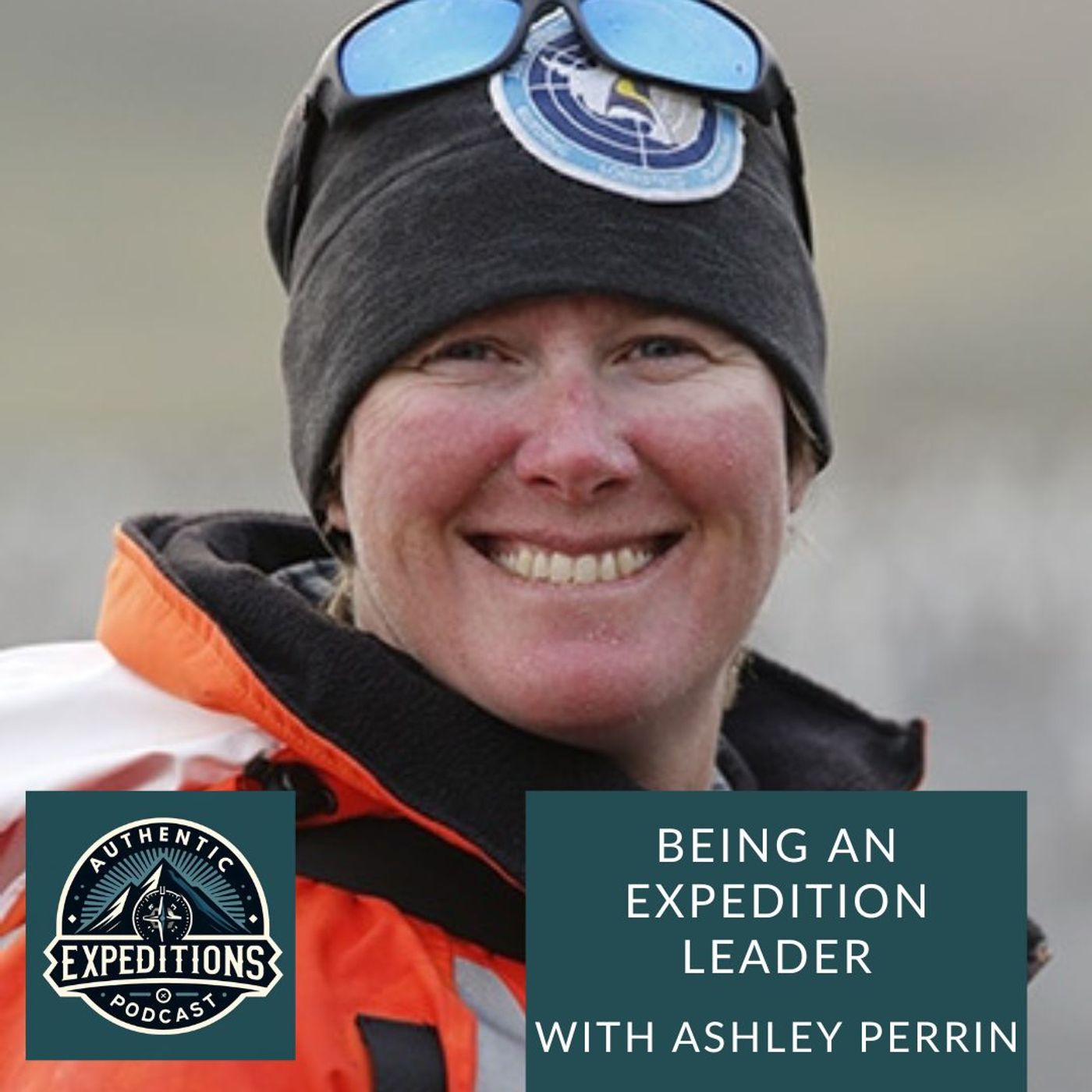
06. The Reality of Being an Expedition Leader with Ashley Perrin
About Ashley Perrin
Ashley Perrin has sailed over 130,000 miles offshore as a skipper on vessels between 20’ and 185’. She is an Ice Pilot and provides guiding services for super and mega yachts in Antarctica, South Georgia, Chilean Patagonia and Falklands and was the first woman boating officer for the British Antarctic Survey on the continent.
Featured Cruises To find out more about expedition cruises contact Jane Middleton on +44 (0)7971 568155 or [email protected]
Plan your next cruising adventure with Authentic Travel company
Producer: Sue Stockdale
Sound Editor: Matias de Ezcurra
Welcome to Authentic Expeditions, the podcast where we explore what it really means to travel with purpose in the world's world's places. I'm your host, Sue Stockdale, and today's guest is a true trailblazer of the polar seas. Ashley Perrin has captained racing yachts all over the world and now operates as an expedition leader with Aurora Expeditions. From being the first female boating officer for the British Antarctic Survey on the Antarctic continent to leading expedition cruises in the Arctic and Antarctica, Ashley brings sharp insight, grounded leadership and a deep respect for these fragile environments.
In our conversation, we dig into the responsibilities behind the role of expedition leader, the power of citizen science, and while slowing down in nature might just be the most valuable experience of all for an expedition cruise. Welcome to the podcast, Ashley, it's lovely to speak to you today. Great talking to you. Thanks for inviting me. Well, you've had such a diverse and adventurous career. I'm really fascinated to find out more about it in our conversation today. When you were a youngster, what got you interested in the polar regions?
Well, my best friend who I met through sailing went to South Georgia with a lady called Sally Pulse, who is an amazing woman, explorer and ornathologist. And I went with Sally to help with an albatross study in the Bay of Islands after she'd raced around the world, single handed in the Vendee Globe. And after that, she encouraged me to go there. And then I also graduated with a girl who went to work for BAS as a marine biologist. And then the last thing that pushed me to join Basin's British Antarctic Survey was that I met a guy on a bus in Malau in Cambodia when I was trekking there.
And he worked at the American station in McMurdo. And I was at a point in my racing career as a race boat captain where I just needed to be in one place rather than traveling so much. So it seemed like the best place to be in one place was Antarctica. I'm sure most people wouldn't have that top of list if they were thinking about where to be based. But it's certainly an amazing and unique continent to be based on for a period of time, Ashley. Yes. It was three years with BAS in the end. And Jane, that time you were the first woman boating officer for BAS, understand?
Yeah. Just to be clear, there was a woman boating officer that you were before me. She was in South Georgia. And I was at Rothera at 67th on the Antarctic Peninsula. So the first for BAS in Antarctica, the proper continent of Antarctica. During that time when you were there down in Antarctica? What were some of the most memorable moments that you'd recall? It was a great period in my life because there was a lot of good friendships supporting science, learning some unique skills. My nephew particularly loved the fact that I was driving a crane.
And a great winter camping. It's just a privilege to be in the continent with just two of you on our winter trips with no one else around you. But yeah, certainly my niece's nephew were quite young at the time. And I remember my nephew getting in trouble at school for telling Thibs about his aunt, which turned out to be true. And my sister actually got called into school to talk to the teacher about my nephew's fibs. Yeah, very unique. But now to them, it's just normal and to me, I guess it's pretty normal, but I guess the outside world thinks it's so unique.
Yeah, it's certainly not an everyday job for most people actually. So now you're an expedition leader with Aurora Expeditions. What is that involved? What does an expedition leader do? So not allowed a lot of sleep. A huge amount of responsibility. The responsibility to the passengers, the expedition team and the company basically. The job is very diverse. You've got personnel management, risk management. You're creating a narrative. You've got a responsibility to educate passengers, your lectures, recaps, workshops.
I love doing a lot of citizen sciences, part of the expedition. You're working with the regulations of the regions that we operate in. And in the Arctic, you're working in partnership with local communities and we have onboard ambassadors and cultural specialists. And on a daily basis, you're weighing up whether in ice conditions, team and passenger capabilities and you're trying to create safe operations that are varied for the passengers in terms of what they're seeing. That's a lot to be responsible for, Ashley.
And for the listener that's not familiar with the size of vessels that Rorah operate, how many passengers do you typically have onboard? The remax out at 128 and 28 of those are non-landing passengers. They're purely activity passengers. They also land, but because our landing sites allow 100 people at a time, some 50, some 30, the company decided that it was best experienced for everyone if we limited it to that amount. That sounds like a sensible approach. And of course, you mentioned the particular nuances or regulations of different geographies that you're operating in.
And those things are changing, of course, with perhaps an increased focus on sustainability and conservation. How do you keep track of all of those things to ensure you're operating within regulations? Well, we are given a lot of paperwork to read. So in order to go to these areas, we have to apply for permits. So when we apply to the permitting authority in our case, the Australian Antarctic Division, which is within the Antarctic Treaty Party, we send in our risk assessments, our contingency plans.
And because we are members of Iado and Iaco, we follow their operating procedures as well. So I will say that if it's Australians or more strict, then we must abide by the Australian rules. So we're basically taking all these regulations and all these rules and ensuring we have a minor and transitory impact on the continent. And these rules are based on decades of experience from multiple operators. So it's not just one operator, it's operators and scientists. What we don't understand right now, to be honest, is our cumulative impact with such a large increase in the numbers of people going to the continent.
But we are continuing to receive our permits based on our procedures and how we're operating. So given that teething to those procedures is paramount as you're describing, and I imagine also safety of passengers and crew and your expedition team is paramount, what do you do to manage the safety and the risks that potentially are in those types of remote environments that you're operating in? Ironically, it's not as remote as you feel like it is because if you look at the marine traffic going across the drake passage, it's starting to be like the M25.
You would struggle in the peninsula area to not be within two hours of another vessel. And I have to create its own search rescue unit and by creating its own search rescue unit, you have pretty much more assets than the national government at that point. Now if you go to the Arctic and you're looking at Northwest Passage, that is a lot more remote and we can have a negative impact on communities because they're not set up for the number of passengers and crew on a vessel. If you go to South Georgia, there's only one way in and out by sea.
So you don't have that fall back of a plane from KGI if the plane can run. So you do have enhanced contingency planning and actually more so in the Arctic because you really don't want to impact those communities negatively. We can't impact in any way the science stations, so we can't ask a national authority for help because we'd be impacting their science. So you do have to be self reliant and as such you make decisions based on that and the capabilities of your team. I will say Aurora's expedition teams are I think the best in the industry.
We have a lot of skill sets within the team and we do a lot of drilling and training and Metafacts are becoming more prevalent and I think that's because people feel like if they go down on a ship, that's a luxury ship. Things are somehow going to be easier but the environment is still the environment and climate change is making it harder to operate. It's more extreme. So sure we're becoming I think a little bit more cautious in our operations because of our passenger group and because of the numbers of people down on the continent.
That makes complete sense. I've had the experience firsthand of being on an Aurora expedition and the role of the expedition leader. What I observe was that rigor within which you're also preparing the guests on board for the unknown experience. How do you do that then Ashley? How do you help them to get into the right mindset for the expedition crews? I'm pretty forthright transparent. I tell them straight off to tear up that itinerary and not come to me with that itinerary in their hands because they won't go well for them.
The reason being is it sets expectations that you can't fulfill and they're going to really enjoy the experience if they just let it all go and just let the people who are good at their job perform their job. So we don't have control and I think in our daily lives we think we have tons of control and we do in a non-remote situation. We can just get in our car and drive to wherever we want to go. So I would say let go of expectations be flexible and trust that the expedition leader and the team have your best interests at heart and that you're going to have a fabulous trip.
And if you do all those things you're going to be in the expedition mindset and that's key for everybody on the voyage. Because I have seen passengers impact other passengers experience by not just being able to let go. It's such an important thing. And given that you do work in some of the world's most fragile ecosystems and you've been operating in those areas for a number of years, what have you seen as changes in terms of climate and wildlife in the places that you've lived and worked, actually?
So when I was on base I started noticing I'd start talking to yachts that came in and they said, oh yeah, the glacier face used to be here and then you look at the start and you're talking two miles difference. I started using radar to see what the ice-paste collapse was and in South Georgia it was a meter and a half a day of ice-paste collapse. So we're seeing massive extremes. It's the canary in the coal mine. The Antarctic connects those experience that rapid warming as it said and it's five times faster than the global average.
So the ice is melting, permafrost in the north is melting. That means the wildlife is dealing with habitat loss and that's resulting in migration if that's possible and changes in food availability. So some species are coming out okay. We're having gentrification of the peninsula. That's gentrification of the penguin. We're lovely to describe it. So they're coming out okay but the rate of change is what's unprecedented and the wildlife can't react fast enough to that. They've moved almost as far south as they can and they're moving to the further steps they can.
When I was on base I was a science diver. So we were collecting reorganisms and they were basically boiling them and it wanted a half degree increase in water temperature. They were stopping reproducing. So stop reproducing that's the end of the species. So we are seeing big changes. The other things are that we're seeing more rain and less snow and if you're a penguin check with downy feathers you don't do well with rain. No that's true. So you're noticing those changes. You mentioned a moment ago actually that you're a great proponent of citizen science and I'm sure that passengers on board should love to get involved in that.
What are some of the projects that guests can get involved in? We support polar collectives and their projects they run are snow algae, survey, happy whale, fiorate phyto, NASA cloud survey, seabird survey, second disc project. And then on top of that I really like to find specific to our destination. So whales of Iceland clean up spellbar and then we run a partnership with an app called the IC app which you can take pictures of garbage and they can actually see that on this heavily. It's quite funny when you press the app it says recover or just say that it's there and then it says oh somebody will come around and pick it up.
I'm not sure what time garbage day is on these places but anyways we pick it up. So it's a free activity on board and you just sign up if it's a zodiac experience where you turn up if it's on board survey or workshop and I try and work at least one of those into each operation that we run. So guests can get it up close and personal with doing something to support science. Yeah I think it's our requirement to do that. If we're going to visit each places we need to give back in some way and buy some remote regions particularly the poles is extremely expensive so we need to give back and we do carry scientists on board as well for certain projects.
What is it that you enjoy most about your job? I enjoy creating a narrative, enjoy doing citizen science, I enjoy standing back at the end of the expedition and watching the slideshow and what has been created by the team and looking at the smiles of the expeditioners and seeing that chat in the bar where everybody is at the end of a voyage they've made lifelong friends and just standing back and knowing that my team did that and I led that and yeah the end result is pretty special. Do you think the expedition cruising has changed you as a person?
Has it changed me? Well I've certainly got a little bit more patient than my team might say that's incorrect but sometimes I do have to take a deep breath and maybe look at things from different perspectives. It's changed how I lead I think especially with the younger guide groups and what they expect from a leader is different I think. I come from being a bridge background so I come from being a sailor and a captain and so I am a very vertical method of leadership I think then in comparison to other expedition leaders so it's changed to me more patience, more ability to look at things from a different perspective for sure.
And when you get back on to dry land and not in a polar region does it give you a different perspective there as well in terms of what's important or just how you're looking at the world in a different way? I don't know I mean I have my other job as a race boat captain so I'm pretty much on the water most of the time and just to give you an idea in the last three years I've been at home 23% of the time I did that calculation though I'm pretty much on the water all the time and I see being on a boat like being on a penny and that penny can move anywhere in the world's oceans but outside of that penny is our world and we are just in that penny and everything that we have on the boat is finite and we use it wisely and it's I think difficult for me when I come back to normal society if you're going to call it normal I guess western society to see how much waste there is and how much we don't really understand the finite resources we have on the globe and I think it would be great if everybody had that perspective.
I'm sure it would make a huge difference so almost in like home is where you are in a given moment whether it's on a ship or an expedition ship or a racing vessel then home is there. Yeah I have a lot of homes my husband lives in Southampton or a village called Hamble near Southampton in the UK I have a home in near San Francisco my parents live between the US and the UK so my life is pretty much about work and my husband is very supportive and it works out well so yeah I'm where my bag is I guess.
Now I know that Aurora expeditions are running a number of specialist type cruisies in the coming years there's a Antarctic women's expedition cruise I think happening in 2027 are you likely to be involved in that? I don't know we normally book or work with Aurora a year in advance so I'm booked up till April 11th 26 so there's plenty of women leadership in Aurora they do a good job with that so maybe I'm involved maybe I'm not well see when I get the phone call. What do you think will be unique about having an old female group of expeditioners on board a ship?
Do you think it would be any different? I don't think it will. I think it will be the same will be doing the same activities but I don't see our passengers in different if they're men or women in how we educate them and how we do an operation. I'm very lucky that I was born in the time that I was born. We have a Zodiac on the Sylvia Earle of named Boyd and she was a woman born two miles from my house in California and in the 30s she was the most wealthy person in the United States and she blew all her money as an expedition leader and it seems she saw Amundsen come through the Golden Gate on the Gjoa having completed the Northwest Passage and despite the culture of that period saying that's not what you do as a woman she wanted did that.
Well I'm sure you're an inspiration for others around you in terms of what's possible for anybody to lead and explore these wonderful parts of the world that few people get to visit. I hope that I inspire people if I do that I inspire them in a good way for sure. Yes I was inspired by a few women to do my career. One of them was Tracey Edwards when I was 12 years old. I saw her race around the world with all women crew and decided that's what I wanted to do. Yeah I was confused by the other kids in my class that didn't have a goal and I think having a goal in life and being inspired is a gift for sure.
So given that you have spent your career on the water in different places where do you see the future of expedition cruising going? Are there any new frontiers or trends that excite you or that you are noticing? I'm noticing that we have a tendency to love places to death for sure and I think we do need to think carefully about how much more pressure we put on the anortic penicillin particular. I don't think it should just be for the wealthy people in the world but I don't know how we continue to have 110,000 people come to the peninsula and not have an impact.
I guess I'm doing myself out of a draw by saying this but as a super yacht captain and ice pilot I'm very thankful for the fact that there's an increase in number of people coming to the continent as well. So I think all of us guides are constantly assessing our part in expedition cruising and the fact that we're burning fuel, fossil fuel, to do this and that is impacting the continent so it's a conundrum. But I will say that I'm very proud of working for a roar and that they are a bee course so they do take it seriously and they do offset the carbon emission.
We're having and I think if we do our job of educating people and creating an order ambassadors then we are doing some good to the continent. Northwest passage, that's an interesting one. I mean I'm doing my fifth this year and I'm pretty certain Amosin didn't think about 104 meter expeditionships going through so easily when it took him so long and I do think we need to maybe even slow down a little bit more when we're doing these voyages to through the experience what's happening in the polls.
I'd struggle with like the four day go tan or the coast trucks because I just don't think we can give people a full understanding of what the continent is about and do some science and educate them when we're just flying them in taking through a few landings, showing them some penguins and then putting them back on a plane. I'm not sure that's what we should be looking for. That's my perspective. One for our listener to consider then in terms of that slowing down so we can fully engage and experience an area in quite a different way than being more of a tourist let's say where it's a shorter experience.
Yes for sure and I think that's what we should be striving for is really just slow down and immerse ourselves in the polar regions because it's a privilege to do that rather than just treat it as a check box. Finally I just wonder if you can give our listener a sense of what it's like either when you're standing on the bridge of one of those aurora ships or even you're on land in one of those remote places and looking around experiencing the silence of the landscape. What is that evoke within you when you have the privilege of those sorts of experiences?
I'll really tiny we are as human beings and the world will just continue the ecosystem will just continue the environment will just continue around us and that is been going on for millennia right and we're insignificant but actually we are having as an entire race a significant impact on nature and ecosystem around us. So a little bit of sadness I think for what impact we're having on the world but also it's just some awe I still am in awe when I stand there and look out. I was standing on the point called recessed curve a week ago on my own just created a flag route up and cut some steps in the ice for the passengers to come and you just have this moment on your own in this ice cliff that's breaking apart right next to you and there's whales and you can hear them in the water below and it's pretty special and that's when you decide that's why you do your job.
Yeah I'm here because of getting to have that privilege of just being for a few moments alone. Are you amazing? Well that's a lovely thought to leave us with Ashley it's been a real privilege for me to speak to you having seen the difficult job that expedition leaders have on board those small expedition ships. I'm in awe of the work that you do and the experiences that you create for the expeditioners on board. I wish you all the best and thank you for taking the time to speak to us today. Thank you for having me.
Appreciate it. Well it was a great conversation. Ashley's honesty, insight and leadership experiences reminded me that authentic expeditions are as much about mindset as they are about location. I hope it left you reflecting on your own relationship with control, curiosity and impact. And if today's episode sparked your wanderlust make sure you check out the show notes for details about this episode's featured crews. Jane and authentic travel company has something exciting arranged for us with quark expeditions.
Whether you're dreaming of penguins in South Georgia or ice cliffs in Antarctica you'll find the information to take that next bold step if you look at our show notes. Thanks for listening to authentic expeditions. If you enjoyed this episode be sure to subscribe leave us a review and share it with another fellow traveler. Until next time stay curious. (music)
 Apple Podcasts
 Castbox
 Castro
 Goodpods
 Moon FM
 Overcast
 Pocket Casts
 Podbean
 Podcast Addict
 Podcast Republic
 Spotify