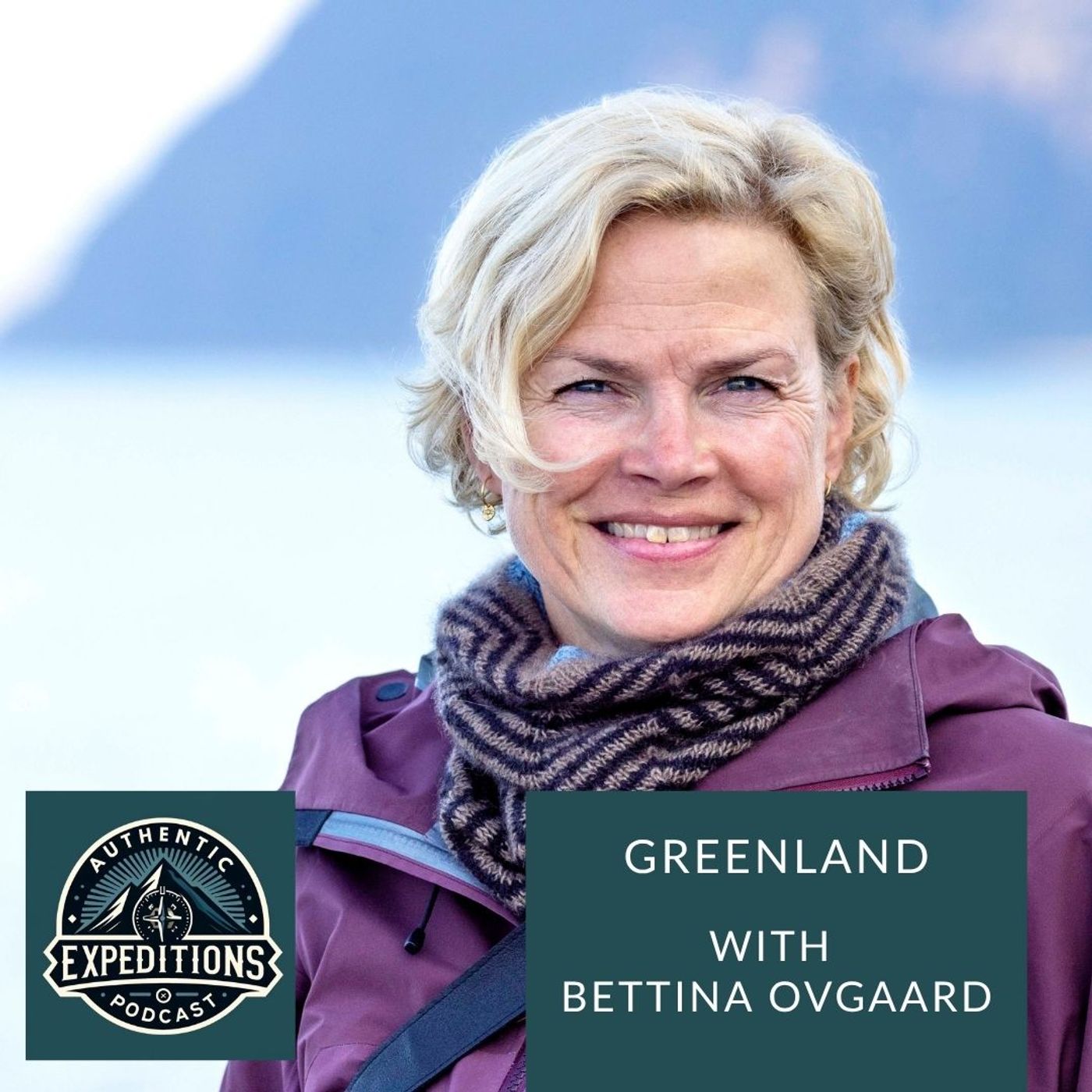
08. Greenland through the eyes of a guide with Bettina Ovgaard
If you’re curious about what it really feels like to explore Greenland, this episode is a masterclass in how to travel with humility and awe.
Time Stamps
00:51 Bettina's Journey to Becoming a Guide
02:09 The Allure of Greenland's Landscape
03:29 Guiding in Greenland: A Unique Perspective
07:47 Unexpected Adventures in Greenland
12:10 The Rich Diversity of Greenland
13:47 Surprises and Silence: First-Time Travellers' Impressions
15:13 Interacting with Greenland's Communities
17:09 Preparing for Greenland's Climate
18:35 Memorable Moments and Final Advice
Featured Cruises To find out more about expedition cruises contact Jane Middleton on +44 (0)7971 568155 or [email protected]
Plan your next cruising adventure with Authentic Travel company
Producer: Sue Stockdale
Sound Editor: Matias de Ezcurra
Welcome to Authentic Expeditions, the podcast that brings you real conversations with the people who explore or guide us through the world's wildest and most awe-inspiring landscapes. I'm your host Sue Stockdale and today we're travelling to Greenland to look at it through the eyes of Expedition Guide Bettina Ovgaard. With over two decades of experience living and working in this vast Arctic land, Bettina offers us a unique perspective. And reflection why Greenland is not just a destination, but a profound encounter with nature, silence and culture.
Welcome to the podcast Bettina. Thank you very much, thank you for having me, Sue. Now you're an Expedition Guide in Greenland, I understand. What led you to do that particular role? Well, we have to go back to the late 90s. I've always been a keen traveler and at the time I was working freelancing in the Danish film industry and I didn't have a gig that summer and a friend of mine worked. For a Danish travel company in sending tours from all over the world to Greenland. And they needed guides for the summer and they did their own training of us in Denmark and in Greenland.
And well the first summer I was working in Narssassuaq, which is in the very south of Greenland. And I was guiding that summer and then later I started for my master degree in the winter which was a fantastic combination and I just loved it. And later I decided to move to Greenland, couldn't get enough apparently. And I worked there at the Thule Base. It's now called Pituffik Space Base. It's a US Air Force Base. I worked there for six years in the very, very high north west of Greenland. And then my next job was in Nuuk, the capital of Greenland, where I was chief of military cooperation for four years.
So basically now I have Greenland in my bloodstream. It sounds like you've certainly had experience of a lot of the different geographies of the country, Bettina, what is it that appeals to you about the country, the landscape? Of course, nature has a big impact on you. I'm coming from Denmark, which is a small, flat country. Most of it is cultivated and Greenland is of course, exact the opposite. It's huge. It has mountains, it has glaciers, eyes. It has a population which is very different from people living in Denmark or in Europe.
I think that the whole environment, what in Greenland is called, "cila" is very fascinating to me. Another thing is that Greenland has this ability to shrink you. You become very small, a very insignificant human being, which I think for many people, probably many western people, it could keep you sane in a way. As humans, we control a lot of stuff, a lot of things around us, but you don't do that in Greenland. It's an overwhelming loss of control when you are in that kind of environment. It's like a dose of escapism.
Nature is a bliss, but it's also a terrible force. To me, it's like magic. So, Tina, you're guiding in Greenland, and of course, you're a Danish, guiding in Greenland and Greenland's a Danish dependency. Does that make a difference? Well, I think it does make a difference in the sense that my perspective as a Danes is not always what matters the most. I try to listen more than I talk when I guide, and I just try to provide a context. I've been guiding in Greenland for 25 years, and I've lived there for 11 years.
So, another thing I'm trying to do is not only guide from facts, but guide from my own experience. And being aware that I'm not an in-wit, I'm not a indigenous, and I'm not living in Greenland anymore, is part of my framework of guiding people from abroad. When you are there on board an expedition cruise ship, Bettina, guiding guests on board you want to explore, what does your role involve? Well, my role is not to guide every moment of the visitor's trips, or tell them what to feel, or tell them how to perceive what they're witnessing.
I see my role as a person that takes an interest in what they're asking, listening more than telling, and being very observant of pointing out details or conditions that might not be visible at first sight. And if you got an example of what that might be? It could be if you were out in a small dinghy, and your mindset is now we're going to look at icebergs. And you are in your little dinghy with your other travelers, and then you look at the big icebergs, and you look at the glacier front if there is such a one.
But you might not know how did those icebergs get from the glacier front to the sea? What is the impact of the ice on the sea? What is the impact on the wildlife that we might see? What is the impact of the sea ice or icebergs on the culture? On the people that live here, has this ice been here a long time? Or is it a new piece of ice? Is it salty? All these little details and all these intricate collaborations that this ice enters into? This is what I can give as a person that's been living in Greenland for a long time.
So it's more my experiences, of course, based on facts, but this is not a school class. This is people being there, flesh and blood, and having an experience to take home memories to take home, which I can then help frame. So you're enriching the experience that they're having by giving some deeper context based on what people's interests are? If they're following their curiosity, you're there to answer some other questions about what they're seeing and experiencing. Yeah, exactly. I think Greenland is very overwhelming in every sense of the word.
Visually, orderly, intellectually, it's like your sensitivity, heightens, whether you're cruising among icebergs, like I just envisioned, or if you're visiting a local community, where the dogs are being fed. And here smells also comes into mind. And the sounds gave me so different. The crashing of ice from a glacier front, or it's a language that you hear that you don't understand. And the silence when you're out hiking and you sit on a rock. So making people aware that this is actually very different from where most travelers come from, and to cherish it, and also to respect, and be curious about these differences.
Now, I know that last summer, I think you mentioned to me, that Mother Nature caused you to export a part of Greenland that you hadn't been to before, Kap Farvel. And that's right at the southern tip of Greenland. What happened there and what caused you to end up being there? Yeah, well, we had a deal with Mother Nature on the ship that we should go to the southeast coast of Greenland. But he opted out. He had sent a lot of pack ice down the coast of East Greenland, which basically prevented us from going to shore.
And we had to find new options. So looking at the map, it was very telling where is the ice, where is the ice not? And so we were directed by Mother Nature to where to go. We listened, you always should listen, especially when we talk about pack ice. And we went to a place that I had dreamt of visiting for years and years. And this actually happens quite often in Greenland that you were redirected into places that never thought that you would ever be able to visit. And then, wow, there you are. And it's all presented to you as it was for us in the sunshine, calm, weather, blue sky.
And we visited these two little places where there had once been a north settlement and the place where the north had their harbor. And the interesting part about this particular settlement was that this guy that had done the settlement was a companion of very the red. And he chose to live very, very near to the sea, not down in the Fjords. And his neighbors basically called him insane for living so close to the sea, but he said, hey guys, I am not a farmer, I am a tradesman. And when the ships come from Europe or Iceland to Greenland, they will darken my harbour first.
And I will have the good trading with them. And you can sit in your dark little fjords doing your farming. That's fine for me. Because it's a little bit of a gem, a little bit of a hideaway, it's not visited by many people. So we headed all to ourselves with the big fjord, with the icebergs, with the north ruins, and the cute little harbor. So it was a real treat. I couldn't object to Mother Nature about directing us to this place. It was very special. That's a lovely example of how, for some, may seem disappointment or change from where they might have imagined they were going.
Actually, that's a whole part of expedition cruising, isn't it, to expect the unexpected, to adapt to nature? Exactly. And I will say that on the way there, we were also blessed with a lot of whales. So even though we couldn't go ashore, we had lots to look at, and several different species also. So we were right entertained by Mother Nature going to our destination. I think travelers more or less are used to this when they are in a cruise ship. Then the program of the day can change, and it's not necessarily a bad thing, and you're not necessarily missing out.
Because we have other things on the menu for you. And as a guide, you also get flabbergasted by the opportunities that you will suddenly hand it. And of course, sometimes you also be disappointed because there were places that you had thought that you would go to. And then you don't. But I have never had a voyage in Greenland where people weren't happy about what we actually saw, and even more, because there are surprises as well. Wildlife, for example, is often a big and very welcome surprise. And also weather changes, and you think, oh, it's going to be a great gloomy day tomorrow.
And then it's not. Then it's a sunny day with no wind. And you can do all kinds of things. So you're making it sound fantastic, Bettina. And Greenland is one of my favourite countries. So I must say I'm slightly biased in listening to what you're saying here. From your experience, East or West coast of Greenland, where would you prefer if there is a preference to one of the coasts to visit? Oh, I often get this question, what is your favorite part of Greenland? And it's so hard because taking into account the vastness of Greenland, you have 2,500 kilometres north to south and 1,000 kilometres east to west and a coastline, which is equivalent of the coast of Equator, 44,000 kilometres.
Then you have so many different climate zones and landscapes. So East coast is really wild and rugged, and you have the pack ice. And there is more communities. And then you have the south, which is lush and green and you have sheep, no dogs, but sheep farms and blue fjords and blue ice and lots of settlements. And then you have the west coast with rolling mountains, north, down by the ice, big fjords, lots of settlements, bigger towns as well. So you have more commotion, you have the more of a human impact, more culture, and then you have the high north, which is again, wild and you mostly have it all to yourself.
So I don't have a preference. Can I just have the whole island please? Well you're giving us a sense of the rich diversity that the island offers for people that want to visit. From your experience or first time travellers to Greenland, what's the thing that surprises the most? Yeah, I've asked that at the end of the voyage sometimes and what I usually get is the quietness. And maybe it says more about us visiting than Greenland that our environment from back home is busy and noisy and demands our attention.
Whereas in Greenland, nothing really demands your attention. You can choose. You have a vast landscape. It's also something that people of course notice and are struck by and you have busy times and settlements, you have a culture which demands curiosity because it's on lack your own, but the quietness, the thing that you can hear silence is probably what we lack the most where we come from. Certainly one thing that is magical for me, Bettina, that the silence in Greenland is deafening almost, isn't it?
Now, given that we've been talking about silence, of course on the other side of that, and you've mentioned it a few times is there are settlements or communities around Greenland and quite a unique culture that the enduets have. What can travelers expect when visiting communities in Greenland? You can expect curiosity. You can expect timidness. And you can expect laughter. Lots of laughter. Not laughing at you, but just having a good time in the settlements with their families being out and also the people you will meet maybe in the church or at the museum or in the store.
Maybe the guy feeding the dogs. It doesn't really matter that you don't understand the language. You can understand the mimic and you can understand that it's sort of a quiet but very lively culture. My experience is that we are welcome. It's not that we are crashing a settlement or a town that will have been made arrangements. So they know we're coming to visit. And I think if you're willing, it's not hard to interact with people. You can use sign language, point at things that tone of your voice will also tell that you are interested and that you are asking questions.
And I think more than anything, your posture, how you walk around, your facial expression, that will tell people that you're visiting, that you're interested, your positive, you smile, and you are there to experience what they do in their daily life. So you're framing for us. There's likely to be a warm welcome from the communities that are visited. Warm is prompting me to think about temperature because I think also many people have a perception that Greenland is frozen and many layers are clothing to go outdoors there.
What's reality from getting off an expedition cruise ship at the seasons that they do travel there? What are the temperatures likely to be? Well, it's likely to be at best a really sunny day and then you don't need your gloves when you're walking around in the settlement. You'll probably need them for the boat though, for their zodiac ride. So you can expect to bring your gloves and your scarves and your hats and more to prove clothes than the warm sweater, but you can also have days where that's not necessary.
You just have a light jacket when you've come off your water cruise after the zodiac ride, you can wear your normal clothes, more or less. What is two things to bear in mind here is the wind, because wind, the wind chill, that it could be on a sunny day, could be really cold if there's a lot of wind. And another thing is of course the water. Anything out on the water or within the water is going to be cold, even on a bright sunny day. So don't get lured by getting out on the deck and you are in a sheltered place on the front deck and the sun is shining and you're feeling really warm and then you're thinking, "Ah, teach it, weather."
Probably not. Probably not. You're given us a good sense of the changing nature of the temperature there, be prepared for everything and that's the best way. When you think about your experiences, guiding cruises in Greenland, but you know, what sticks in your mind as being significant and memorable? Well, I think it's very significant that people that are on board accrues in Greenland are very open, open and active people that want to take part in the adventures and that doesn't matter if you are doing a bit of a hiking or you are visiting a glacier front or looking when the dogs are being fed in a community.
It's very rare that people will stay back and I think also that reading a bit up on the places that you are going to visit will also tell you what kind of activity and where you will need. So I think mostly I've experienced people experiencing Greenland at the fullest. I would say, "What stood out to me once was that I talked to a person. We were just beach-combing because the person was not a very good walker. So we were just looking at different things at the beach and just talking." And then she said, "You know what, I've been to many countries and also when I was younger, I could do much more and now I can't do so much anymore."
But just walking here on a beach in Greenland, looking at what the water was start and I can see the icebergs and I can see the vegetation, I can see the flowers and there's a little bit of blueberry, where we just were, like you pointed out, it's just enough. It doesn't have to be grand and exhilarating and out of this world in that sense. I'm just thrilled about these little details at this place so far away from everything that I get to experience. So I don't feel limited even though maybe my body is a bit limited.
I have all my senses, I have my brain, I have my heart. And it really struck me that she got it right. That's the sense there, I'm using that word again, but you know that you've just used, that connecting to our senses are even more heightened when we're in Greenland, perhaps compared to other places, senses about nature, about the culture, about the environment around us. Now given that that environment is changing, it's fragile, what measures do you think should guests on board expedition cruises take to be mindful and cognizant of that sustainability issue and making sure that these places remain for many people to enjoy in years to come?
Well, I think it's an our most important that the cruise ship operators listens and are aware of what the government of the high-actics are issuing of regulations and rules. Now in Greenland, there's just been a new regulation on cruise ships and before the regulations issued or the acts were issued, there was a hearing and I know that the AAECO, which the Association of Arctic cruise ship operators did or delivered a hearing answer to this proposal of the act. And I think interaction and interest in these hearings and acts and governments is crucial because in that way, the cruise industry can be prepared, but also interact in a way with nature and settlements and the culture, the way that that particular country be it Greenland, Canada or Svalbard wants the interaction to be like because the industry is huge, it's wealthy and it's growing.
And the population in Greenland and the government is not growing. A lot of infrastructure is growing also towards the cruise industry, but it's a huge pressure from a cruise industry or for tourism that Greenland welcome tourism, but they just want to do it on their own terms. So being alert to that, I think, is very important for the cruise industry to keep the warm welcome coming, so to speak. So passengers can gain more awareness themselves, even before they travel somewhere of some of the regulations that cruise operators have within the given countries that they're travelling to.
Well, they could, but also, I think, organisations like AECO and they're very good already in making guides for human interaction and interaction with different plant life, cultural remains and animals. And that might be a good idea to look at these websites and might also be good to do, it could be pixie books on how to interact in these different Arctic countries that you visit, but also, of course, the staff on board, cruise ships have an obligation. To, I wouldn't say teach, but inform guests about regulations, sometimes when you explain why we do operations like we do and also know about the acts and regulations in a country.
That makes more sense to people in why can't we do this or why do we do it this way and why can't we visit this place. So it's also, I think, a staff obligation to underpin the operations in how is it that this country would like us to act with them so we don't interfere. So just as we bring our conversation to a close patina, if somebody was considering their first expedition cruise to Greenland, having listened to what you've said about it, what's the one piece of advice that you would give to them?
I would say, "Hoo, not your curiosity, open your mind and your heart as much as possible, bring a warm hat, and then the program you sent, throw it out the window. Their attenery is not going to happen, but a lot of other things are." What a wonderful way to end our conversation, patina. Thank you so much for your time. Are you going to be heading off to Greenland this season yourself? Absolutely. Any particular coastline or location that's you looking forward to? Yeah, I'm going to the west coast of Greenland that I've visited tons of times before, but this time the cruise is going above the disco bay area and there's a lot of small settlements up there that I haven't not visited before.
And so something old, something new, something blue. That's my marriage to Greenland. Wonderful. Well, thank you so much for your time. You've painted a lovely picture for us of Greenland and I hope your comments will inspire some people to visit. All me too is just a little taste of it. Thank you, patina. Thanks so, patina, that was fantastic. My curiosity is tuned up on my mind is open and I have my hat packed ready to go as I head off to Greenland in a few weeks. If this episode has sparked your curiosity, then remember to head over to our show notes and find out more about the range of expedition cruises we can help you discover.
Just contact me, Jane Middleton, at the Authentic Travel Company. If you'd like to explore this incredible part of the world, it might just be the start of your own Arctic story. Thanks so. Thanks for listening to the Authentic Expeditions podcast and make sure you follow us, subscribe and share it with others you enjoy travel too. I look forward to connecting with you again soon. [Music] [MUSIC]
 Apple Podcasts
 Castbox
 Castro
 Goodpods
 Moon FM
 Overcast
 Pocket Casts
 Podbean
 Podcast Addict
 Podcast Republic
 Spotify