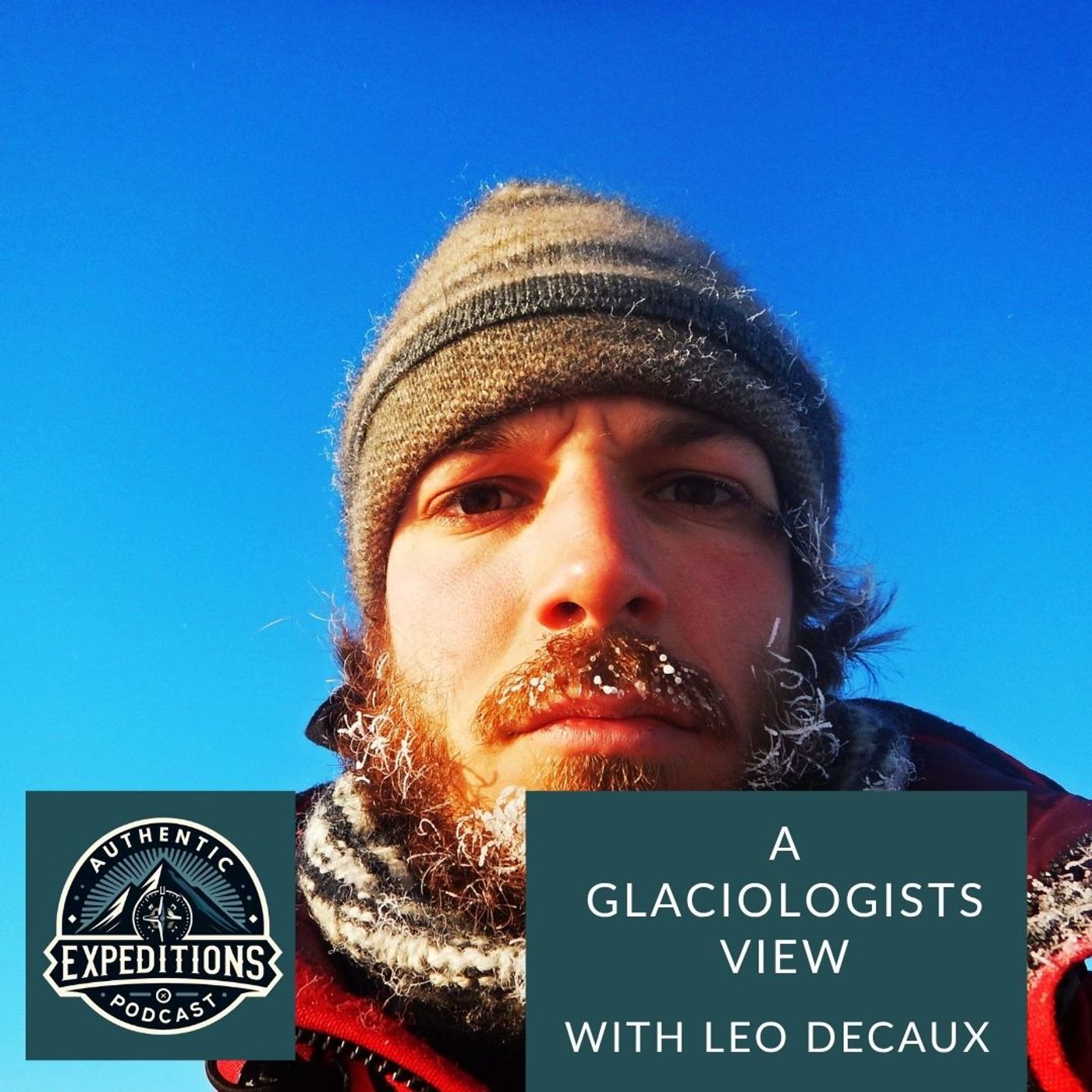
09. Inside the Ice: A Glaciologist’s View of a Melting World with Leo Decaux
He also guides on expedition cruises through Antarctica and the Arctic, helping guests witness the polar regions with scientific insight and deep respect. Join host Sue Stockdale as Leo shares what it’s like to live in extreme cold, work beneath the surface, and stay curious in a world that’s rapidly changing.
Time Stamps
00:17 Meet Leo Co: Glaciologist and Expedition Guide
01:04 Life and Work in the Arctic
02:04 Understanding Glaciers and Their Impact
02:58 Exploring Svalbard: A Visual Journey
05:54 The Science of Glaciology
09:10 Field Research and Data Collection
12:35 Challenges and Discoveries in Glaciology
19:29 Guiding Expeditions in Polar Regions
26:36 Living in Svalbard: Daily Life and Practicalities
29:15 The Importance of Polar Regions
31:19 Looking Ahead: Future Plans
Featured Cruises To find out more about expedition cruises contact Jane Middleton on +44 (0)7971 568155 or [email protected]
Plan your next cruising adventure with Authentic Travel company
Producer: Sue Stockdale
Sound Editor: Matias de Ezcurra
Welcome to Authentic Expeditions, the podcast where we explore all things expedition cruising and talk to the people who live, work and guide travelers in some of the world's most extreme and inspiring environments. I'm your host, Sue Stockdale. And in this episode, we journey by ice, literally, with glaciologist and expedition guide Leo Decaux. Based in Svalbard, Leo spends his time exploring the hidden inner worlds of glaciers to understand how they're shifting, melting and revealing the story of our changing world.
From deep ice tunnels and the Arctic, to guiding cruise guests through the wilds of Antarctica, Leo blends science and adventure in equal measure. This is an episode for anyone curious about the frozen frontiers and what lies beneath them. Welcome to the podcast, Leo Decaux, how are you today? Hi, Sue, thanks for your invitation. Really good, and I'm actually in Svalbard. All say also, "SpitsBergen." Unfortunately, now it's quite warm compared to what is supposed to be. We have positive temperature the last day, so it's a very tall amount of snow, little, very little amount also of sea ice, and everything is quite icy here because it's meltdown, and then we got a bit of negative temperature again, but then everything falls down again, so now we need to use spikes to walk into the town.
That must be a little tricky. So you mentioned those two words right at the start, Svalbard and Spitzbergen. For the uninformed, what is the difference? It's funny because so in French and in France, Svalbard is mainly known as Spitzbergen, but actually Spitzbergen is the main island of the archipelago of Svalbard, so this is the difference. Oh, that's helpful for us to understand that. Now, I know that your specialty and area of interest and expertise is glaciers. That played quite a major role in your life as a youngster, I understand.
Yeah, I grew up actually in Nancy in the north east of France, and we actually have some mountains there called the Vorge, the massive of the Vorge. I know that people in the Alps in France, they laugh at me when I say that I have mountain in my place, because there is actually no glacier there, so I start to study the tracks of the past glacier that are not existing anymore. But then for my master degree, I wanted to touch some real ice to stop to scratch the rocks, so I went to the Alps in Grondab for my study there, and then I start my real work of glaciologists in the French Alps and Alpine glaciers.
For somebody arriving in Svalbard on an expedition cruise ship in the summertime, what are they likely to see? Help us get a mental image of arriving in Svalbard, and what would we see in it? Experience. First of all, you will see Longerbjörn, so you will arrive in the northernmost city in the world where I am living, and me the first time I saw it, I find it very pretty with some very colorful houses, but then when you come back from the cruise, when you've been out in the wild in Svalbard, then you come back to Longyearbyen and you find it quite ugly, actually.
You have a chimney, the coal power plant that is actually not working anymore since one years, now we rely on diesel energy, which is not obviously better, but it's a coal mining town, but then when you start going to the wild in Svalbard, you will have this typical flat mountains with quite some bird cliffs also, and you will see quite a lot of glaciers in some valleys, in some fjords, we call them land terminating glaciers, so it's glacier that are ending into the sea, it's composed two-third of all the glaciers in Svalbard, and sixty percent of Svalbard is covered by glacier, when I arrived here ten years ago, now it's 58%.
So the glaciers are very imprecise because you have this big ice cliff with very nice blue colours, you can see them calving, so it means that they are breaking some ice into the sea and they create icebergs, so of course you will see some iceberg around, not really big compared to Greenland or to Antarctica of course, because the ice from that you will see from the glacier they will be between 20 and 40 meter high above the sea level, and roughly around two or three or four kilometres wide, except if you go on the ice course then you can have glacier with 20 kilometres wide ice from it.
Yeah, so you will have quite a lot of birds, some sea mammals, wereoses, seals, then on land you will see what I call the Svalbard cow, it's the renders, so there's quite a lot of them then. Yeah, then some polar foxes, and of course people are coming here to see the king of the Arctic, the polar bear. I haven't done any cruise at the moment when we haven't seen a polar bear, we had some very close call, we saw it only the last day, so cruise is between seven days and ten days, but so far we have already seen at least one.
Oh fantastic, and as you look out at those glaciers, I imagine that you're looking at the glaciers with completely different eyes from an average person like me, Leo, what drew you to have this interest in glaciers? And what do you notice as you are looking at them with that expert eye? I went to glacialogy through natural sciences, because since I'm a kid I always wanted to know why do we have some clouds, why the winds, so we are passing on Earth for a very little amount of time, hopefully I could say for 80 years I would be happy, but compared to the years that is 4.5 billion years old, I think it's very important to know on what we are living on and to understand all these natural environments and this system because it what gave us life.
So I find it a shame to just pass by on the Earth and to don't understand how it works, because then if you understand how it works, then it helps us as an animal species because we tend to forget that we are animals, to understand what we live on and this will allow us to live in a better harmony with it, so then to try to stay as long as possible on Earth. So I start with theology, then I wanted to study natural risks, so I was hesitating between this seismology, volcanology and glaciers, but I wanted something with a lot of fieldwork to be outside, so then I choose the glaciers, especially that it's a very actual science and quite new science compared to the other one.
Then we are in Svalbard, I'm showing to the tourists when we are on the Zodiac cruise in front of a glacier front, our position on my GPS and I'm telling them, "Okay, so where are we now?" And then they are telling me, "But we are on the glacier and I see him, yes, so why is that?" And actually the map that I have on the GPS in purpose is 10 years old, but the glacier here they retreats in average between 100 and 200 meters per year. So it's very, very fast. Svalbard is the fastest warming place on Earth, so it's 7 times more than the global average.
So the consequences of the global warming, not something very abstract like in France or in Europe or in other latitudes. Here you can touch it, you can see it, here after here you can see the landscape that is surrounding me changing so fast every year. So I want the people to understand that what is happening here, it's very strong, it's very dramatic and that it does have a huge impact on our daily life, whatever we live on the world. So now you're starting to get us into the amazing science of Adolf Lille.
As a field expert and a scientist yourself, if you're doing your research being outdoors, it's it that you're actually doing when you are getting too aglacier or even getting inside a glacier, I understand. So my main field of expertise is about glacier hydrology. So I study how the water is flowing on the glacier but mainly inside and below the glaciers. Because in a context of global warming, you have more and more melt, more and more water produced by those glaciers and the water is denser than the ice.
So it wants to go down. So when it finds a small crack, it will dig its way inside the ice. So it will dig what we call some mollins, some vertical shafts that are between half a meter and 20 meter diameter and up to 120 meter straight vertical. And then the water is going into some cave systems and it reached the glacier bed forming what we call subglacial rivers and then it should be evacuated at the glacier front. So me, I was focusing on water motion within the glacier and trying to relate this water motion with the weather conditions and the glacier velocity.
Because the more water you have at the interface, glacier bed and bedrock, the more you will have some rebubification of this interface. So then the glacier can go faster and if they go faster as they ended into the sea, then they will potentially calve more ice or they will break more ice into the sea and they will therefore accelerate the sea level rise. So the amount of water that's coming through these mollons that you described, that will accelerate the flow of the glacier having at the front given that it can move more quickly?
Well, potentially because actually if you have more water inside the glacier but if this volume is quite steady, then it will flow very efficiently through this cavities. So actually it will not make the glacier accelerate that much. But the main point is one of the main discovery of my PhD is that the water volumes that reach the inner part of the glacier has a huge variation and has more and more variation because we have more and more rain, episodes in Svalbard and the glacier they are reacting very, very quickly to these water volumes.
So when you have not that much water flowing into the glacier, the pipes, let's say, are quite small but then you have a rain episode or big melt events and you have more water coming and the pipes need to adapt. Then it put a lot of pressure within the glacier and the glacier accelerate the lots. So it's going to be more the variation of the water inputs that will make the glaciers accelerate. The main discovery I made through my PhD was to look at what was happening into the winter because so far we got only 54 days of water motion measurement within the glacier and it was only during the summer.
But then I realized that in winter we have more and more warm episodes like the one we have actually right now and just one week of positive temperature in winter can make the glacier accelerate like five times more than what is going in the winter on few days and then it destabilize the glacier completely for the entire rest of the winter and it can be up to two times faster than the normal winter speed. So it means that the glacier potentially will participate to the silver rise two times more than what it was doing in the past year.
This is really fascinating and I'm wondering then how do you collect those measurements? Does it involve you actually going inside the glacier or are you putting sensors in there? How does it work? So far we got only 53 days of water motion measurement inside the glaciers and this is because it was done in summer and it's very easy to do it only in summer. You put a sensor on the cable, you dropped it in the morning from the surface and it's only a melting period so your cable can't get stuck by re-freezing.
So before the winter is coming then you just have to pull and get back your data. But me I wanted to have for the first time somewhat a motion measurements within the glacier through the entire year. So for that I had to go inside the glacier system to be sure that it was well attached to the glacier walls to prevent them to re-freeze into the wall because then I would not measure what I want to. So I had to do a lot of ice caving so I was counting the time I spent for some tourists and it was between 700 and 800 hours within the glacier.
That's a lot. Which is more than one month 24 hours within the glacier. And when you're inside the glacier does it feel close to foreback? What was the sensation that you had when you were in it? The first feeding inside the glacier is that I feel very privileged to be there because there is a lot of system I've been where I know that there is more people who have been in space than the place I was. Also some of the system doesn't exist anymore unfortunately. But then of course you don't have to be close to foreback because having spent more than 700 hours within the glacier I got my moments and my mum is not aware of everything.
For example I had to dig a way to try to find back the sensor from last year because all my data are recorded inside the sensor. So if I don't find the sensor back then I am losing between 6 months and 1 year of work so I was quite motivated to find them back so I started to dig moving out some rocks because was at the bottom of the glacier. And then I went and I found them and the glacier had moved a little during the time I was looking for the sensors and it was very very tight pass. I had the bed work on my back and the base of the glacier on my chest.
So it's not a place where you want to stay for a long time especially with 50m of ice above you because if the glacier is moving then your chances are very little. But the fact that the glacier had moved in between made the passage to an arrow for me so then I was stuck and people had to dug me out in another way to get me out of the glacier. So yeah definitely you don't have to be close to foreback. Sounds like quite a job that you have Leo and all in the pursuit of research and science to get your data.
When you then collected that information for people who aren't in small part how does it help them understand what about the world? As most of the scientists you will not answer to one question and then it will make a revolution in science. This is what I thought when I stopped my PhD as all young PhD students but then actually my contribution is more to answering to few questions that would be add to the global knowledge and that will allow for example the people from the IPCC to connect all those studies and then to have a better understanding on what's going to happen in the future.
So it will help the scientists to have a better understanding on what's going to happen in the future and on my field especially to know how the glacier reacts in the context of global warming to answer to this big question mark that is what's going to be the sea level in 2050 and in 2100. And being able to then add to that global body of knowledge with regards to the work and research that you're doing Leo is that what gives you satisfaction from doing it? That's a good question. Yeah I think the first satisfaction is that I'm not doing a job that is feeding the big machine that we create which is impacting a lot the nature and our climate and environments.
And of course it's very rewarding to know that the data I got are the first of a kind and I know that a lot of scientists ask me about those data as they are really important and they really increase our understanding of glacier processes. So it's one of the big rewards and the other one is also to spend times to do what I like and to unjoin the life I'm living with a lot of uncertainty every day because there's not like a typical day if you ask me okay what's your classic day in your work I would say there is none.
This is a big satisfaction to be able to answer that for me because you spend time in front of the computer of course but then you are doing also a lot of field work in my field and it's always going in the unknown each day when you are going on the field. So you've told us we might find you inside a glacier in Svalbard of course you also guide on board expedition cruise ships not only in Svalbard but in Antarctica as well. What are you sure with guests on board expedition cruise ships down in Antarctica and South Georgia?
I have more and more trouble to go on cruise ships. We live to go on smaller ships especially sailing ships with a smaller impact on the environment but when people are coming in polar regions I'm trying to be sure that they are not coming and saying okay I'm back home I got my picture of the polar bear of penguin of the glacier and I could take this case and I've done it because then there is no point to come here. If you come in polar region as a tourist it gives you some responsibility because you burn a lot of fossil fuel to arrive there.
So it has to have an impact on your life on your way to see this region on your understanding of this region. So I'm here to educate the tourists and to try to convince them or to demonstrate them that whether they live in the world with mountain or glacier or nuts what is happening in polar region in the Arctic in Antarctica does have an impact on their daily life even if they concede every day. But I'm trying to demonstrate that it's very important for our climate system, for our life in general as a human species that we rely on the ice.
But we can't live without a polar region and that actually speaking for the Arctic is not that far. If you come from France or from England and you go in Svalbard it's only 3,500 km away from your place. So New York is much further than that. So I'm trying to show them that what we are doing in our latitude does have a strong impact on the spread and that the spread are giving this back to us. But in a negative way because we have a negative impact on those places. So you're helping connect people to see the greater impact of these regions within their own lives.
What is one of the most unexpected or surprising things that you've experienced during your travels in the polar regions? I think the most unexpected thing I experienced travelling in the polar region with some tourists it was few months ago when we crossed the path of the biggest iceberg of the world of the moment, which is named 823A. This iceberg is so massive. It's 50 km wide, 70 km long. So this iceberg is nearly 4,000 km square, which is half of the size of Corsica. It's massive. It's really massive and the thickness is around 300 m.
So when you arrive next to this iceberg you can just see a huge ice front and you've got the feeling that you are just in front of Antarctica, this big ice sheet of Antarctica because you can see the beginning, you can see the end of it. And this iceberg is so massive that it reminds you that we are so little compared to the nature in general and also to the ice, especially in Antarctica. And it's a iceberg that has been a lot on the news lately because it's heading towards South Georgia and people are worried that this iceberg will grant at the shoreline of South Georgia, preventing all the animals there to reach the sea to go for some food.
So that's quite a risk. I imagine as you're describing it there, Leo. And there's also some other potential impacts, more recently this season that you experienced first hand down in South Georgia with avian flu. What's happened in that type of situation? Yes, so the avian flu is striking very strongly in South Georgia and also in Antarctica in Venezuela since two years now. But this year it was really, really strong in South Georgia and it's not impacting the bird that much anymore. It's going to the marine mammals, to the seals, the first seals, elephants, and all the kind of type of seals that you can find on the peninsula.
So there is a high peak of mortality this year and so it means that you have a lot of places where you are not lending anymore because you don't want to have a hike in the middle of hundreds of carcasses. So it makes the itinerary very complex to compose. And on the peninsula they have a different policy than in South Georgia. They are actually closing some sites. So it was a lot of lending sites that were closed and it makes also the travel tricky because you have more and more ships coming in Antarctica now since two years we are over 100,000 tourists coming just on the summer season.
So the system makes that we have to book the lending sites and now it's start to be very tricky to change your plan while the base of what we call an expedition cruise is to go on an expedition so it's to change the plan. You have a plan A plan B plan C and we are always adapting to the sea condition, the weather condition, ice conditions. So the nature decide. Now when the nature says, "Okay, you can't go there" so you have to change your plan so we need to re-book a site then it's start to be really, really difficult to book another place because the peninsula and South Georgia is super crowded with cruise ship now.
So the reality of those looking to travel and have an adventure in those places is so much governed not only by the regulations of Iato but nature and what is actually happening in nature. Looking at back north and the realities of you living in Svalbard you've been there 10 years. It's quite a remote part of the world. Are there any practicalities, things that you can and cannot get there? Just give us a hint of what it's like living in Svalbard. Yes, I'm coming in Svalbard since 10 years. I think the last 10 years I spent five years in total in Svalbard.
Living here is very special because you are in the northernmost city in the world. I think my friend first they thought that I was living in a warehouse but actually it's a poor town with proper facilities so we have cinema, we have shopping mall, there is more and more cultural activities. We have some music festivals to celebrate the beginning of the dark season to celebrate the end of the dark season. We have just festival and the blues festival two weeks ago. So you can buy the regular thing like if you live in Norway.
So as a French person I'm missing the cheese and the good wine a lot. But it's not because I'm in the Arctic. When I was living in Poland for my PhD I was missing the same. We actually have a very good internet which allows to communicate right now. We have the internet fiber and this is because there is a big center working with satellites here which is very important for NASA for ASA. So thanks to this facility they needed a very very good internet. So actually the thing that changed compared to other towns is that everything is imported.
So I think that we have the worst carbon balance per habitance. Fortunately we are only 2600 people living here but it gives you a responsibility. Me I'm living here because this is a place to be if you want to speak about global warming as this is the fastest warming place on earth. So I hope that the carbon that I'm using with living here is used to raise awareness about what's going on in the Arctic and about the importance of the Arctic for us as a human species and that's in finnay it will contribute to reduce those carbon emissions.
So finally, Leo if there was one message that you would like to leave our listener having in front of mind when thinking about the polar regions what would that message be? If I want to leave one message to people that are listening it would be that polar regions are not that far from you especially if you live in the North hemisphere the Arctic is very close. When you see a glacier it's big it seems to be strong but all this ecosystem and all those glaciers are very fragile and that all our small actions do impact those regions.
It can be in a negative or in a positive way but for the moment it's mainly in a negative way. Fortunately and that this is triggering a lot of phenomena here and that the Arctic is destabilized and it's changing really really fast and all the things that are happening in the Arctic have a very strong impact on our latitude and on the places where we are living even if we can't see it even if we can't touch it. So we really need to have some sort to this region because the survival of humanity depends on the ice.
Yeah which is for the climate, for the sea level, for the energy, for the water resources, for the food. It's really at the heart of our survival owners. Thank you so much for living us with that thought Leo. Sounds like you're really at the extremes there in the North but the extremes in terms of seeing what impact climate change and global warming is having on our environment. What's next for you as you look ahead with your research and your work? What's on the horizon and exciting you? I wanted to give just a small positive word because I'm actually quite positive still for the moment because we have around 30 years to react and the difference can be huge because if we are going on our current policies this will lead to a warming of about 2.7 degrees Celsius by 2100 which means that only 24% of the glacier mass will survive.
I'm not speaking about green Antarctica but the glacier. But then if we managed to limit our global warming to 1.5 degrees Celsius which is the goal of the Paris Agreement we will have more than half of the glacier mass remaining. So we have the power to change a lot of things so this would be my positive message to pass which is directly correlated with my future plan because now I'm not 100% in the research anymore. It's good to continue to know better about all those mechanisms and to be able to better predict what's going to happen in 2,100 but we know that we are not going in the good direction so which is urgent now is that the society globally reacts in accordance to the urgence of the problem.
My main goal now is to raise awareness about the climate, about the glacier, by doing for example some podcasts, going for some TV show with some documentaries, there is a lot of journalists that are coming in Svalbard so I'm trying to go on glaciers with them a lot. And I'm also part of several artistic projects because arts is very strong media to pass this message because in science you can't put any feelings, right? It's the fact it's like this, fortunately it's like that because otherwise the science will be subjective and not objective anymore.
But if you want to make the people care about it you need to make them feel something about those regions. And the first thing to do when people ask me what can we do because I'm so small compared to the entire world, to all the countries, but the first thing to do is to learn about the problem because you can't solve a problem that you don't know. So the first thing to do is to educate yourself. And I think it's still important that few people are coming here to see those regions because there is a sentence that I really like which say that you protect what you love and you love what you know.
So the first thing is to know it, then you will have some feeling that you will care about it and then you will act in accordance to protect it. Thanks so, and Leo, thank you. I mean one of the things that comes across about all of our speakers and everybody you've interviewed so is how passionate they are about their topics. And I think for me, Leo is so right at the end that if we're going to be ambassadors for places around the world and to look at the impact of climate change and everything, we really need to go and experience these places and understand them more.
So if Leo has inspired you to explore Svalbard or other remote regions of the world, please get in touch. Thats Jane Middleton at the Authentic Travel Company and I'm sure that we can explore which expedition cruises we can offer you and how to experience Svalabard for yourself. Make sure you follow us, subscribe and share it with others who enjoy traveling to the remote places and I look forward to connecting with you soon. [Music] [MUSIC]
 Apple Podcasts
 Castbox
 Castro
 Goodpods
 Moon FM
 Overcast
 Pocket Casts
 Podbean
 Podcast Addict
 Podcast Republic
 Spotify