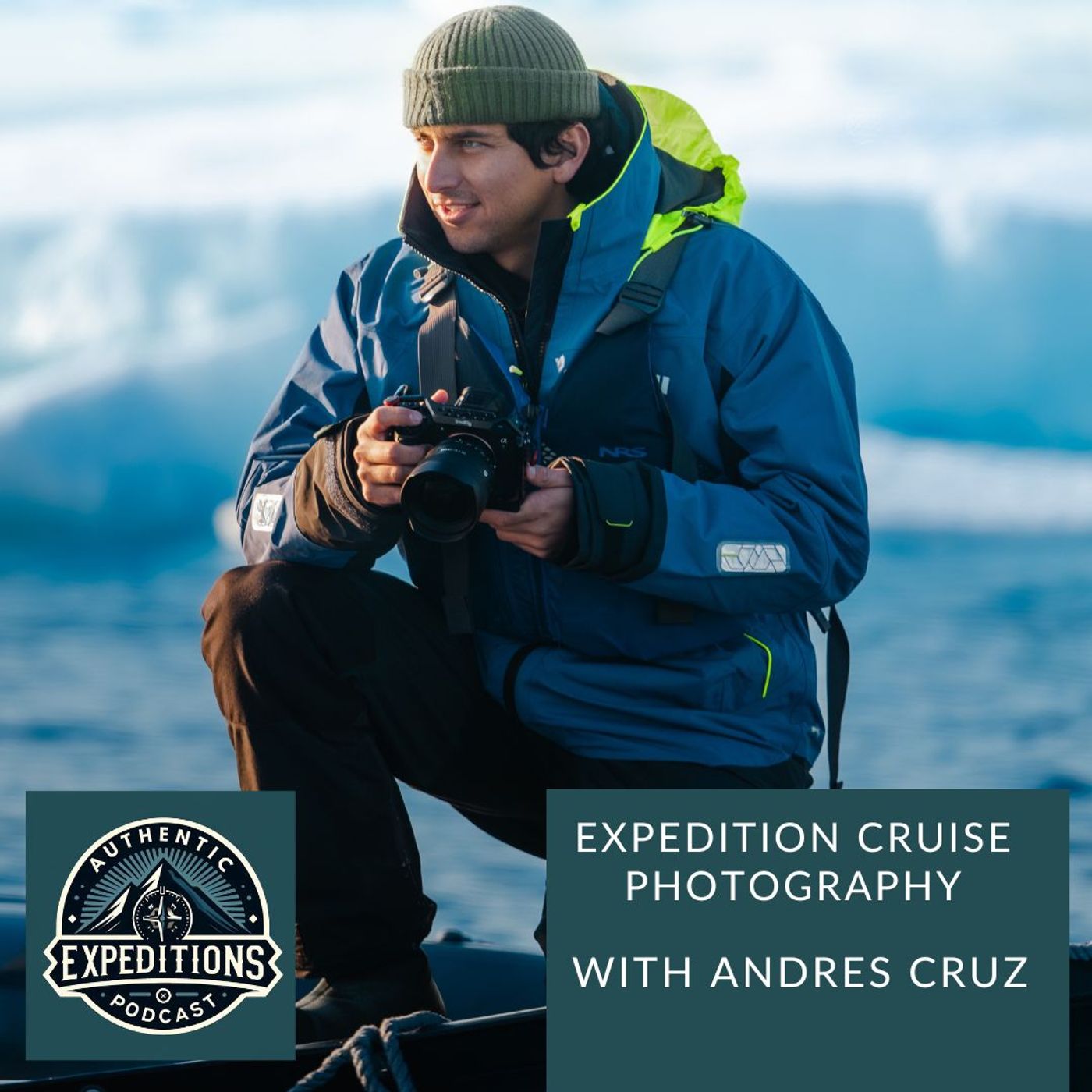
18. Expedition Cruise Photography with Andres Cruz
(00:01:05) Growing up in the Galapagos
(00:02:02) Isolation Then and Now
(00:04:09) Discovering Photography
(00:05:15) Cruise Photography Mindset
(00:07:31) Smartphone Photography Tips
(00:09:09) Wildlife and Composition
(00:11:00) Camera Gear Essentials
(00:12:29) Video and Snorkel Footage
(00:13:28) Arctic Challenges and Zodiacs
(00:16:21) Common Mistakes
(00:18:29) Learning Patience in the Field
(00:19:48) Favourite Shots and the Golden Hour
Host Sue Stockdale speaks with Galapagos-born photographer and naturalist guide Andres Cruz. He reflects on growing up on remote Floreana Island, developing a conservation mindset from close everyday encounters with wildlife, and later appreciating the islands’ pristine nature after leaving for university.
Cruz explains how surfing led him into photography and how expedition cruise ships enable travellers to access to hard-to-reach places like remote Galapagos islands, the Arctic, and Antarctica. He describes his dual role onboard as naturalist guide and photography instructor, offering practical guidance on composition, light, smartphone techniques and preparation for zodiac shooting.
Featured Cruises To find out more about expedition cruises contact Jane Middleton on +44 (0)7971 568155 or [email protected]
Plan your next cruising adventure with Authentic Travel company
Producer: Sue Stockdale
Sound Editor: Matias de Ezcurra
Welcome to Authentic Expeditions Podcast, where we explore all things expedition cruising and talk to the people who live, work and guide travelers in some of the world's most amazing environments. My name is Sue Stockdale, today I'm joined by photographer and naturalist guide Andres Cruz, whose story is rooted in one of the world's most extraordinary environments, the Galapagos Islands. I've been born and raised there. What I found fascinating about speaking to Andres is that he has witnessed first-hand the delicate balance of nature and the impact of humans.
Seeing Galapagos up close, not as a tourist, but as a custodian of the place. Welcome to the podcast Andres Cruz, it's lovely to speak to you today. Hi Sue, it's a pleasure to meet you and thanks for having me over here. Now I know that you're in Ecuador at the moment, is that right? Yes, I'm in Kitoruay now in the capital of Ecuador. But that wasn't where you were born. Yes, I was born and raised in the Galapagos. I come from a small community on Floreana Island, which is this beautiful place in the southern part of the archipelago, where right now we have less than 150 inhabitants, so we know pretty much each other by name.
Wow, what was that experience like as a young child living in that environment? Yes, it was quite an interesting childhood, I will say. It's quite normal to see in the Galapagos the animals, roaming freely all over the town. So it is normal to see half encounters with the sea lions, with the marine ones, with the blue-footed boobys. So you get this feeling that you are really connected to nature and not something separated from it. And that thing that it creates this environmental or conservation mindset in order to protect the place that you grew up.
And I think that's amazing. And when you were a young boy Andres, did you all also then see the visitors that were coming to the Galapagos? Did you notice that that had an impact? Well, especially Floreana, the place that I grew up, we didn't have a lot of tourists back in those days going to the town basically. So it was not common to see people coming in and visit this place, so it was really isolated. It was actually hard for us to go to the nearby islands to Santa Cruz, which is the most inhabited island.
So it was, I think, more isolated than what it is right now. We didn't have any internet, no TV, no cell phone. So it was really being isolated from the outside world, I will say. So as a kid, the thing to do was just go to the dog and then swim and every now and then there will be some sharks, some sea turtles, some sea lions. And yeah, basically play outdoors was a big thing to do. Wow, it just sounds like an idyllic childhood to have experience and not have all the modern day distractions of digital and technology and things like that.
Yeah, that's for sure. It's funny, but when Starlink came up a few years ago, it was a big thing for Floreana. My dad was really excited because he can now make phone calls from the farm that we have, so it's funny. So now when you're on mainland and not in the Galapagos, do you have any different perspective of those islands? Yeah, I think that happened to everybody that was born and raised in the Galapagos. Most of the people we need to leave the islands to go to the university or look for other opportunities.
And then when you're living in a different place, it value what you have over there because it's really a paradise that still will protect it and be seen. So by living in another place or going out of the Galapagos, you really understand how beautiful it is the place that you are from. Yeah, I imagine it's quite different. And with that perspective, which brings us nicely around to our conversation today about photography and your experience of being a photographer on expedition cruise ships. What got you interested in that line of activity?
When I was about 13, I started surfing. So surfing became quite important for me. And that's the time when my parents gave me my first camera and it started as a way to document surf sessions. So when you're going to look for waves, you're going to be exploring the surrounding areas or the nearby areas. And since you are in the Galapagos, the wildlife is all over the place. So you will have encounters with sea lions, with sharks, with sea turtles, with blue footed boobys. So it started as a way to document surf sessions and ended up being capturing the wildlife and the landscape that was in those areas.
So that's how I got into photography. And of course, when I went to the university, I started something that was related to it and that's how it all began. So when somebody is traveling on an expedition cruise ship and from a photography perspective, does it make any difference when you're on a cruise ship, expedition cruise ship as opposed to being on land? I think what is beneficial about being on a cruise ship is that you will get the chance to visit hard to reach places. So in a cruise ship, you can go to those pristine and remote locations.
So you're going to encounter beautiful wildlife, beautiful landscape. I think that would be a big part of being on an expedition cruise, go to those places that are really hard for you to go on your own, like Antarctica, the Arctic, in the case of the Galapagos to the islands that are really far away from the town that you cannot go on a daily tour. So I think those would be the most important things. So those hard to reach places that you wouldn't get to very often. So now I'm thinking in my mind, the pressure ramps up to get the perfect photograph, to capture that image.
There's also a sense of then missing the reality for just looking through the lens of our camera. What would you say to that? Well, yes, there's that as well. Sometimes you're too focused on the camera rather than enjoying the moment. But it all depends on the individual, I will say. For me, if I'm traveling somewhere, if I don't have the camera, it feels like I'm not traveling. But if people are coming to the Galapagos, we call the animals over here, ecologically naive. They are not afraid of us.
They have been living for many millions of years without natural predators. So it's relatively easy to photograph the wildlife over here. So guests will have the chance to take a photo and enjoy the moment as well. In the case of the Galapagos, not in the other places. When you're traveling on board a ship as an expedition photographer, what is your role involved? I have two roles. When I'm on board the vessels, I work as a naturalist guide. That means that I will lead the hikes, tell the information about the human history of the natural history of the place, and also teach photography.
So photography instructors. So that means that I would provide some lectures on board in order for the guests to improve their photography skills and lead some photo walks. So it's a combination of those two things. Now, I'm wondering whether we can sneak a little bit of your advice on this podcast, given that maybe some of our listeners may never get on an expedition cruise ship. What would be this our general advice you would be giving to guests in regards to photography? The first lecture that will provide onboard the ship is composition and understanding light because those topics are quite essential to understand because the people that are common on board, some people will have smartphones, some people will have professional cameras.
So those concepts of that information that if you know and understand can be applied to any device that you are using. So that's the first approach to photography onboard the vessel. And the most popular one that we have onboard is how to use your smartphone to take great photos. And it's the one that everybody gets excited because everyone is carrying a smartphone nowadays. And if we were just getting one of your top tips around using a smartphone, what springs to mind? It will be high level is the one that we encourage people to do a lot.
So that means get to the high level of the animal instead of snapping shots at your eye level because that's how we see the world. And if you take a photograph with that perspective is not anything different to how people see the world. So if you change that perspective by getting really low to the eye level of a level before anyone, it will change drastically how the image look and that will be great. So getting to the eye level of the creature that you're taking a photograph of would be a really simple and practical tip to try out.
And in terms of then applying the knowledge that you've shared with them on these lectures and then you're going out with them as a naturalist guide, what are some of the tips that you might offer for wildlife spotting? I dare say in the Galapagos it's very much easier than other places. Are there any things that you think help people to be able to start to tune their observation skills? Well, in the case of all Galapagos is like almost 100% sure that you're going to see the sea lion, the one, the land, the one.
So it's relatively easy to photograph. So that's quite nice because if you're doing wildlife photography you can focus on different aspects of photography rather to be searching for the wildlife. So you can work with the best with composition, maybe applying the rule of thirds, leading lines and you are doing that with a guest and the animal is right there cooperating with you. And what's a bit challenging will be the action shots. For example, it's quite easy to get the blue-footed movie feet because it's right there but it will be a bit hard for you to get the bird lunchtime and get in a fish.
So those moments, but in general that is relatively easy to work in the Galapagos with the guest and the wildlife teaching photography at the same time. And I imagine it also brings a sense of pride for you. Yeah, it's amazing. I think that I'm a foil being from the Galapagos, especially when I go to other places that I see that the animals are really far and not cooperating with me and I think it's a bit frustrated. What type of kit should our listener prepare for? What should they bring if they're traveling to the Galapagos and want to get great photographs?
I think that from a photography standpoint of view, the best or the ideal kit to bring is two camera bodies, one with a zoom lens, so something between 70 to 200 millimeters or 100 to 400 millimeters. In that way you will have good reach in order to photograph the wildlife that is far away from you. And in the other camera body, a wide angle lens. So that means something between 16 to 35. In that way you have two camera bodies with two lenses and when you are outdoors you can capture whatever is close to you or far away from you.
So the wide angle lens will be for the landscape or for the animals that get really close to you because when you are outdoors and you have to switch lenses, it will take your time. You might miss the moment and also your outdoors so there might be rain, humidity, dust, sand and you don't want to have any of that into your sensor. So it's quite a good idea to have actually two camera bodies and if you don't want to have two camera bodies, you also only one, give priority to the zoom lens and you can use your smartphone as a second camera for landscape of wildlife that is really close to you.
And also make sure that you bring a drive back to protect your gear when you are going on enough to the boat and the microfiber cloth as well. I'm not going to forget that for my next expedition crew. Just one other point that you mentioned there under, and I haven't asked you about yet, is videoing because of course our smartphones today is very easy to video as well as take photographs. You have to think about it differently for doing video rather than photographs. It will be the same tips according to composition it will be applied to video but in the case of the Galapagos we go and snorkel every day.
So if you are going under the water, it will be a good idea to have a camera and an actual camera or your phone with underwater case to film in a high frame rate. So that means that you can later on slow down the footage because when you are swimming you are moving a lot and if you get excited you are going to move more. So if you slow down the footage then those small movements won't be that significant. And which other destinations have you travelled to as a photographer, Andreas? Well I've been to Greece, I've been to Greenland, Iceland, Norway, Svalbard and antarctic Peninsula and of course all over the Galapagos.
So you had to get a few more warmer clothes for heading north to the Arctic? Yeah. That was actually one of my favourite places to be. What did you notice there? What did you observe for the listener again to get them a sense of the wildlife or the nature that they might experience up there in the Arctic? I think that it's a bit more challenging to photograph wildlife in those places since there's natural predators on land for them and in the case of the Arctic you are looking for the polar bear.
So the polar bear is often really far away from you. So if you don't have a big lens with a good camera you might not be able to get a good portrait of the animal itself rather like if you are in the Galapagos with a phone you get to see Lion a few feet away from you. So that would be a big difference. But a scenery of the place, icebergs and the whole landscape is so dramatic. It's a very special place. I've been to the Arctic on several occasions and it always inspires me to be there. And one of the features from an expedition cruise perspective is people are going out on Zodiacs to have their tours and see the different areas.
What do you do to prepare to be able to get great photographs from Zodiac? Yeah, so the Zodiacs is a tool of exploration as we call it and we use them all the time since we are on a boat. We need to get on and off. Sometimes it's a bit challenging when you are doing these coastal explorations because the weather changes. So what I would suggest people do is that if they have a camera it's quite handy to have a high shoulder speed. That means that the sensor is closing really fast. So the fact that it will have in the image is that image will freeze the action and you won't have a blur image.
On also avoid, I've seen people doing that, avoid kind of using the edges of the Zodiac as a support. It's better to talk your elbows to your body and then it will be better to photograph like that. And some cameras right now they have in body stabilization so you can set that to on and it will help you a bit. But something that I always tell my group is that you are never going to be in the right side of the Zodiac because if you are photographing something on the left, something is unfolding on the right side and then you are going to miss it.
So you need to be aware that there are some moments that you are not going to be able to capture. It sounds like you need eyes on the back of your head when you are traveling in a Zodiac. When you were in the Arctic, it was perhaps more difficult to spot the wildlife and then it may be a distance away from you given that you are also taking guests into these fragile environments, whether any rules that you had to follow. Yeah, I think that the most important rule is respect the place that you are visiting and try to not interfere with the natural behavior of the animals in order to get the shot that you are looking for.
So it's not because you are going to the Galapagos and you want to get a photo of the land you want to hit in a cactus spot, you're going to get one of those spots and give it to it. So respect the place and also be aware of the local rules, most protected areas they do have rules that you need to follow. So be aware of that and we will keep those places as pristine as possible. Are there any common mistakes from your experience, Andrews, that people typically make when they are photographing wildlife?
People when they go on the expedition cruise, they sometimes focus too much on rent or buy a new camera, but they don't bring something to protect it. Like a drive-back, for instance, that is quite essential because we are on the ocean, we are on the landings that sometimes we have swelves. And the most important one I will say is that people sometimes is not familiar with the gear that they are using, so they struggle a bit when they are photographing something because they are worried about the technical details instead of whatever is happening in front of them.
So I will strongly suggest whether you are using a smartphone or a professional camera, you need to be familiar with what tool you are using. So that would be the biggest thing to consider. Sounds like a little bit of practice ahead of time. Yeah, and there is something that I see people forget all the time is the microfiber cloth to clean the lens. That is just a small thing that people always forget. I always have one in my bucket because I see people cleaning with a t-shirt with the shorts instead of the microfiber cloth.
Have you been spying on me? That is one of the things I do. Yeah, you are not the only one. So when you were starting out doing the role of an expedition photographer, and is whether any mistakes you made early on that you've no realized that you need to do differently? I think that at the beginning something that maybe happened to everybody is that you are worried that you are never going to be on the right side to photograph whatever is happening in front of you rather than take advantage from the position that you are and get the shot that you are going to be able to get from that perspective because if you try to look for another perspective you might miss the shot.
So I think that would be the thing that I have learned. Also, first secure the shot that you are looking for. Okay, if there is a dolphin swimming around, try to get the shot that you are looking for and then you experiment or try to get different details or the landscape, just secure the first shot that you are looking for and then experiment a bit. So there is a sense of perhaps having a bit of patience, though maybe another opportunity to get something better or different. Yes, yes, that's for sure you need to be patient and sometimes you don't get it and it's part of the photography.
So when you think about the places you've been, we've spoken about the Arctic and of course the Galapagos, you mentioned the Antarctic as well and what have been some of the most stunning images that you've been able to capture through your photography? Well, I have two moments that I can recall right now and one is what's in the Arctic. So we were cruising or sailing and the guides or the bridge spotted a polar bear that was on the hunt. So it was sneaking behind steel that was resting on top of the sea ice.
So everybody was ready with the cameras, I was filming and I was able to capture this polar bear sneaking and then trying to get the seal, luckily for the seal, kind of escape getting into the water but the polar bear ended up half of its body submerged. So it was just a beautiful moment to witness and something that kind of stayed my mind and the other one is in the Galapagos. So we were coming back from this hike on Espanola Island and it was late in the afternoon like 5, 5, 30 and we were coming back on the Saudiaks and then this large bottle nose, the old things were around and they are really playful so they got really close to us that jumping about riding and I've seen this behavior before but since it was late in the afternoon is the perfect power for us photographers so golden hour.
So I was managed to capture this dolphin all the way up in the mid air with those beautiful colors of the sunset, the warm tones and the deep blue in the ocean and the sky. So it's just a beautiful frame that I was managed to capture by luck. So I think those are my two favorite moments. Those are just absolutely amazing to have those sorts of experiences. You also mentioned there and as the golden hour, what significant about that from photography perspective? Why people love golden hour is because the tones that you get at that time of the day is basically these really warm tones on the subject is early in the morning or late in the afternoon and since the strength of the light is not too strong so it's easier for the camera to get information in the shadows and in the highlights.
So you will get information in the whole frame so that's why it's quite a good time of the day to photograph on also the side of the light. So when you have sight lighting, that means that it will create some interesting shadows as well in the subject. So that's why it's often the best time of the day to photograph due to the light that is able to manage by the camera and how the shadows are being formed. So you're already making me think that for guest listening, they shouldn't be thinking about heading off to the bar at the golden hour.
They should be heading off to the deck to look for amazing wildlife. Yes, that's for sure. Keep the bar for the night time. Where are the places that you have yet to visit that you're looking forward to some stage heading to in the future? Well I have not planned anything yet but one place that I really want to go or I've been dreaming about to go is Africa. So I've never set foot on that continent so I don't know where I should be going but I for sure want to go over there and get a few photos of the big five as it's often set.
So that will be a beautiful place to go. Well I hope that you have the opportunity to do that in the future at some stage. And when you go back to Galapagos, do you go back with any new perspective? I go over there basically every month so actually this Sunday I'm going to the Galapagos getting on board and working as a photo instructor again. So I'm not sure. Since I'm going all the time, I really miss it a lot and I don't know it's a profession that I think everybody in Galapagos want to have and it's just getting paid for showing your home and then teaching how to capture those beautiful moments in the place that you live on and then incentivate people coming and visiting.
I don't know it's just paralyzed I guess. You've got the dream job by a sentiment. By the way, nothing but that I plan. I never imagined that I would be working on expedition vessels. How did it come about then? It's something that was offered to me at the right time of my life. So I was about to finish university. So as soon as I got my degree, I was not looking for a job and then a limblet expedition actually was looking for a videographer on the Galapagos and I applied. I got the position and that's how I started to work in the expedition vessels in this archipelago.
I work exclusively right now as a naturalist guide and photo instructor and it's a wonderful profession actually. Sometimes just being in the right place at the right time can bring those amazing and interesting opportunities that we didn't expect. Yeah, I'm going to the places like I was mentioned here. Like the polar regions. Yes. They are pretty amazing. What you're inspiring me now by your conversation and how you're describing it to me is. It's been really informative to just listen to what you have to say here and I hope that our listener has a better sense of what to expect when they get on an expedition cruise and they do load a preparation ahead of time with their smart phone or camera to ensure that they have are able to use it competently.
And of course the all important soft fiber cloth. So thank you so much for your time today and I hope you enjoy your next expedition cruise this Sunday. Thank you so much for having me as well over here and share all the information that I know from the Galapagos and my photography tips and hopefully I get to see you in the Galapagos. Thanks so and thank you Andres for sharing your journey as an expedition photographer and guide. I found totally fascinating and as you say it's about being in the right place at the right time and that's certainly paid off for you.
Back in February I was lucky enough to meet Andres on an expedition cruise with Lindblad Expeditions around the Galapagos and he is so right when he says to ship allows you to visit some of the more remote islands that otherwise would not have been accessible to us on day trips. And of course this in turn meant we got to see the amazing wildlife up close and get some over those great eye level shots Andres mentioned. Andrews thank you for sharing some really useful photography tips with us today.
I can still recall your very helpful lecture on board about how to get great photographs with your smartphones proving that photography really is for everyone. If you're a keen photographer or just starting out with photography expedition cruises can be a great way to immerse yourself into taking photographs in unique and special environments, to mention the wildlife you'll see. If you want more information please get in touch with me Jane Middleton of the Authentic Travel Company. My contact details are down in the show notes.
Until next time thanks Sue and don't forget you might grow a fiber cloth next time you travel. Make sure you follow us, subscribe and share it with others who enjoy travelling to remote places and I look forward to connecting with you soon. (soft music) (gentle music) (music fades away)
 Apple Podcasts
 Castbox
 Castro
 Goodpods
 Moon FM
 Overcast
 Pocket Casts
 Podbean
 Podcast Addict
 Podcast Republic
 Spotify