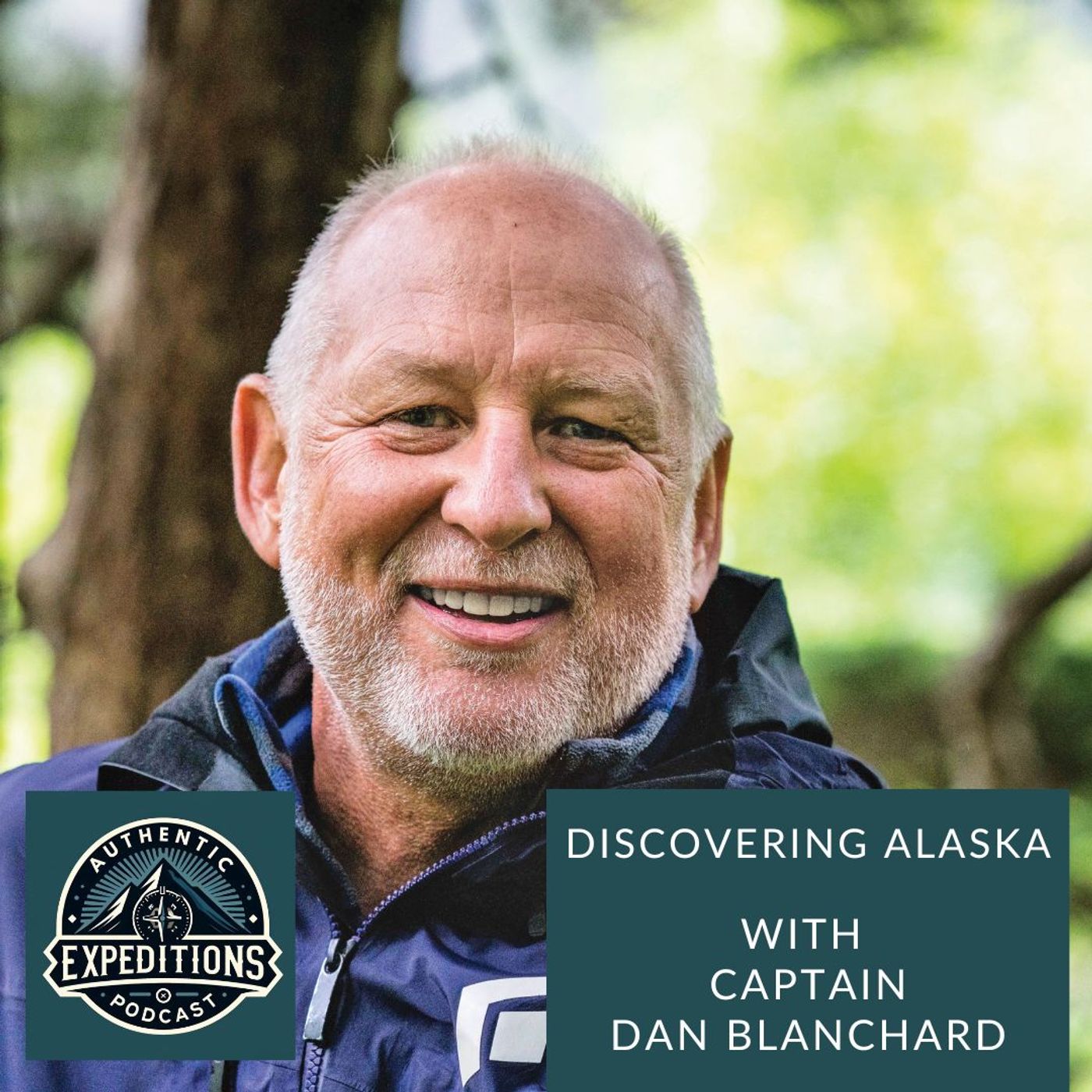
17. Discovering Alaska with Captain Dan Blanchard
(00:04:11) Small Ship Advantage
(00:06:58) Best Time to Go
(00:10:21) Wild Encounters At Sea
(00:13:12) Passion behind UnCruise
(00:15:18) Responsible Travel Choices
(00:19:52) Why it is called UnCruise
(00:21:25) Tlingit Adoption Story
(00:24:04) A Day on Expedition
(00:28:59) Wifi and being present
(00:32:02) Planning a Trip
(00:35:37) Measuring Success
In this episode, host Sue Stockdale is joined by Dan Blanchard, captain, entrepreneur, and founder of UnCruise Adventures, to explore what makes Alaska one of the world's most remarkable expedition destinations.
Dan shares his deep connection to Alaska's vast wilderness, describing a landscape of towering glaciers, remote waterways, and extraordinary wildlife encounters. He explains how small-ship expedition travel offers a fundamentally different experience from traditional cruising, allowing guests to reach secluded locations, navigate narrow fjords, and immerse themselves in places that larger vessels simply cannot access.
The conversation explores the best times to visit different regions of Alaska, depending on whether travellers hope to see bears, whales, seabirds, or dramatic glacier landscapes. Dan also recounts some of the unforgettable wildlife encounters and human moments that have stayed with him throughout his years on the water.
Sue and Dan discuss the philosophy behind UnCruise Adventures and the decision to create what Dan describes as an "anti-cruise" experience—one centred on adventure, flexibility, learning, and genuine connection with nature. They also examine the role of technology onboard, the benefits of disconnecting from constant connectivity, and the importance of being fully present in remote environments.
The episode concludes with a discussion on responsible travel, including practical measures to reduce environmental impact, support local communities, and encourage a slower, more meaningful approach to exploration.
Whether you're considering your first expedition voyage or simply fascinated by Alaska's wild places, this conversation offers valuable insights into experiencing the Last Frontier with curiosity, purpose, and respect.
Featured Cruises To find out more about expedition cruises contact Jane Middleton on +44 (0)7971 568155 or [email protected]
Plan your next cruising adventure with Authentic Travel company
Producer: Sue Stockdale
Sound Editor: Matias de Ezcurra
Hi, welcome to Authentic Expeditions podcast. I'm Sue Stockdale and today we head north into wild coastlines, tide-water glaciers and whale-rich seas as we explore what truly makes Alaska extraordinary. I'm joined by Dan Blanchard, captain and founder of UnCruise Adventures, a company that has built its reputation on doing the opposite of traditional cruising. Dan shares why small ship expedition travel and locks places that the big ships simply cannot reach, such as LeCont Glacier and quite harbours where porpoises surface in the stillness.
We talk about timing your expedition cruise, whether you're interested in bears, whales or bird life and why expedition cruise operators need to operate responsibly in fragile ecosystems. Dan also reflects on the personal moments that define his work and why he is so passionate about expedition cruising. If you're curious about Alaska, then I'm sure you're going to enjoy this episode. Welcome to the podcast, Dan. It's lovely to speak to you today. It's great to be on board with you, literally and figuratively, and looking forward to a great chat about expedition and adventure travel.
I hope that by the end of this conversation our listener has a much better sense of Alaska from what you tell us, Dan. Just to start off from your perspective, what makes Alaska so appealing for the cruise ship traveller? What Alaska has to offer is just a massive volume of both wildlife and wilderness areas. And what I mean by that is that we have multiple species of bears and we have unbelievable amounts of bird life and sea life. And even though I love the further Arctic, the far north and the far south, what you find is that you find those areas are abundant with very few things to where the majority of Alaska outside of the very, very north is just plentiful with all sorts of wildlife.
The other thing that is really unique is so much of Alaska has been preserved so the area that I live in in our capital, which is Juneau, Alaska, it all lies within a 17 million acre area called the Tonga National Forest, which much of it is preserved for the edification of ourselves as adventurer and expedition travelers and for the safekeeping of all the critters that are there. I mean if you look at the continental United States or where we refer to it as the lower 48, so that's a tip for anybody who's listening and if you go to Alaska and say, "Oh, so what do they think about this in the lower 48?"
You will automatically be just adorned with appreciation. But if you look at it from a sense of the continental United States, Alaska is more than one third the size of the lower 48. So that gives you a little bit of an idea. Even if you were to drive, which you can't, but if you could drive from the very southern to the very northern to the very eastern, which actually this is an interesting thing, Alaska is also the most western and eastern state in the United States because the illusion chain actually goes beyond the international date line and all of a sudden becomes east, but that was.
So it's an amazing place, but it is one of those places where you can't go there one time and see the whole place unless you're spending maybe five months. It's just so big and people don't understand that. One of the biggest challenges as someone who lives in Alaska is getting people to kind of understand, you know, take this region of Alaska this time, come back and go to an area that is entirely different and not just geography, but the way the wildlife is there, the way the weather is, this type of thing.
I heard you in another conversation explain that there's quite a difference in traveling on the uncrewed small ships. It gives a completely different experience compared to some of those larger ships with many more passengers that only go into one or two ports. Where do you get into on your small expedition ships? First of all, expedition adventure, those two are combined with us. We can't really separate them. So what that means is to have an expedition trip for us, it also has to have an element of outdoor adventure, which can be the hiking, it could be going out in skiffs, it could be snorkeling even then Alaska if you want to do that or it could mean just sitting in the hot tub and watch it all go by, but that's not our typical client.
So I think for me in Alaska, what UnCruise brings to the table is because we're an expedition company with a bent on adventure, we're able to take people in our own land, our own state and show them the very intricate areas partially because our vessels are so small. I mean our largest vessel is 86 passengers, all of them are under 100 passengers and what that means is we can go into places like LeCont area, which no ship can go into. It's got a narrow tight entrance at shallow, but yet it is the most active glacier in southeast Alaska.
So these kind of things that we can bring to the table offer a lot of value. Also, the fact that we are a U.S. flag means that people don't have to go from Vancouver Seattle to go to Alaska and waste four days out of their eight day trip just moving back and forth. They can actually fly right into Juneau, Sitka, Ketchikan, Seward, Dutch Harbor and take off from their trip right there. So it's highly efficient from a time spent on board boat. I love that you're seeing your biggest ship as fewer than 90 passengers.
What's your smallest ship size? We have one charter yacht that is from our very beginning. We started in '96 and I think we got this far request in '97 and she is just 22 passengers. She does almost all our family charters. We get celebs and that kind of thing that just want the privacy of a small vessel, but she explores just like other ones. And I have to say my daughter is the captain, which brings a lot of joy. But since I get to be a family affair there. Well, yeah, I mean my son was once a captain.
He now runs the Seattle Maritime Academy. So he's actually just a mile from me right now, but yeah, my daughter's been a captain as far it quest for about seven or eight years now. Oh, wonderful. And in terms of the time of year to visit Alaska, is there a prime season or does it depend on what you want to see and do when you're there? Yes, to all. Again, you have to realize how big the place is and what the weather is doing in Ketchikan, which is the most southern area compared to what's happening in Barrow, you know, 1500 miles or so away is dramatically different.
It's like the same difference between San Diego and Seattle, even more so. So you have to keep this perspective going all the time. There is no perfect time if you say for the state, if you say for a region, I could give it, for instance, in Southeast Alaska, the big mega international cruise lines have tried to convince everybody that there's this narrow window and they up until recently were running all the way into November. Well, the reality is anytime you're in Southeast Alaska in October November, it's terrible.
That's when we all go on vacation because it's windy and wet, but the big cruise lines are always trying to expand the number of days or traveling, but conversely from about the 10th of April to about the 1st of June is our driest season of the year. When I was growing up, we used to call it the painting season. So you have to look at each region in the same way. For instance, we will operate out of a place called Seward, which is further north than where I'm out in Juneau, and we go all the way out the Aleutian chain.
Now, we don't do those trips until June, and we generally shut down by the first weeks of September, but it does depend on the area, but I would say for Southeast Alaska where much of the adventure travel, exhibition travel takes place, really anywhere from about the 10th, 12th, 15th of April, all the way to early June is going to be the driest, but cooler. But then as you say, it depends on what people are looking for. So for instance, bears are always a big thing. Whales are always a big thing.
Now, we have whales year round. People don't realize that, like for instance, humpbacks don't all go to way in Mexico. There's a population that stays. We have orcas, and of course other types of whales as well. They're always in Southeast Alaska, but the big, big times, quite frankly, that the magic moment is kind of that late July through early September period when they tend to be more active. However, that's not necessarily the same for other species. Like if burners want to be there in the early and late seasons, so they get trans-tory birds going back and forth.
Bears are terrific in the early season, and I mean again April, May because the bears when they come out of denning, not really hibernation, but it's denning, they come out and they don't have salmon right away. They don't have berries right away. So they forage on the beach at low tide, so the early season is really good for that. So there's all sorts of ways to look at it from a wildlife perspective. Of course, glaciers are always there. That's going to be good any time. Given you've capped in chips for a number of years, Dan, what are some of the unusual sites that you've witnessed from the bridge?
As a captain myself, as you say, and one who still travels on my boats regularly, what is unusual to me and what is unusual to a gastric to different things? So for instance, obviously I've seen workers taking out whales. I've seen bears being chased by moosh in the water. I've seen sea lions hop up on the stern of our boat because they're trying to escape orca whales. The list just goes on and on, but for me personally, because that's part of my life and it's not necessarily unique anymore because I see it so much.
To me, it's really more of the human wildlife interactions that are subtle and beautiful. For instance, two years ago, I was out on one of my boats and when I go on board, I tend to go out on the expeditions off the ship, which is really what we're all about. We're not about the ship. That's just the tool to get there, right? So I'm out in a double kayak and I'm leading a kayak group up by a place called Taylor Bay in Glacier Bay National Park, and then on the way back, we just said, "Hey, y'all, just go at your own pace, paddle.
We have about three miles to get back. Just paddle at your own pace, enjoy Mother Nature, and I'm with a woman who's in the front of the kayak, didn't know her before this trip, and she asked if we could stop, and I said, "Well, sure, what's up?" And it was just at a time when these really wonderful little harbor-porpoise were just popping up and they're a very docile porpoise and they were just popping up all around, it's 20, 30 of them, and not in a big jumping in the sky, just a very gentle and it was just in a flat, calm, sunny day, and she said, "I've got something I need to do, and at first I thought, "Oh, I hope you don't have to use the restroom right now."
But the reality is she was about my age, maybe a little younger, and she had a little vile that she was carrying with her, which were her parents' ashes, and everywhere she went, whenever there was a moment that touched her, she spread their ashes out. So those are the human, very human wildlife-centric moments to me that is really why I do what I do. We're all going to see whales at some point, we're all going to see bears, we're in sequelae-shers, but when you have that kind of experience in nature, that's truly off the hook.
Well, I can just imagine that was to make the hairs on the back of your neck stand up on end. Getting what we call goose bumps or chicken skin as they say, "And why, as I show that story with you?" And what you did touch on there, Dan, was about why you started up the business, why you do what you do, how would you summarize that? That's interesting. You just had our big annual company party, and I shared the same thing with them that I'm going to share with you. My father and many of his friends, you know, they went into World War II, so I'm a baby boomer, late baby boomer, and I grew up with him telling me, "Danny, follow your passion," because so many of those men and women that were in the service, when they got out, they followed a similar path that they've been trained on in the service, not necessarily what they wanted to do, but what worked for them at the time.
And my dad, I would call him a genius, he was super smart, handed up being a mechanical estimator, because he was a mechanic, I was there, a craft, and knew all about plumbing and engines, and that was his life, but he didn't like it, he was always a diver, and he was always encouraged him to follow my passions. I was sharing with my staff, I was growing up near Seattle, I probably could have done a lot better financially if I had followed the whole tech boom, which is Seattle, right? But I probably would have hated my life, so I do this because I'm passionate about the outdoors.
I took my family on a three-year sailboat trip before I started on cruise, and that just embedded in me, aboard our little 42-foot sailboat, just embedded in me the importance of human beings, finding solace in nature, but also working to preserve it, and that's been really the essence of uncurs. And such a powerful mission to follow, I think it comes back to the point you were describing earlier, Dan, when we can see the wonders of nature, bears, and whales, and so on, but we also want to make sure that they're in the future for other people to enjoy, for us to be stewards of the environment.
You know, ask God, given that it's such a popular place for people to visit, what do you do within your business to try and ensure that you're minimizing the impact on the environment? Well, there's a lot of things, and I don't want to sound. There's just a lot of greenwashing that goes on in the travel industry, so I would have been very selective with my words. To me, so oftentimes when we think about environmental things, we think about plastic, we think about recycling, we think about stack emissions, but the things we don't think about is if I'm buying a car of three two to five years, that has an environmental impact because the energy that goes into making that car is massive.
I can recycle plastic, but if I don't bring that plastic onboard at all in the first place, we're way ahead. So we pulled out of many green certifications because we felt like they're just greenwashing, and it's in the industry trying to raise the flag of what ends up really being scratched the surface and not really very meaningful. So to me, and how we formed uncruased the way it is is, for instance, one of the biggest environmental things we can do is burn the right kind of fuels. We don't burn heavy crude oil, we don't burn marine gas oil, which big cruise lines all swear as the best.
We burn the same kind of diesel you would have in your vehicle, which is the highest refined diesel that you can typically get. And what that means is our stack emissions are almost nothing. And we also realized that the industry tends to follow this idea of traveling from thousands of miles away and literally might go 1500 to 2000 miles a week and more. Steaming underway, just in wide open ocean to get to a destination. But one of the things when you have so few guests like we have, we're able to stay in the destination.
So even when our vessels travel to Costa Rica, Panama, Mexico, they want small vessels like ours. So we import boat and we import it for the season or for two seasons. And what they do is they allow us to run within the country and not make an international port call, which is typical. Now that not only allows the product as far as the adventure and expedition side to just expand, but it also is more efficient on time and in the environment. For instance, we're not running from San Diego in the United States all the way into the Gulf California, which alone is a thousand miles trip each direction.
We're actually right there. So people just come to the destination. We might do three to 400, maybe 500 miles a week compared to a large expedition ship that will literally be traveling thousands and thousands of miles to get there for a very limited time than do the ocean trip home. So I think that the way you look at efficiency and not only in the fuel you burn, but in the engines that you have, what we have on our boat are the same kind of high efficiency engines you would find at home around you because the technology is kept up.
The other thing for us from an environmental standpoint, not only our stack emissions, but another thing that we don't talk about in the industry is where do you get your products? We're small enough to where we have farms in Hawaii. We have farms in Mexico. We have farms in Costa Rica that farm annually just for uncrews and it's all organic and just comes from a few miles from the ship. We're not picking up container loads of food every second week in the United States and going to these places.
So I think that there's something to be said about changing our mindset and not brainwashing through saying, well, we recycle. That is such a small piece. And generally, the pain on the type of recycling, particularly plastics, there's more carbon burn involved in that recycling and all the plastic than anything. Just get rid of the plastic and then you solve the problem. I think I'm getting a sense or at least a hunch as to why your business might be called uncrews because what you're just describing there to me is your willing to take a different perspective and what's meaningful for your business, which gets me down to asking the question, and why is it uncrews?
What's the un-bit stand for? Well, I remember when I was a little boy, there were the colo wars going on in the United States, and it was Pepsi Coke, and then there was the unCola, which was seven up, I think at the time. And years ago, before we branded our name, I had a travel writer on board with me, and it was a small group that we had on our little yacht, this furry question. And at the end of the trip, I debriefed with them and got their stuff and Gigi, who was actually in the travel industry as well.
She said, "You know, Dan, it's kind of like you're the opposite. You're the antithesis of anything on the water. You are actually very active, and we're seeing things, and on that trip, it was one of them where the sea lions came up on the swim-step of the boat because they were being chased by orchids. And she said, "These are things that we'll never be able to experience." And that was the first trip we had run snorkeling in Alaska, so she had a chance to get out and try that. But the point being, as she says, "You're kind of like an uncruise."
And we started over years peppering that uncruise term into our literature and eventually did a lot of focus groups. And what we found out is that the name wasn't necessarily something that people just loved, but they always remembered it. It stuck for whatever reason. So yeah, that's how we became uncruise adventures. What a lovely story. One of the things I read about yourself, Dan, was that you were adopted into the, and no, I can't pronounce this correctly. Is it Tglinglit? Tribe? You're very close.
I mean, a lot of outsiders will put the emphasis on the tea, clink it. It's more like a "k." Clink it. But yeah, my tribal brother Joe is a guy I knew for decades. He's probably 15 or 20 years older than myself. And one day he called me up and he goes, "Dan, I want to adopt you into our tribe." And I was shocked. And there was a whole ceremony in Ketchuakan that hundreds of people were there in the whole extended family was there. And it happened to be that the governor of the state of Alaska was being adopted on the same day by my tribal brother Joe.
And yeah, it was a little emotional. It was very important to me. And I get this strong sense of the passion and the connection to the land, the people and the whole elaskan environment that is very meaningful for you, Dan. It is. And you know, learning through my tribal family, I'm an eag, I'm adopted, my moiety, I'm an eagle of the killer whale house, by the way. My native name is Al-Gunuk. Gunuk, which means "fisting" a little one, by the way. It was actually his deceased brother's name and it meant even more.
But I think that as far as the appreciation from the land and the culture it has expanded my viewpoint. And at one time I was going to name my private boat, the Lonnie, which in Tglingit is the story of the killer whale and how the killer whale came to be or the Orcas, more commonly known. And I had to go before my private brothers and sisters because Al-Gunuk was a non-Salani, was a native name and they don't take lightly. And you know, they said, "You can do it, but we'd prefer you don't because you're in business."
And this is a private boat. It still can be associated with your business. And we don't want these terms being used in a business sense. This is about who we are, not what money we make, this kind of thing. And so I never did. Even though they gave me permission, I never did go ahead with that because I thought it was important that I respect those that are now part of my adopted leadership. Well, it's really interesting to hear you talk about the meaning that it has for you Dan. Turning our attention then to travelers who may be coming on your ships to experience Alaska.
What would a typical day be like for them? Well, first of all, I have to share with you just a prelude to that answer I'm going to give you, is it whenever I meet my guests before they are sailing on their ship? I grab our brochure and I talk to them and I basically say a year and a half ago when we created this thing and I met with my captains and exhibition staff and we laid it all out. It was the best we could do to tell you our story and what you're going to do on this next week or two weeks or three weeks whatever they signed up for.
And I said the best thing you can do with that expectation you got from us right now is get rid of it because no adventure or expedition travel. We as an industry and this is one thing that I'm finding is changing, we as an industry need to be not on railroad tracks because we need to respond to the situations that are in front of us that moment. A person could return to the same trip, the same route year after year that we operate and it will never be the same because we're not operating our clock we're operating on nature's clock right so from a day to day perspective that means that we may not be where we say we're going to be.
We may be someplace else because the goal isn't to follow the brochure. The goal is to provide the best trip we can provide this week for those guests. So with that let's just say we're into the second day of the trip. The night before at cocktail hour our adventure guides come out and they take their eventual orders they talk to people about oh do you want to go kayaking? Do you want to do a short kayak or an introductory kayak or do you want to go on an all day trip because we're going to offer both.
Also this is the day we're going to go snorkeling. You want to go snorkeling this afternoon and the morning and are you into hiking? Do you want to go for a beach stroll? You want to just kind of sit on the beach and absorb the place or do you want to go get a mountain with us? So they'll go around and they'll take the adventure orders and then the next morning typically there's a very small group that might go out on a skiff ride before breakfast and they're typically burgers or people that just want to go out for photographers and they'll get up at six in the morning they'll be in the skiff by 630 and then they'll come back for breakfast maybe at a clock but for the rest of the group that doesn't want to get up that early because people have been traveling away.
They're not necessarily always going to get up early. The rest of them will have a breakfast and then by nine o'clock or so we start you know sending the skiffs out to generally the snorkeleers go out first because they're going to be gone for a while generally the long all day trips go in the first few heats as well. That many skiffs going back and forth taking people to shore and getting them already and then the majority of the people will come back for lunch some on the all day kayaks or all day hikes they'll actually pack food with them but the rest of the group comes back at lunch and then they have another set of similar activities that are offered in the afternoon that they signed up for and then lastly at about six or six 30 all the guests are back on board we have happy hour which is just this joyous period everybody sharing what they saw.
Oh I want to do that tomorrow I'm going to change my order tonight and the excitement cannot be understated that happens during that happy hour and then we have dinner where generally the captain comes down and talks and kind of goes this is what's happening tomorrow and the captain is always present oftentimes he's her she is helping on the stern which I will say we have I think four female captains in her fleet right now which is probably the highest percentage wise of any company on the planet we have eight vessels and four of them have female captains running them at one time or another but anyway the captains are very involved very much seen by the guests and then after dinner is generally where we going to education and so by seven three or eight o'clock those that one of a ten an educational program on why Alaska unique why the Gulf of California and Mexico is just this unbelievable place that's so underrated and they'll get these conversations about the natural world and the sea life and land mammals and such that are involved so that's kind of a typical day one of the things that you haven't mentioned and I know that is unique to how your cruisies operate done is that the Wi-Fi
isn't on all the time and that it gives guests an opportunity to really be present as opposed to having their head and their emails or looking at their phone thank you what caused you to make that decision well you know I have to admit you have to adapt and there was a time when I with all vigorous said you know we are never going to have Wi-Fi on our boats I mean we would allow for the crew and for safety that kind of thing but I was convinced probably five years ago that for one a Wi-Fi back then wasn't always through a reliable source and the biggest complaint you would get would be Wi-Fi so why build complaints but the other more important thing was that I just didn't believe it was conducive in creating an intimate heartfelt experience that a small group of people can partake in but as time goes on it became more of a requirement and had people leaving us because they couldn't have Wi-Fi and so we experimented over a couple of your period with a boat having full Wi-Fi all the time to not having Wi-Fi in wildlife areas to we revise the policy now to where basically it's on from after dinner to breakfast and so people have all evening all night if they want to get on Wi-Fi because we were seeing it particularly with younger people or folks have just got addicted to the
Wi-Fi they would open up their tablet they'd be making phone calls in public areas and we just shut it down so now it's it's very limited but it does allow people to send images home to check in on stuff and it seems to then we finally struck the right now it's in course it's all included just like everything with an increase there's no extra fees or anything oh that's wonderful and I think it does give people an opportunity to switch off when they know that it isn't available they can switch off and really just fully engage in the experience around them yeah that's true and we do limit the bandwidth so you can't like stream a movie or can't frame the news because oftentimes one of the joys about being out of cell coverage or out of Wi-Fi or range in the past was that today's news didn't take over the boat and certainly whenever there's news that actually impacts an area people are traveling in we share that when a captain comes down the talks every evening but the reality is in today's world there's just so much garbage out there that people tend to get cranked up about stuff that has no bearing on what they're doing right now that's true I'm sure I can speak to you all day about Alaska
there's so many interesting things you've got to share with us Dan but time is also getting on in terms of a listener that might be considering visiting Alaska what advice would you give to them to make their experience transformative rather than just being a tourist what really helps them to engage with the place well obviously doing your own research helps I would avoid getting onto a lot of the chat groups that are about because most of the chat groups are so heavy big cruise ship meaning the major brands not even I'm not talking about the expedition vessels left sirly so what that does is that crowd sways everything so don't get onto these chat groups because they're really about stuff that you're not even going to be interested in if you're going to be on an expedition trip I would do the old fashioned way and specifically research if you're going to Galatia Bay or research Galatia Bay specifically if you're interested in wildlife of Alaska what you have to do is you have to go wildlife of southeast Alaska or south central or the illusion chain you know as far as best time to go called amplacery even my own travel industry Alaska atia Alaska tourism industry association puts out a best time to travel calendar for the whole state and it makes no sense because
you can travel in southeast and April but I would never send you to the illusions or Prince William Sound or north of Anchorage in April but yeah it's the most beautiful time to go in southeast so these are the kind of things that you need to check with the right sources and stay away from anything that's out there about big ships because it's volumous and there's no consideration for the region which again the difference between San Diego and Seattle is less than the difference between Ketchikan and Barrow but yet they're wrapping it all together in one thing when they say you can come at this time of year also I think people understanding what they're coming for and what is most important to them particularly on their first trip is really important so if whales or if they say glaciers or all I want to do Dan I'm going to send them to our Prince William Sound there's 17 tidewater glaciers and Prince William Sound it's the glacier area but if they want to see whales I'm likely going to send them to southeast Alaska because that's where we have the best opportunity sounds like you're the man to speak to Dan you know everything about it 1-800 Dan that will get I listen to the answer
it's been really fascinating just talking to you and getting a good sense of the places to visit the diversity really and the effort that people should go into to understand what they want to experience there where to find it and how to be able to do it with a minimal environmental impact yeah it's really important to I think that not being in a rush on week is what people generally go but if you can even stretch it to 10 or 12 days and maybe before going on a boat maybe you spent a day or two in town and you get to meet Alaskans you have a local beverage with them in one of our local pubs get some king crab outside of where the cruise ships go I mean you can have these authentic experiences if you don't rush it so Dan finally as we wrap our conversation at the end of the year when you sit back and reflect on the guess you've had the places that the ships have traveled to in the year how do you evaluate success I can tell you just like any business on a small business right I have about 350 employees which were a larger small business but in my industry I'm a microcosm right so I still have to make money as much as I'm passionate about it you know I have to make a living there is a responsibility to my staff to keep their jobs going and give them good insurance and everything else
but on the emotional side I tell my staff all the time that we should measure our success not by what we do but what the result is in other words when our guests hop off the boat our crew is lined up on the dock and as they hop off the guests have a chance to say goodbye teach one of them and pass words back and forth and I tell my staff when there are hugs and tears that have happened just over a one-week period we know we've been successful and that is the litmus test if we got into the human heart and we got into the human soul have we fed their brain have we given them visual experiences that allow them to look back and go this was one of the best times of my life that's in essence the emotional side of this is where I see the success I did suspect it was going to be an answer something like that done because I think that in the last 30 or so minutes when we've been having the conversation you demonstrated that connection to heart as well as head in how you share your passion so it's been a real privilege to experience that with you and I can well imagine why your guests will have hugs and tears after a week on one of your adventures thank you so much for your time it's been wonderful to speak to you and I wish you all the best
well thank you Sue and the only regret I have is that you haven't been on board with this yet there's still time thank you so much thanks Dan that was fantastic and as always your passion and love for all things Alaska shone through as you say Alaska is huge and at a third the size of the lower 48 that is great of place to visit by region and really do your research first so you know what you want to go and do and for me more importantly what wildlife you want to see because for me it's all about those bears uncruse is the epitome of small ship cruising and provides folks the opportunity to get away from the mainstream towns and see what the real Alaska is all about I love your mission to provide solace in nature whilst working to protect it whilst making real changes to how you operate rather than just ticking boxes and greenwashing as can be the case these days I've been lucky enough to meet you a few times in London now Dan and even in the corporate environment it's always so obvious you are about the connection of land and people with the Alaskan environment so it came as no surprise to me that when Sue asked you how you measure success you said it was with hugs and tears of which I'm sure there are plenty as folks reach the end of their adventure with
uncruse by the way if any listeners find themselves in Juneau looking for a great Alaskan food experience hop along and grab a bite to eat up at the hanger on the wall up by the Juneau sea plain base you won't be disappointed thanks Sue for another great episode and I look forward to next month's recording make sure you follow us subscribe and share it with others you enjoy traveling to remote places and I look forward to connecting with you soon
 Apple Podcasts
 Castbox
 Castro
 Goodpods
 Moon FM
 Overcast
 Pocket Casts
 Podbean
 Podcast Addict
 Podcast Republic
 Spotify