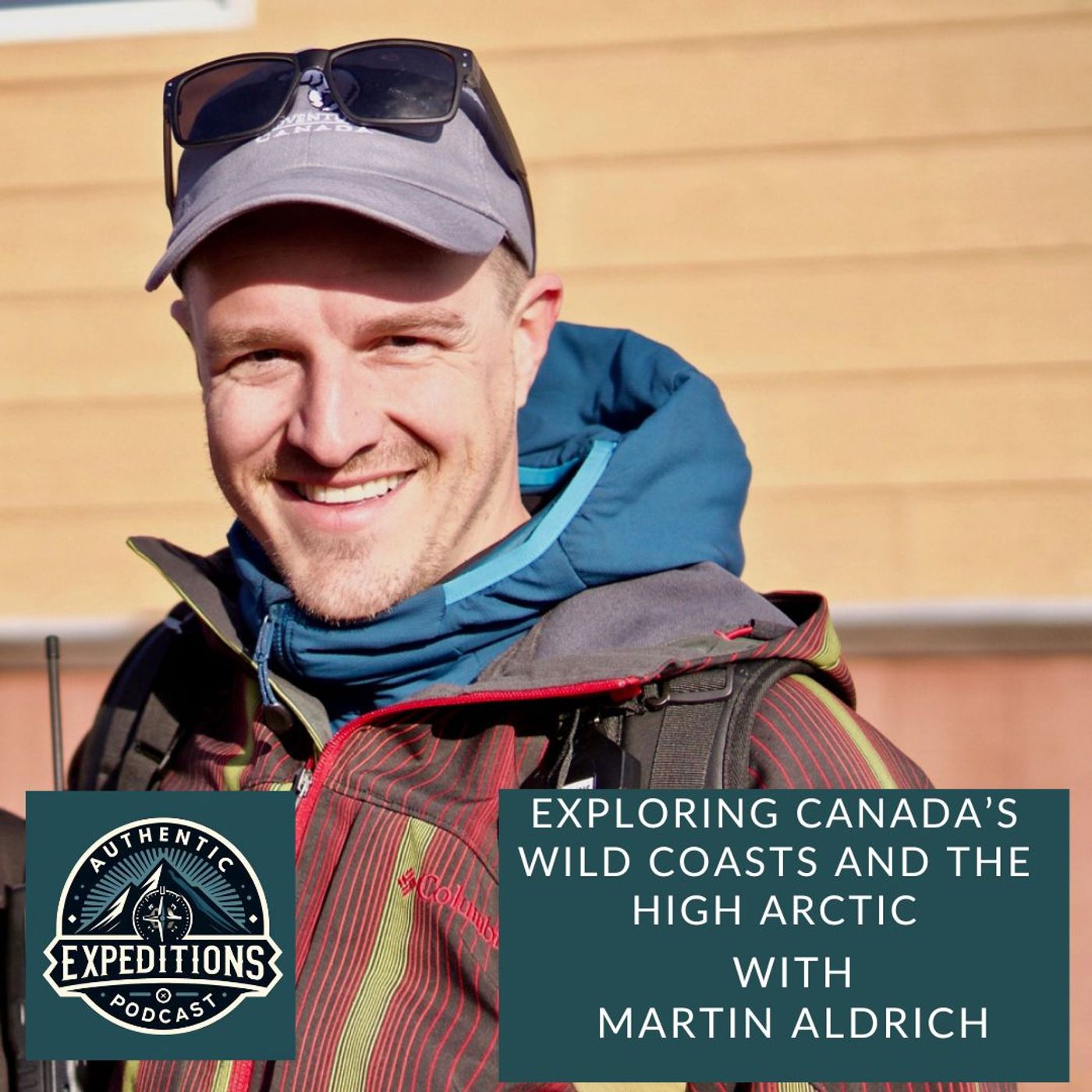
16. Exploring Canada’s Wild Coasts and the High Arctic with Martin Aldrich
(00:03:25) Where the High Arctic Is
(00:04:28) Best Time to Go North
(00:08:45) Life and People of the Arctic
(00:12:57) Building the Expedition Team
(00:15:52) Atlantic Canada Highlights
(00:18:58) Pacific Northwest Voyages
(00:20:06) Solo Traveller Options
(00:21:40) New Trips and New Ships
Host Sue Stockdale is joined by Martin Aldrich from Adventure Canada to explore what makes Canada one of the world’s most compelling expedition destinations.
From the rugged fishing villages and seabird colonies of Atlantic Canada to the temperate rainforests and fjords of the Pacific Northwest, and north into the vast stillness of the High Arctic, Martin shares how each region offers a distinct sense of place, wildlife, and culture. The conversation explores:
- The contrasts between Atlantic Canada, the Pacific Northwest, and the Arctic
- Why the High Arctic often becomes a deeply personal and transformative experience
- The importance of travelling with local guides and engaging meaningfully with Indigenous and coastal communities
- How scientists, historians, and artists onboard enrich the journey beyond sightseeing
- The role of expedition travel in deepening our understanding of living systems and remote environments
Featured Cruises To find out more about expedition cruises contact Jane Middleton on +44 (0)7971 568155 or [email protected]
Plan your next cruising adventure with Authentic Travel company
Producer: Sue Stockdale
Sound Editor: Matias de Ezcurra
Hi, welcome to the Authentic Explorations Podcast. Today we're heading to Canada and we'll be exploring some of the extraordinary coastlines. From the seaboard cliffs of Atlantic Canada, we explore what makes Canada's regions so distinct, Atlantic fishing villages, temperate rainforests and of course the powerful stillness of the high Arctic. We also discuss travelling with scientists, historians and artists on board and why engaging with local cultures isn't just an add-on to an expedition cruise, it's central to the experience.
Welcome to the podcast Martyn, it's great to speak to you today. Thanks for having me on, it's my pleasure. Now I know you're living and working in Canada and just to give our listeners some context, Canada of course is the second largest country in the world, it spans six time zones and it's 41 times larger than the UK so for our British listeners they can get a sense of this huge size and scale of a country Martyn. Where have you visited in particular in Canada to date? Oh wow, I've been very fortunate to live in three different provinces but I've actually visited all of our provinces and all of our territories, mostly with Adventure Canada but I've also roadtripped across the country with my family and friends in the past.
It is a huge country, it is massive. I went to university in Victoria on Vancouver Island and I believe Vancouver Island itself is the same size as England for a reference in terms of square kilometers. Definitely a huge country, it takes a long time to drive across three days just for Ontario for reference. I'm sure there are many amazing places to visit. In terms of expedition cruising which of course is the main focus for our podcast and you work with Adventure Canada. How did that company come into existence?
Because of my senses that you're very much more focused on the adventure side of things compared to some of our other guests we've had to date. Yeah, absolutely. I think you're right. We would call it soft adventure but it definitely is more focused on getting onto the land and into communities rather than the ship and the amenities of the ships. Adventure Canada came about from two brothers and their friend who were river raft guides on the Ottawa River and they thought to themselves, "One summer, we need to get Canadians even further afield out into our backyard, the backcountry."
They decided on Bathurst Island and I believe it was 1987. They did the first overland expedition to Bathurst Island and learnt a lot of the constraints of the Arctic and being on land. So decided to move to small vessels. So I think in 1991, very small vessel maybe only 20 passengers or so taking passengers to Bath and Island again and realized that this is the way to travel in the Arctic especially with some of the constraints with amenities having food and there aren't really hotels. No roads or very few roads.
So an expedition ship is definitely the best way to get around for a tourist to be able to travel, to see a lot of different areas, experience more of the wildlife because we certainly don't control the wildlife and so to be able to take a ship to where we know that polar bears or bowhead whales might be really allows us to be flexible and to see more than you would in just one spot. I also really like the aspect of just unpacking once and then you're really immersed into that destination especially with our team onboard it really gives you that feeling of not leaving the destination each time you come back onto the ship especially with our team onboard being from the locations that we travel to.
Well we will come on to that in a few moments time obviously when we dig a little bit deeper into the reality of some of these expedition cruisies. Before we came on to recording Martyn you mentioned that you've been into the high Arctic quite a number of times. Tell me about where that is for our listener who may not have the geography in their mind immediately. Yeah that's a great question so most Canadians live right around the 49th parallel with the border with the US within 100 kilometers or so I think that's 90% of our population.
The Canada spends all the way to about 85-86 degrees north of the very northern tip of Velsmere Island so when we go up to the Canadian Arctic we're looking mostly at Baffin Island and the Northwest Passage which is a collection of islands in Nunavut which is one of our three territories. We typically are ranging between around 60 degrees north and 80 degrees north on our Arctic expeditions. All of the trips that we do to the Canadian Arctic also include Greenland as well which is actually funnily enough at the moment a very popular destination and is a spectacular place which is understandable why people want to go to Greenland.
Now of course the seasonality is important given that in the Arctic of course the Northwest Passage would not be able to be traversed in the winter months. In terms of the months of the year when those expedition cruisies would take place when do they happen? Typically in the later part of the season so August into September we start our season typically in May or June and that would be more southerly locations of Newfoundland, Labrador, Sabel Island and the Gulf of St Lawrence. We also have trips over across the Atlantic to Scotland the Faroe Islands and Iceland but for the Canadian Arctic you're really looking at July for being able to get up to Baffin Island.
You're still going to encounter quite a bit of sea ice at that time but it's been melting for a few months so it is starting to disperse and the open water is starting to take over and so we can get further north into early August the northern part of Baffin Island. It's that Lancaster Sound to Tallurutiup Imanga that's the newest marine reserve an area that's harder to get into until mid-August and then as we go further west into the Northwest Passage it's really late August into September that we're able to get in there.
It's about a 7 to 8 week window where the Northwest Passage is. It's open enough that an ice class vessel can get through. There are icebreakers that will go through at different times of the year but for a commercial cruise, expedition cruise really I think the season starts in July at the earliest. I'm sure the significance of the Northwest Passage is probably familiar to many people. Again for our listener why is it such a magical place that conjures up in people's imaginations somewhere that they want to visit?
Well that's a great question. Explorers were thinking that there was a way to get from Europe to the Orient for hundreds of years. It wasn't till 1906 that Robison first crossed through. There's the famous Franklin and a British explorer who attempted to go through in 1845 and that's a whole other story. There's even a TV series about it. The challenges are the sea ice and so as they discovered as they were trying to go through Martin Frobisher there were a ton of different British explorers that went through Scottish Ray who was a notable explorer.
It was a challenge. It's a very interesting area. It's full of sea ice. There are pretty much no trees. So when you look at the landscape especially when it's frozen it does look just like undulating white in a lot of places. Of course you see some rock in places but when it's frozen it's hard to know where the water ways are. And so I think the biggest challenge is that the sea ice shifts and blocks certain passages so it is a challenging area to navigate. And now I've had years where we've had to re-root a few times.
The last time that I went through the north of this passage in 2022 we actually had zero sea ice until the very end where it was starting to form behind us because it was much later in the year. So it's this kind of legendary way to get through northern Canada to get over to China or Russia. The Sir John Franklin's expedition was probably one of the most notable. They were going through with modern technology in the mid 1840s which was canned food, tin cans, a food which essentially was part of their demise.
They went through with steel reinforced steam ships which were destined to never be able to sink after 1845 when they left Greenland they were never heard from again. The Erebus which is one of the ships that was found in the 2010s. Adventure Canada is actually the only expedition cruise company to have visited the ship. We were lucky enough in 2019 to pull alongside and in partnership with Parks Canada be able to actually visit the ship and the barge above. I think it's about ten feet or so underwater to the top of the ship but it's in a very, very remote island and very remote fiora on that island so it's very difficult to get to and essentially we were the only ones and probably will be the only ones to ever have visited that ship which is quite an honour.
Now you're giving me a proper sense of adventure Martin. Yes. And it also conjures up in people's minds doesn't it the sense of history and exploration and as you say there's no clear route through and there's a lot about adapting in the moment to find your way through. This sounds amazing. Oh absolutely. It really gives you a great perspective when you're travelling with Adventure Canada you're there in the summer. It's warm there's typically more than 12 hours a daylight up to 18 to 24 hours a daylight in the peak of the summer and it still feels quite desolate.
Hard to get a scale of things with no trees you're looking at a mountain you're wondering is that a thousand feet high or is that 5,000 feet high it's quite hard to tell and it is an incredibly immense land which gives you that feeling of being quite small in the world and then you think of all the people who have survived the Inuit people and the Thule people and the Dorset people who have lived in the Canadian Arctic and survived through the winter. We're there in the summer but I can't imagine being there with no sunlight in the depths of November December January into February and with modern technology some of the staff members that I've met are on Facebook and to see their photos in November all this is the last time I'll see the sun until the new year and then you get a post and you see this little sliver of light on the horizon and that's their first sign of daylight in the new year in mid to late February right around this time really fascinating and it gives you a really great insight into what is life living in the north especially when you're on an expedition with adventure Canada and you go to remote community like Gjoa Haven or Arctic Bay or our most northerly community Grise Fjord for just such a warm welcome people who are living in incredible adversity and just the biggest smiles opening their door to you.
Those are some of the most amazing moments that I've had is cup of tea sitting in a zodiac with a local fisherman and we don't speak the same language but we seem to understand each other. I think people do go to the Arctic thinking of polar bears and sea ice but I think a lot of the times what they take away are the people and that those interactions with community members in the places that they go to visit because it really just stick with you were an incredible species but there's so many different ways to live and I think that gives you that great perspective.
I think also one of the unique characteristics of traveling with adventure Canada as far as I understand is the amount of opportunities that are to really connect with the local communities and to have local scientists and guides on board your ship so it seems like it's very much a part of integrating in with the community as opposed to being a tourist and an observer from the outside. Is that correct? Absolutely and I think it comes back to the founding ethos of the Swan family. We're now in the second generation of the Swan family that ethos it's all about people.
It's people discovering places but also discovering things in themselves and connection to other people which really broadens our horizons of what's out there and what's possible. We've already talked a little bit about the Inuit people but the main area in the Canadian Arctic that we travel to is Nunavut which is one of Canada's newest territories from 1989. It was split off from the Northwest Territories and it's 80% of Canada's coastline, 20% of Canada's landmass and yet there's about 45,000 people that live in that entire area.
Yeah, incredible resilience. Some of the staff members that I've been able to meet on I think about 12 exhibitions to the Canadian Arctic just incredible the resourcefulness, the knowledge of the land, spotting polar bears where 10 minutes before I can even see polar bear and binoculars they've spotted a polar bear from experience just from having been on the land and living it it really shines through and that's what adventure Canada really wants to foster is that connection for our guests to the people that are the Expedition team members on board but also for the members in the communities that we meet as well to really get a better understanding that there's so many different ways to live.
There's so many different cultures in the world I think especially when you're invited into someone's home and you're trying their traditional food. It's such an incredible experience to connect with someone else and really learn about what their life is about day to day. Quite different to most of us if we're not living in that tough environment of the extreme cold and dark for many months of the year. So on board ship in terms of the staff, the scientists, the historians, the filmmakers, the artists, whomever you have on board, how do you select what particular skills will be on any particular expedition crews?
That's a great question. We really try to keep the team well rounded. Having started exhibitions in the 1990s were almost 40 years on next year so that a number of the staff have been with Adventure Canada for over 20 years. So there are repeat expedition team members that bring a wealth of knowledge. We are now expanding so we're not just on one ship. We actually have two ships that will operate in the Canadian Arctic, 75 passenger ocean Nova and 175 passenger ocean victory. And so the teams will be a different size because of the different size of ships but the importance is to be well rounded so we want to make sure there's a photographer, there's always going to be a host and an expedition leader.
But then in terms of the naturalists will really depend on the trip. Like a North-West passage is going to be very important to have a historian on board that trip. So we just look to have the team be well rounded and there are so many multi-talented people that work with Adventure Canada that allows us to have someone who may be a photographer but they're also an incredible or anthologist and because of their experience with traveling with Adventure Canada for such a long time, they typically know many other aspects of what it's like being in the Canadian Arctic.
We have one of the Swan family members and I'm a Swan is the person who takes on hiring all of those different team members and she's been doing this since she was in her early teens I believe like all of Swan families and so there's a great connection between our staff members that are working on the ship and our office staff that are setting up these operations. I'm sure we have many that are thinking, oh Canadian Arctic, yeah that sounds great interesting. So what sort of things will I be doing every day from an expedition cruise?
Can you give us an idea of a typical expedition day? Well we try to keep you today a little different and we do have some main pillars of experiences that were incorporating into the entire trip which would be zodiac cruising expedition landings where we're getting off the ship and going for hikes or walks and then community visits. In terms of a typical day, we're up relatively early to capitalize on on those long days, lots of light so you might start with a yoga class in the morning followed by breakfast and then after breakfast we're typically getting ready to go off the ship so maybe we're doing a community visit this day, a place like a lula sat which is in Greenland, we'd be off the ship into the community in the morning and then the afternoon maybe we're in the zodiacs and out exploring the sea ice the massive icebergs that are outside of lula sat.
There's split days where we're in two different locations in the Canadian Arctic. We can always come back to the ship for lunch which is quite typical and then dinner as well all the meals are included and then if there is a day where perhaps we're having to cover a larger distance like the Northwest Passage Expeditions cover about 26 to 2700 nautical miles over 17 days so it's quite a large distance so sometimes that maybe we have an outing in Goa Haven Community in the morning and then the afternoon we have presentations on the ship so those specialists that come on board for just typically that one trip are going to then talk about maybe the marine biology or preempt us for the next community that we're visiting and give them a little more information into the history of the place or perhaps it's deep dive into the heat saving techniques of a polar bear as we're going into the areas where we might see polar bears.
So we do really want to make sure our clients are learning as much as possible and we know from surveying our clients that's really what they love about Adventure Canada and why they keep coming back is the depth of knowledge of our staff and how much they learn on our trips. Now you've given us a lovely sense of the high Arctic and the Northwest Passage as one example. Give me a little bit of a sense first of all of Atlantic Canada on the East Coast and some of the things that people can experience if they go to the East Coast of Canada.
Yeah, absolutely. Well, there's a number of provinces in Atlantic Canada that we can visit. I myself was born in Halifax, Nova Scotia. So quite fond of Nova Scotia. We do visit a quite a unique place off the coast of Nova Scotia called Sabel Island. It's a sand spit island where there are about 500 wild horses roaming and about 500,000 breeding gray seals that come there every year as well as the rare Ipswich Sparrow. So there are quite a few birding opportunities there as well as different wildlife is quite a different place.
I know people live on this island. It's essentially like a crescent moon sand spit and there's also a marine protected reserve off of there. So we see a lot of the larger, pelagic animals there. So we were lucky to see a blue whale one year. We've seen Malamala, Beluga whale, very rare whale in that area. So it's a great area for wildlife. It's also one of our shortest trips. We do switch up our trips a little bit every year. So there was a trip in 2022 that I was on board called Atlantic Canada Explore, which visited Sabel Island, but it also went to Cape Breton, which is the northern part of Nova Scotia.
And then the Gulf of St. Lawrence is a fantastic area for multiple provinces, 15 different species of whales, including the beluga whales, which you think of as being in the Canadian Arctic, but they do come all the way down into the St. Lawrence. We have our Gulf of St. Lawrence expedition that goes into that area as well. And Newfoundland's circumnavigation is a fantastic trip. I did that trip in 2018 with my parents and it's the best trip they've ever done in their entire life. And when we're traveling on a ship, when we're going around an island, that's typically where a lot of the people live in Newfoundland based on fishing.
So a lot of the communities were on the outskirts of the island. So it's a great way to see a place where you can really not have to travel inland and drive between places you're relocating overnight and then you're in the destination during the day. What I love about Newfoundland, myself, is just the people. It's such a warm welcome into any of the communities in Newfoundland. A France way on the South Coast with no roads to in and out is probably one of my favorite just such a fantastic experience there.
Dramatic landscape, which you don't necessarily associate with, or at least I didn't with Nova Scotia or Newfoundland, but you have rolling granite rock in the fjords as well in the South Coast of Newfoundland. These incredible fjords that we can travel up and then not to mention Labrador. It's part of the province of Newfoundland and Labrador and Newfoundland is the island and Labrador is the main land coast. And as we travel up Labrador, we get into this spectacular location called the Tornget Mountains of Labrador.
And they are one of Canada's newest national parks, about 12 or 13 years old now. I think maybe a bit more than that. And there are again, no people that live in the Tornget Mountains of Labrador. Incredible fjords, teeming with fish. We have black bears as well as polar bears in that area. We spend four days typically getting onto the land in the Tornget Mountains. Probably one of the most special places in Canada for me, just so pristine and untouched and quiet. For me, one of the most amazing things on one of these expeditions, when you go really remote, you have no cell phone signal, you get onto the land, you're not hearing any humming of generators or anything like that, it's just quiet and you don't get that in many places anymore.
And do you do any voyages or journeys on the Pacific Northwest Coast? Yeah, we've just recently reintroduced our Hydroguide Expedition, so this is on a 12 passenger ship, much smaller. And then we have going to the Great Bear Rainforest, a 24 passenger vessel is taking our guests there. Those are typically in the summertime, very different big trees, wet weather typically. I mean, July and August are definitely the dry months, but Hydroguide itself is a windswept island off the coast of British Columbia, very unique flora and fauna.
I don't believe there are many predators there, so the deer are essentially just able to forage themselves. And so there's very little low lying brush in the area, so it has a very different look. It almost looks like a pixie forest. But yes, we get to experience the Hyda culture in that area. And then when we're in the Great Bear Rainforest, of course, the big focus there would be visiting the Spirit Bear and the home of the Spirit Bear, which is also called the Carmoid Bear. And there's also Grizzlies and Black Bears in that area as well and dramatic landscape on the west coast of British Columbia.
That's where I live now. I live in the Rocky Mountain trench, so I'm not on the coast, but BC has so much to offer. It's really quite incredible. Well, it's sounding very appealing for what you're describing to us, Martin. And one of the developing areas of interest amongst people traveling on expedition cruises is the solo traveler. How do you cater, if anything, in particular, to appeal to the solo traveler who may be listening to this and thinking, "Oh, it sounds wonderful, but I'm not sure I want to travel there on my own."
Yeah, we have a very large number of solo travelers come with Adventure Canada. We offer solo cabins, so they're just set for an individual. We've actually decreased the capacity of both of the vessels that go to the Canadian Arctic in order to open up cabins for solo travelers. So we have twice as many as we were thinking initially to offer because of just listening to our client base and knowing that there were such a number of solo travelers that wanted to continue to travel with us. We offer share opportunities on both ocean, novant and ocean victories.
So if someone wants to travel, they want to meet someone or they don't want to book a solo cabin, they can book into a share cabin, and then we find a guest to share with them with the same gender. We find that some of the ways that our guests are making new friends. So we do solo, mingular events. We do hosted dinners for all of our guests, so they'll come on to the ship. And at one night, they'll receive an invitation to a hosted dinner, which is where Adventure Canada staff sit down with them and they can ask questions directly.
So it's much more of an intimate and personal experience. That's really a great way to ask those questions. Of course, but it's also a great way for our single travelers when they all get hosted together to meet other solo travelers. So yeah, it's a huge part of our demographic, and we continue to offer more and more opportunities for solo travelers to get on board. As you look ahead, Martin, then in terms of destinations becoming more popular and your guests are asking for what's on the horizon these days?
Yeah, so we're offering more trips that go to different areas in the Canadian Arctic, typically. So we've offered a new trip for 2027 that goes to the top of the world. So we're aiming to get up to 80 degrees north around Ellsmere Island between Ellsmere Island and Greenland. I already mentioned this. Greenland is incredibly popular at the moment. So we're offering now a new Eastern Greenland expedition that goes up to Scoresbysound, which is the largest, longest, fewer system in the world. So I'm excited for that trip in 2027.
And then, as I also mentioned, we tend to tweak our itineraries a little bit. So in 2022, I was on Atlanta, Canada Explorer, which did Ellsmere Island and the gate right, as I already mentioned. And then we've adapted our mighty St. Lawrence trip to a Gulf of St. Lawrence trip, which is going to go to some of the areas we do on our Newfoundland circumnavigation and some of the areas that we went to on our Atlanta, Canada Explorer. So changing the itineraries each year, just a little bit, not necessarily all of them.
There's certainly staple itineraries that don't change like the North West Passage, maybe minor adjustments, but we have a really high repeat customer rate. And our clientele really loves the new trips that we offer. So we've just launched trips to Svalbard. We've already mentioned the Pacific Northwest. We're doing like a Laugus and Antarctica, Japan. And there will be more stuff coming as well as we continue to expand, chartering different vessels throughout the world. I've been with Adventure Canada for 10 years now, 11 seasons, and we were on the same ship for those years.
It was a 200 passenger ship, and we're now onto a modern X-Bow 2021 build. That's Ocean Victory, and it's a bit smaller at 175 passengers. So going from ocean endeavor to Ocean Victory, it's a big change. There's definitely a lot more amenities on board, like fast internet is something that's you know, really coming out into the expedition world and does change things a little bit. So that's one option for someone who wants something maybe a little more upscale, more modern, but also 175 people, so certainly in that small ship realm.
But if you're looking for even smaller ocean Nova, it isn't offering all the bells and whistles that Ocean Victory has, but with 75 passengers, we have much more opportunity to be interacting with each other. Probably everybody will get to know each other. And we've designed the itineraries on Ocean Nova to spend a little bit more time in the destination. So it'll take less time to get off the ship with fewer people. And we will be in the locations for longer with Ocean Nova. So small ship, if people want really small, Ocean Nova is a fantastic opportunity.
And Ocean Victory for those who want a little more upscale, Ocean Victory will be the ship that will cover the north of this passage. It does cover a lot for their distances that Ocean Nova. I know you've told us a quite a number of countries in your life. Over 40 now is it? I think almost 50 now, yeah. 50, wow. Where's next on your agenda then? That's a great question. I'm in a very different place. My wife and I are expecting our second child in May. So the trips are going to be much closer to home at the moment.
But I still have yet to go to Antarctica. So that's very, very high up on my list personally. And I love going to the Canadian Arctic. It's such a beautiful place. I love traveling there with our staff. So I'm looking forward to getting back up north again soon. In all of the travels that you've mentioned to us, you seem to really have an attraction for the Canadian Arctic and the Northwest passage in particular. If you were going to give our listener a memory of when you think about that place, what is it of work within you?
Oh, that's a really good question. Just kind of a warm feeling of the excitement of those times. I mean, there's just so many different experiences that come into my brain when you ask me that. Whether it's just seeing some incredible landscape, the fjords of the very far north of the Ellsbury Island or tea with a local in Greenland or being surrounded by blue-go-wales off beachy island, where we went there for the history and we had 50 blue-go-wales cycling around our zodiacs. It's that excitement of something new and I love travel and I've traveled, as you mentioned, quite a bit through my life.
It changes you. Those experiences are lifelong. Those experiences are deep rooted and they really do take hold of you. My personal feeling is that we really do have to look after this natural world and seeing how incredible it is, how different cultures live or how mammals in the Canadian Arctic are and how beautiful they are, but such an incredible place that we have to protect. I think that's the main focus with Adventure Canada too is to create stewards who see this. You can see the impact on culture on the land with climate change and to have people come back and take that home and make changes within themselves and to talk about the difficulties of the enua culture and how they're challenged with modern society.
There are maybe things that you didn't expect to feel and you might be challenged in what you're feeling. Maybe it's challenging some of the deepest notions of who you think you are or what you think life is about. I think it's just putting out there to the listeners that life can be quite easy these days but getting yourself out there and challenging yourself and I think travel is one of the best ways to do that. I think that can really broaden your mind and really give you some great insight into your life and other people's life and how to interact with other people to us.
It certainly is social media is making socializing a little bit different these days. There's so many different learning opportunities and so many different things you can take away that's what I love about travel. That's why I continue to travel and we'll get back to travel once I'm able to. Yes and I'm sure you'll be able to pass on that inspiration that you have to your children as well in due course. Well I've certainly learned a lot about our conversation today Martin it's been fantastic to talk to you.
I have a much better sense of what Canada has to offer as a place to experience. So thank you so much for your time. No thank you so I really appreciate all your great questions and having the opportunity to chat about travel. That's fantastic. So thank you. Thank you Martin for taking us on what felt like a real adventure to me. I always forget how large Canada is and how remote some parts are. Parents tell me they want to go to Canada and then they look at you funny when I ask them whereabouts.
As there are many different destinations offering wildly different experiences as you've shown us today. Having been to British Columbia experience mountains and wildlife and sailed the inside passage I got really excited when you were talking about the Northwest passage. My goosebumps on the back of my neck when you described the amazing opportunity you have to visit the Arabus site for a real once in a lifetime adventure. It was interesting to hear you say you've increased the solar capacity on the ships as this is a growing market and more people than ever are happy to travel on their own but with like-minded travellers.
Thank you for taking the time as well to run through a typical day for a small ship expedition and explaining how more versatile at getting into the places the small vessels can be. Well, I'm off to clear 17 days in my diary for my Northwest passage expedition. Anyone would like to join me or have a chat about finding your ideal Canadian destination. Get in touch with me, Jane Middleton at the Authentic Travel Company. My details are down in the show notes. Thanks Sue, I look forward to next month's podcast.
Make sure you follow us, subscribe and share it with others who enjoy travelling to remote places and I look forward to connecting with you soon. [MUSIC]
 Apple Podcasts
 Castbox
 Castro
 Goodpods
 Moon FM
 Overcast
 Pocket Casts
 Podbean
 Podcast Addict
 Podcast Republic
 Spotify