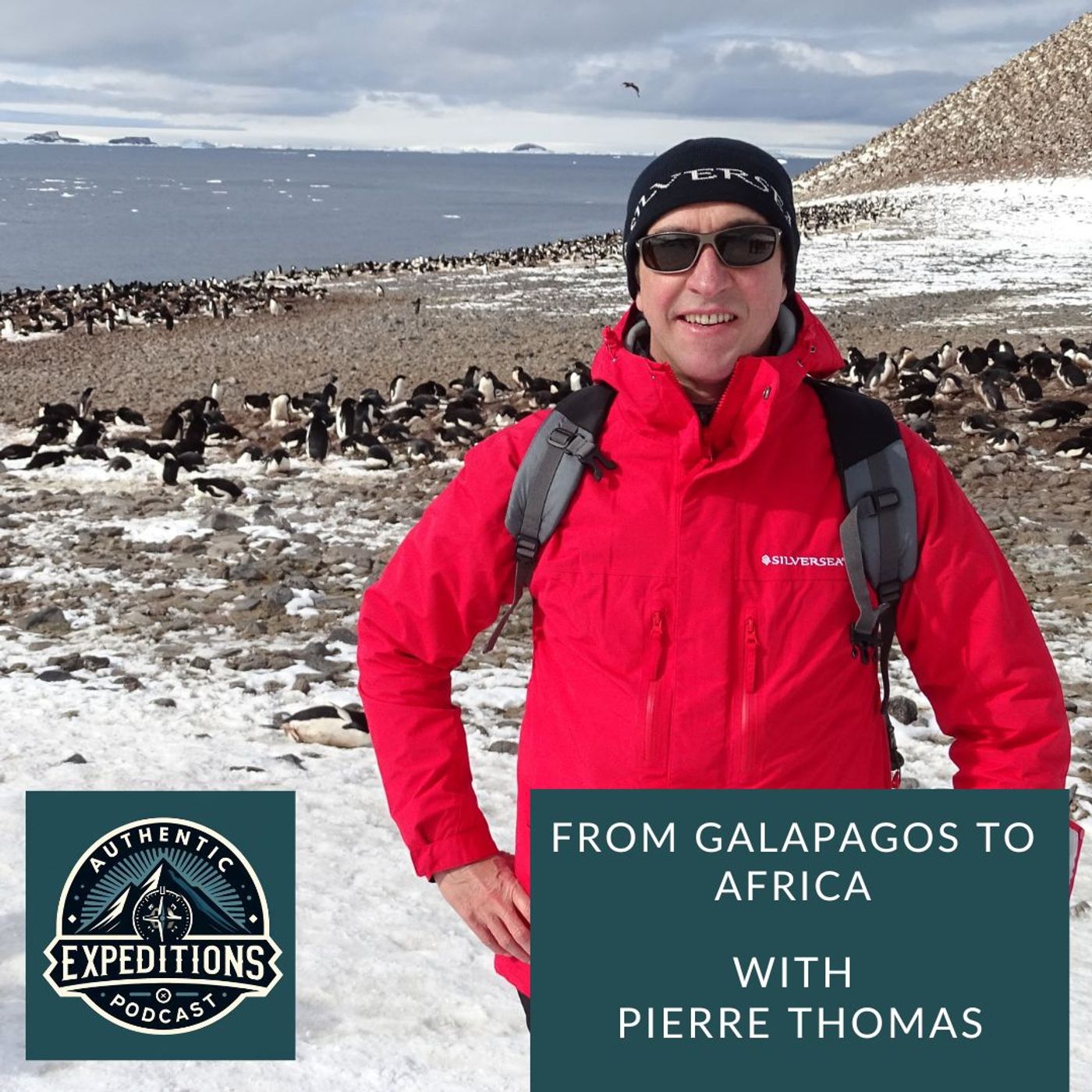
15. From Galapagos to Africa with Pierre Thomas
Pierre, who has traveled extensively in Africa, highlights the unique itineraries of small-sized expedition cruises to remote locations like the Galapagos, the Arctic, Antarctica, and Africa's coasts.
He describes detailed itineraries along the east and west coasts of Africa, noting wildlife experiences and cultural encounters. Pierre talks about the evolution of expedition cruising and new destinations like Japan, and underscores the importance of sustainability in expedition cruising, particularly in regions like the Galapagos and Africa.
01:21 Expedition Cruises Explained
03:25 Seasonality of Expedition Cruises
05:30 Exploring the West Coast of Africa
08:47 Highlights of Namibia and Skeleton Coast
10:32 East Coast of Africa and Safaris
13:45 Evolution of Expedition Cruising
21:18 Sustainability in Expedition Cruises
23:36 Dream Destinations
Featured Cruises To find out more about expedition cruises contact Jane Middleton on +44 (0)7971 568155 or [email protected]
Plan your next cruising adventure with Authentic Travel company
Producer: Sue Stockdale
Sound Editor: Matias de Ezcurra
Welcome to Authentic Expeditions, the podcast that takes you into the world's most remote and remarkable places. I'm your host Sue Stockdale and today my guest is Expedition Leader Pierre Thomas, who has traveled extensively in the Galapagos, all regions and along Africa's coastlines. Pierre describes the itineraries along the east and west coasts of Africa and how expedition cruising is evolving, opening up new destinations like Japan for the curious and adventurous traveler. Welcome to the podcast Pierre, great to speak to you today.
Well wonderful and thank you so much Sue for the invitation I'm looking forward to this chat on expedition cruises in general. Now you've got an interesting background given that you have an experience as an expedition leader and also working with an expedition cruise line. What's it like from both sides of the fence? For our listeners I'm based in Antwerp in Belgium, I grew up in Africa, I grew up in Kinshasa, the capital city of what was then known as Zaire, now the Democratic Republic of Congo.
From there I was fortunate to start working in expedition cruises in the Galapagos Islands where I worked from 1994 to 2003 and the Galapagos obviously opened possibilities to work in other areas of the planet such as the Arctic and Antarctica, the west coast of South America, Caribbean, west coast of Africa, East coast of Africa, Indian Ocean Pacific and so on. So I've been traveling mainly on board of expedition cruises that are relatively small in size and go to areas where it is difficult for other vessels to get access to and the main difference between an expedition cruise and a classic cruise will be the use of zodiacs.
As there is no man-made infrastructure in the areas where we explore we will be disembarking our guests safely and with comfort on board those zodiacs for exploration trips called zodiac cruises those will be our main part of transportation. Well it makes it the adventure straight from the start when one gets on a zodiac and heads off to explore. We're recording us in December Pierre and you told me you've just come back from the Galapagos. It was the perfect time of the year to go to when here the weather gets a little grim, the rain is kicking in, the temperatures are dropping so for me it was an incredible experience.
Having worked 10 years in the Galapagos as a naturalist guide and expedition leader, then being away for 22 years and the last time I was back was in 2018 seeing the Galapagos unchanged in the national park but of course the human population has grown over the years. There's better standards in accommodation in the main settlements and so on but the national park was absolutely incredible. I recharge my batteries fully ready to get into the winter in Europe and we had some spectacular two weeks in the Galapagos doing great snorkeling.
I was taking care of two groups there, really unbelievable under water world, great populations of sea turtles, penguins, flightless corn run, sea lions, it was really great to be able to witness this and I always say as travelers were fortunate to be able to go to those remote and almost untouched parts of the planet. We certainly are. And listener we do have a whole episode on the Galapagos so do look back in our past catalogue and you'll find that episode there which makes me think now Pierre given this podcast is coming out in April that there is a seasonality to expedition cruises so in April so in springtime in northern hemisphere countries where are places that typically travelers are traveling to?
You know that in Antarctica the season typically goes from the end of October till beginning of March at the end of the Antarctica season the vessels exploring Antarctica will reposition to other areas one of our vessels goes along the west coast of Africa up to the British Isles repositioning to the Arctic where the season typically starts. I would say not going too early to the Arctic but will be mid-May towards end of September that's the typical season for the Arctic another vessel repositions along the east coast of Africa passing by the seashells including Al-Dabra where we have the largest population of giant tortoises roaming in the wild now with days with about a hundred thousand on Al-Dabra and then from there the ship repositions to the Kimberley which is located on the northwest coast of Australia.
So April is a great time for the west coast of Africa or the east coast of Africa those are great destinations that people often do not think about as an expedition destination but yes there are more alternatives than just Antarctica or just the Arctic and the Galapagos there's a whole world out there with incredible possibilities incredible biodiversity and incredible ethnic diversity as well. In Africa is a country we haven't spoken about yet on the podcast some curious to dig into this a little bit more pier even obviously you've lived in continent as well where are some of the most visit destinations from a expedition cruise perspective on the west of Africa.
Yes at the end of our Antarctic season the ship repositions from Puerto Williams goes over the Falklands, South Georgia, Heds, Tristan, Da Cunha and then goes to Namibia where the vessel starts sailing along the west coast of Africa all our guests gather in Cape Town then we organize the logistics to bring them from Cape Town by private charter plane to Namibia where they will board the vessel and from there on we have the possibility to go from Wavis Bay where the expedition along the west coast of Africa starts it goes all the way to Tehma in Ghana and from there the guest wanting to stay on board to continue the second leg of the expedition continue onwards towards Lisbon.
So if you would combine those two legs we end up with 37 days along the west coast of Africa which is great because otherwise those are countries where it is very unlikely people would travel to those countries overland so the ideal way to explore and to experience the west coast of Africa in my opinion is by expedition vessels because this way people will have the opportunity to have an impression of the country but always coming back on the comfort of the expedition vessels. Now you were asking about some of the highlights of the west coast of Africa I mentioned earlier that I grew up in Kinshasa that was and is the capital city of what was known as Zaire now the Democratic Republic of Congo but we spend three nights in Puan Noir which is in the Republic of Congo not the Democratic Republic of Congo but the Republic of Congo and there we have the possibility to bring our guest to one of the late Jane Goodall project called Chimbunga where we look forward to to some chimpanzees in a kind of rehabilitation center we bring our guest to the Lysio Luna National Park which is famous for the low-land gorillas in Congo and so there we have actually two full days but three nights in the Congo we go along the small countries of the western part of Africa and then we have some proper expedition as well around the Bijagos archipelago belonging to Guinea Biseau where we spend three days exploring the different ethnic communities it is a great destination for biodiversity ethnic diversity cultural diversity and the incredible African situations such as the little markets the voodoo ceremonies the history the slave castles the history of the colonialism the independence it's really an eye opener for anyone who would like to
know and enrich their knowledge on Africa it's seeming fascinating and many of these places are new names to me pier in terms of what you're describing also just coming back to Namibia is that the skeleton coast then of course this is Sub-Saharan Sub-Saharan but it's even an incredible and pleasant climate it's surprisingly cool when we're sailing along the Benghwala currents the waters are incredibly rich along the west coast of south africa and the coast of Namibia we're talking exactly about the skeleton coast and then we have several days where we're able to explore not only witnessing incredible marine life, fur seals, pelicans, flamingos and then exploring the desert of course in Namibia is spectacular but we also explore some remains of abandoned old settlements such as Kulman'skop which is just inland from Luderitz where we also spend some time and this is a kind of abandoned diamond mining area that was abandoned there now it's been overtaken by the sand it's really spectacular for photography the history is great and after Namibia of course and when we go inland we see some incredible vegetation hard to believe that plants are able to grow there but we have the famous Well-Witcha plant that reaches ages of over 1000 years so it's really spectacular to
see that plant growing slowly in the desert. Well you've given us a rich itinerary already pier on the west coast of africa you also mentioned the east and some of the places that expression cruises we've traveled to when we go to the east coast of africa the east coast of africa is famous for its safaris and there we cover different countries starting in Cape Town we go along the east coast of South africa giving our guest possibilities to do during the day great wildlife experiences such as going to private game reserves experiencing the big five in different areas such as Richards Bay, Port Elizabeth and so on then the vessel repositions towards Mozambique where we have the chance to go to some of the oldest European settlements Indian Ocean by the Portuguese and then after that we go into Tanzania where we have the possibility there to go to Kilwa Kisewani which is world heritage side by UNESCO but cultural world heritage side great place early trading post in the Indian Ocean and after that I have to say we go to one of my favorite places on the planet which belongs to the country of the seashells which is also parts of africa it is the al-dabra at all where we nowadays find the largest population of giant tortoises in the wild with an estimate of over 100,000 giant tortoises we also find the only
flightless bird in the Indian Ocean which is a rail species that is endemic to al-dabra and I have to say so that the snorkeling in al-dabra is just like straight out of a Jacques Cousteau documentary it is absolutely spectacular snorkeling so it's sounding like there's lots of activity and plenty to see for those that love adventure I would more call it like a kind of hybrid expedition where there will be a little bit less use of zodiacs but of course as we sail along the west coast of africa where there is plenty of man-made infrastructure and where the ship can get alongside we use local transportation to bring us to the highlights of each country.
As the east coast of africa we go to safaris we go to remote islands of Mozambique where we make more use of zodiacs we will go to Zanzibar to stone down the birthplace of Freddie Mercury and then we go to al-dabra which again is a great place for zodiac exploration and so on so I would say a little bit more wide life oriented expedition on the east coast in comparison to the west coast of africa generally a little bit more focused on cultural and ethnic diversity. So you've given us a lovely example of why we should go and visit africa and the rich diversity of places and experiences that we can have here and we also talked about April being the month where travel to africa might be an optimal time of the year to visit.
You're now making me think about how expedition cruising is evolving. Africa is a fairly new destination given that you're also very close to what the guest is interested in. Where is expedition cruising evolving too? So expedition cruises started around the mid-1960s the company I work for Silver Sea started in 2008 with expedition cruises and I was part of the expedition team along the west coast of africa already in 2015 2017 2018 so we've been doing the west coast of africa already several years and we've seen that it is more and more popular why because people look for new destinations and as you were asking what new destinations we have in offer?
Well surprisingly we have developed programs in Japan so we will be offering expedition cruises in Japan which I would of course love to go to because Japan is still one of the few places I haven't been to especially as in an expedition cruise basically the excursions are included it's an all inclusive experience which is great especially in destinations like Japan so this is definitely a great program the company has been developing and we're looking forward to offer in the years to come. And how has your role changed from an expedition leader perspective over the course of these years where you've been involved in expedition cruising?
That's a very good point I just came back from the Galapagos and I will be totally honest when I saw all my former colleagues that I actually was working with 30 years ago I was missing it to be able to share your knowledge with fashion enthusiasm to share with the guests but I enjoy a lot doing podcasts like like we do today but also talk to the public talk about what expedition cruising is about what people should think of preparing themselves when preparing in expedition cruise so I like the fact that I was able to work for 30 years on board expedition vessels and leading expeditions but now I also enjoy visiting partners talking to consumers participating at consumer fairs and helping our team of sales directors to promote our expedition product so I like the fact that I have worked on board makes it of course nice because everything is still very clear in my mind when I talk to people I know exactly how the whole operations go how it works and of course today it is very different in the past I was coordinating activities with the captain of the vessel the officers making sure that the hotel director had everything ready by the time we the expedition team got back from our expedition experience now it is different now I don't have to
coordinate the program with captain officer's expedition team hotel director so it's another different nowadays one of the things that any guest traveling on an expedition cruise should prepare for I think Pierre is to expect the unexpected when we talk about expedition cruises it is two important things you mentioned it is about discovery it is about exploration it is about unpredictability so it is about flexibility and we explained this clearly when guests arrive on board a settle-in we have a welcome briefing explaining them what to expect but the important thing is that specifically in polar regions we will be more weather-depending than in the tropics meaning that we will tell our guests that we count with their flexibility so depending on what the weather conditions will be like we have a plan A to start with but that plan A could change it to a plan B a plan C a plan D and who knows how many plans we have to work out together with the captain the officers our meteorological department in our office with whom we coordinate our activities to make sure that we're still offering a safe kind of exploration to our guests so yes it is important that we're talking about unpredictability mainly in the polar regions otherwise in the Galapagos for instance
it is quite predictable in the 10 years I was leading expeditions in the Galapagos I never had to cancel or change a program so this is quite predictable thinking about expecting the unexpected I wonder what surprised you most about experiences or questions that guests have asked over the years are there any things that have surprised you I think it's quite important and this is my main job nowadays to clearly describe to our partners the two operators who work together with us the travel agencies and also the final consumers what expedition cruising is about because we've seen in the last 30 years that people get more and more better prepared to go on an expedition cruise with the information available nowadays which was not available in the early 1990s we often had people traveling to Peru in the early 1990s and afterwards getting to the Galapagos and I had people asking me whilst being on the zodiac how high we were above sea levels so the most unexpected questions because people go from one altitude to the next finding the arrive at sea level but they're totally unaware that they're actually at sea level but yes nowadays people are quite well prepared I have to say that people reaction what really surprises me is that they're quite curious and actually
more interested especially wise in the Galapagos to learn about sustainability to learn about how to protect the areas and so on so whilst on board an expedition vessel in the Galapagos and whilst disembarking we'll do everything in our power to create new ambassadors so when people come back home they will talk about their great experience they had so yeah this is one of the important I would say ways of creating awareness and traveling you'll get to go to places who will create a kind of curiosity and afterwards will be transmitted to their network whilst coming back.
It's a very good point just picking up on the point about sustainability Pierre I didn't ask you this about the african itineraries does that sustainability element also relate to those other geographies in the world? Absolutely so when we go to places like the west coast of Africa particularly as well in the Galapagos I have to say that the Galapagos is one of the most important national parks and best known national parks in the world so there we work on different ways to be as sustainable as possible our expedition team is almost entirely from the Galapagos Islands raised got the schooling got their training in the Galapagos but besides that we also tried to source as many ingredients that are served on board to our guest are sourced locally and produced sustainably so for example we work together and support local farmers in the Galapagos we work together and support local fishermen who catch fish sustainably and besides that the company I work for silver sees also a strong supporter of education and schooling in the Galapagos so we have a foundation that supports local education so this is just on the Galapagos if we go to Antarctica for example we will work and include a lot of local Argentinian and Chilean guides on our expedition team which is great and then when we go to the west coast of Africa for example as you mentioned earlier we will love to go to villages to schools and support those as well as
this is part of the experience and this is a way how as a company and as guests we can give back to the people that invite us into their daily life which is important to do it on a respectful way respecting the local communities and giving the most authentic experience to our guests we prefer to split up our guests into small groups to make it as an authentic experience as possible so from your own personal perspective given there's so many countries in the world that you have already traveled to where would you love to create a dream trip to go and visit I really love the Galapagos but as I mentioned there are some other fascinating destinations on the planet where I want to go to or better say it I want to go back to so of course we have the Arctic we have Antarctica we have the Galapagos but I particularly like the area around Indonesia fantastic biodiversity fantastic ethnic diversity an unbelievable underwater world with spectacular snorkeling so everything that is around Rajampat Papua New Guinea Commodo Singapore Indonesia Solomon Islands Vanuatu great history don't forget this is an important area where we have what we call the Pacific theater where in the second world world it was a lot of action going around that area and for our listeners who are
interested in learning a little bit more about the history in the Pacific there's some fascinating books about that part of the history there so yes I would love a 35 day expedition voyage combining Rajampat do some spectacular snorkeling then go around Papua New Guinea going to Commodo island why not going to Panticoast island for the land diving which is also spectacular there and then going to Solomon going to Vanuatu this is definitely an area and not forgetting around Indonesia you have the Urangu tanks of course Borneo so this all can be combined in a great 35 day expedition you've given us loads of different parts of the world to consider for our next expedition adventures Pierre thank you so much for your time today I love your passion and enthusiasm for expedition and travel thank you everyone for listening I hope you enjoyed it and I hope I could inspire you for future voyages of exploration or future expedition cruises thank you so much thank you Pierre for your passion and inspiration and I for one would love to join you on your imagine 35 day expedition cruise around Indonesia taking in Rajampat and finishing up in Vanuatu by a Papua New Guinea in the Solomon Islands wow that would be one amazing trip I'm in so it was interesting to
hear Pierre talk about his journey from being born in Kinshasa and traveling most of the world which is still such a dream for many of us I totally agree with all he has said about the Galapagos having just returned and like you said so if the Galapagos sounds like your time per place these learn more by listening to our episode five Galapagos uncovered I love this idea that Pierre has of creating new ambassadors for our world by sharing these remote locations with them and having these conversations on sustainability and environmental impact whilst traveling Pierre I have goosebumps on the back of my neck when you spoke of inspiring people towards future journeys of exploration I love that word exploration and the feeling of excitement and wonder it creates when you say it Pierre thank you so much for an inspiring episode and I look forward to catching up soon thanks soo love the questions and I look forward to our episode next month so if you're interested in exploring expedition cruising more please get in touch with me Jane Middleton of the authentic travel company details are down in the show notes till next time safe travels make sure you follow us subscribe and share it with others who enjoy traveling to remote places
and I look forward to connecting with you soon
 Apple Podcasts
 Castbox
 Castro
 Goodpods
 Moon FM
 Overcast
 Pocket Casts
 Podbean
 Podcast Addict
 Podcast Republic
 Spotify