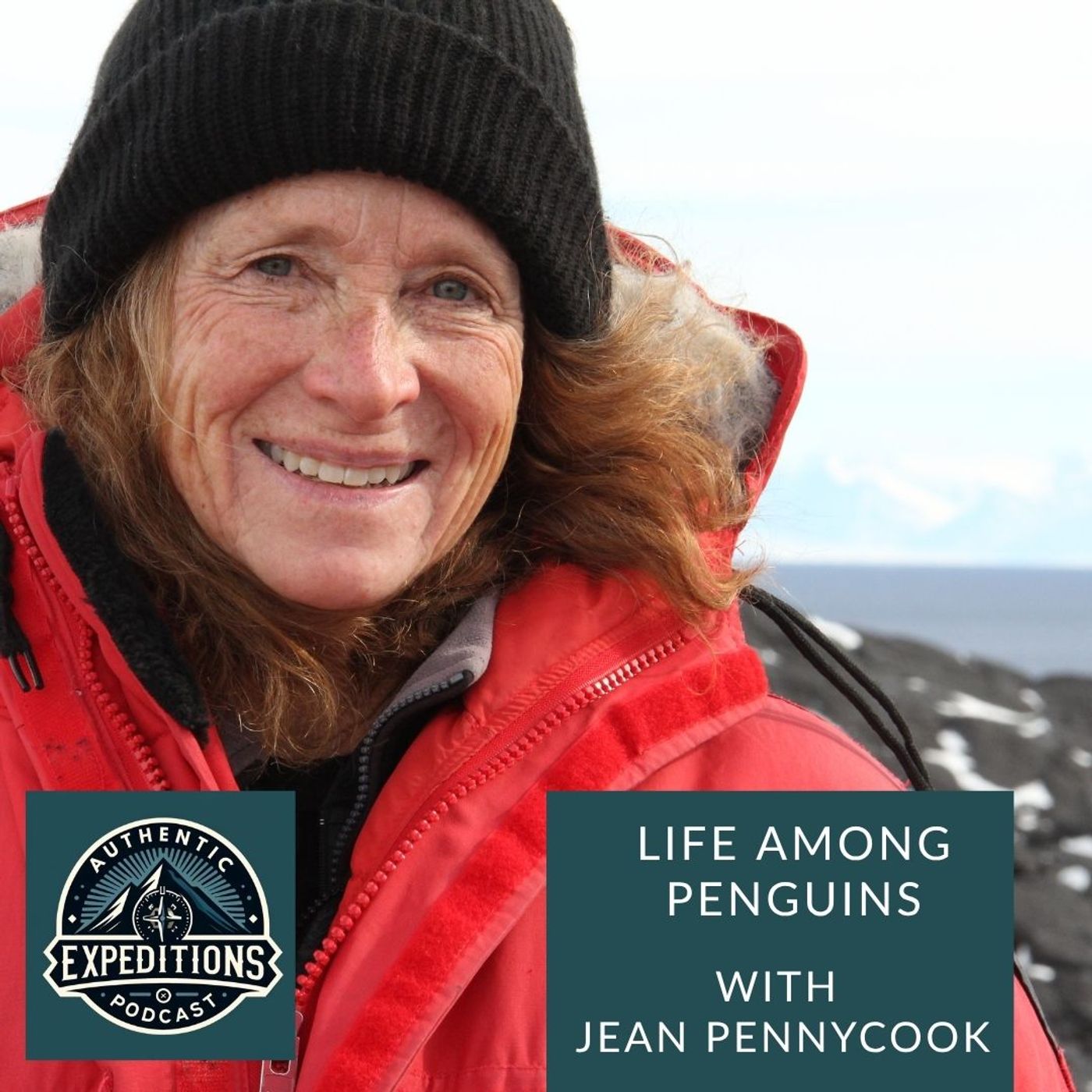
12. Life Among Penguins with Jean Pennycook
She discusses the study of penguins, their adaptability to the harsh environment, and her role in citizen science projects. Jean also emphasises the importance of protecting the Antarctic ecosystem.
Additionally, she provides insights into her work in the Arctic and highlights the significant changes in expedition tourism and polar environments over the years.
Time Stamps
00:35 Life in Antarctica: Living Among Penguins
02:45 Studying Penguins: Research and Observations
04:53 Connecting Classrooms to Antarctica
05:48 Inspiring Guests on Expedition Cruises
13:15 Arctic Adventures: Contrasts and Comparisons
16:06 Citizen Science: Engaging the Public
19:53 Environmental Changes and Tourism Impact
Featured Cruises To find out more about expedition cruises contact Jane Middleton on +44 (0)7971 568155 or [email protected]
Plan your next cruising adventure with Authentic Travel company
Producer: Sue Stockdale
Sound Editor: Matias de Ezcurra
Welcome to the Authentic Expeditions podcast. The podcast where we explore all things expedition cruising and talk to the people who live work and guide travelers in some of the world's most amazing environments. My name is Sue Stockdale and my guest today is Jean Pennycook. Now Jean has a passion for seabirds and in particular penguins and provides guests on board expedition cruise ships with deeper insight into what they are observing while they sail in the Arctic and the Antarctic. Welcome Jean to the podcast.
Thank you for having me. I'm fine and I'm calling from California. Oh wonderful. Well, I know that since 2004 I believe you've spent Antarctic summers living in a tent near the Adali penguin breeding colony on Ross Island in Antarctica. That sounds like a quite a way to spend your summers Jean. How did that happen? Well, I have a background in wildlife and fisheries biology that was my degree and I did do field work early on. Then I had children and I had to be a little bit closer to home. So I became a high school science teacher.
When my son was a senior in college, I saw the job to go to Antarctica and work with the science down there and I got that job and that was over 20 years ago and I've been going ever since. My background is in birds. So the penguins were the obvious team to be on and yes, I live in a tent in the colony at Cape Royds on Ross Island in the Ross Sea. So we go in through New Zealand from there and we get US military transport from Christchurch down to McMurdo and then to my tent site at Cape Royds and yes, it's a canvas tent stretched over wood and there's two of us there from the first of November to the end of January while the birds are breeding.
Wow, that's quite exciting life that you're leading there, Jean. In the Antarctic summer. What are the temperatures like because I imagine seeing to somebody that you spend time down in Antarctica, they'd be thinking it's pretty cold. Well, it is cold and remembering that we're there during the summer of Antarctica, when I get there in first of November, it's usually around negative 20 Celsius and it never gets above freezing but it does get warmer in January but it's still always below freezing.
We're at 78 degrees south so it's very very cold but the penguins are well suited for that. I'm not. I have to wear 25 pounds of clothing and my sleeping bag weighs 30 pounds and I wear big boots and I have to be protected but the penguins are just out there. It doesn't bother them at all. And what are you doing when you're studying the penguins there? On Ross Island, there are three colonies, Cape Roids where I am. We have about 5,000 birds down the way also on the island. There's Cape Bird with about 30,000 birds and over at Cape Crozier also on the island.
There are 600,000 birds so each one of these colonies is an order of magnitude larger than the other and my team monitors these three colonies. We want to know when do the birds come back? Are they the same number of birds as last year? Do they have the same number of chicks? Are the chicks fatter than last year? What are the birds eating? We put trackers on them so we can see where they're feeding. We put trackers on them before they leave so we can see where they go in the wintertime. It's a few hundred of them.
When they're chicks, we band them with an ID. It goes around their wing and this is a numbered metal band like an ID band. You might put on your wrist and this number tells us which colony they were born in and what year so we can track their lives. How long does it take for them to come back? About three or four years before we see them again. Do they always come back in the same colony? Usually not always. Do they always breed every year once they start? Yes, but not always. Do they have the sameness?
Sometimes, but rarely. So these are the questions that we are tracking. That sounds fascinating. It sounds like you've got a kind of summer family to observe and understand when you're down there. It is and you do get used to seeing the birds. So some of the numbers come back every year and I go, oh, there's 10, 15, there's my bird and I'm always interested to know that this bird has come back to the same colony and is raising chicks every year. It's just delightful to get to know these birds. Now penguins hold a real fascination for us as human beings, don't they?
So my question is, if people are not able to travel on a cruise ship to Antarctica, how do you convey the experience that you're having? Because I know you're also doing things via video. I do. I do zoom calls to classrooms from the colony. The star link has helped us all have internet and very remote places. So children around the world can watch the penguins live as I'm sitting there watching whatever happens to the penguins and the penguins are not afraid of me. So they come up to me and play it with my shoes and I'm only sitting a couple of feet from them as long as I don't touch them.
They are very happy that I'm close to them, which is an honor, an absolute honor that these birds allow me into their space. But yes, I'm able to connect all this to classrooms around the world. Well, I'm sure it's not just young children that are fascinated by what's happening in penguin colonies. Us adults too are also fascinated hence, of course, why people do go on expedition cruise ships to see wildlife in its natural environment. When you're on an expedition cruise ship, Jean, and you're inspiring the guests on board and you're describing what they're seeing, what for you makes it magical to do that?
I think the story that I tell is how these birds have adapted to live in such a harsh environment. How are they able to survive and not only survive, but thrive, and when people realize how difficult it is, how far they migrate, what they have to do to find their food, how do they stay warm, how do they raise their chicks, the story of their life. They give the story of your life where you have a house and it's nice and warm and you go to the grocery store and get food. Well, that's not what these guys do.
So I think the life strategy story of these birds is very compelling and each bird, each species has a slightly different life strategy. These stories, when I unfold them and show pictures of them doing this work and doing their lives, is quite compelling and very interesting. I also imagine it's quite humbling for us as human beings as well to realize that we are sheeding the planet with such amazing birds. That's exactly right and I do point those out one just specific example. These penguins are walking on ice and they don't have boots like we do and if we were to walk on ice, it would not go well.
Our feet would become frozen very, very quickly. We would become cold because we would lose heat to the environment. So we have to protect ourselves at a multitude of levels of clothing and equipment and yet these birds are just out there and they're able to do that and they're warm blooded just like we are and so they have to keep their bodies warm just like we do and yet they do not have boots, they do not have jackets and they're in the water too. So when you think about that that these remarkable creatures are able to do that and live in that environment, it is very humbling.
It's very humbling. When I do show people the number of layers that I wear both on my feet and on my hands and on my body, the entire package of clothing weighs 25 pounds when I live in the tent and I'm out with the birds. It's a lot but remarkably it is enough for me. So being cold is not an issue because I have the right equipment but I have to get the right equipment. These birds are born with it, they're absolutely born with it. You have to have a lot of respect for them. And in terms of how they retain their heat, is it through their feathers?
What's the mechanism that enables penguins to keep warm? For their bodies it is the feathers. You know you think that you pick it up like it's a nice fluffy chicken but when you pick up one of these birds it's like picking up a football or something and you can't even get your fingers into the feathers. You know if you wanted to stick your finger in there to get to their skin, it's very very difficult because the feathers are so tightly laid down, kind of like the shingles on your roof. Keeping out the water, the feathers are that type inside the outer layer.
There's all this fluffy feathers on the inside, a downy layer which keeps them warm. Now on their feet where they do not have protection, they cool the blood going down from their body and then the blood is actually cold when it gets to their feet. That way they don't lose heat to the environment and then it warms up on its way back. If you were to take a thermometer and measure the temperature of their feet, it would be like two degrees, two or three degrees Celsius and yet they're able to walk and swim in the freezing water and if your feet were that degree you would not be able to walk.
It would be frozen but these birds are able to do that with their feet so they do not lose very much heat to the environment. I can tell by how you're describing these stories gene that you're very passionate about the birds that you're observing. I guess from a broader perspective, why should we care? Why is it important that we should be observing and pay attention to what's happening with penguins and Antarctica? The birds are protected because of the Antarctic tree. We have made the decision as a world thankfully to protect these space where these birds are.
What we did forget to do was to protect the ocean around them where their food is. So it's important for us to know what's happening for these populations. Are they getting larger, reducing it and what's happening for them and how many there are and what the demands they have, where do they go in the wintertime? Are they migrating to get their food? If we know the answers to these questions, we can hopefully control the fishing because they're taking the krill now and the krill is their source of food as it is for the whales and many other birds but if we continue to fish the krill at the level we are, these birds will not survive.
Remember these birds have been here and doing what they are doing for millions of years. We've only been here for a few thousand years and yet we are already destroying and altering their environment and these birds deserve to live on this earth as well and as humans I think it's our responsibility to protect their environment both their breeding area which we do protect but also their food source which is the ocean. It's interesting that you're causing me now to think Jean about Antarctica as part of a living system so it isn't just the land mass or the sea ice that gets frozen every season or those ice shelves it's the whole ecosystem in which Antarctica exists.
Exactly and it's not just the penguins it's other seabirds and as you know the whales and the seals as well. And how did you get your knowledge about all this bird life and sea life that exists both in the Arctic and the Antarctic so that you're able to share their wonders with the guests on board expedition cruise ships. My degree is in wildlife and fisheries biology and the ecosystems that support them so that's been my background but I did not know that much about the polar regions when I went to school so the polar regions came later when I got the position down in Cape Roids in Antarctica and that was 20 years ago so I've done a tremendous amount of reading listening to other people learning the science being with the scientist being part of the science team and just learning it as I go along.
You developed your knowledge through your learning so how do you take somebody who's a guest on board a ship and interested to see the penguins for example how might you get them to think differently and engage in understanding more almost be a citizen scientist. Well I think when you're at home and you're watching the BBC Frozen Earth and you see these images on the TV it is very interesting but when you're actually there and you're standing in the Arctic and you see the animals are the plants that are surviving there or the Antarctic and you're walking among the penguins and the penguins come up to you and you watch them feed their chicks and you watch them go into the water and you see the leopard seal that is just looking for a meal as well or the quails.
When you actually experience it and see it I think it's a whole another level of understanding and I think people who did not get it so to speak before they come to these expeditionships they do get it when they leave because they actually experience it and again I try to tell the stories of the life strategies what these birds are doing it what the seals are doing here how is this behavior linked to their survival let's watch it together I think you cannot come away from that experience and still be the same person.
Being up close and personal it makes such a huge difference. I know that Jane Middleton from Authentic Travel Company she met you on board an expedition cruise ship in the Arctic so what took you to the Arctic and how often are you spending time up there? Well I just got back from our Arctic experience our season was over a couple of weeks ago and there is a big difference up there their wildlife is still hunted so it is a little bit more jittery and as we approach they tend to run away but the landscapes are very dramatic there's plenty of icebergs and animals too see we do see a lot of birds the sea birds of course are still there but yes on land we're not going to run into any birds that we can just walk up to and of course the polar bears we have to respect and stay away from but we do see the fox and the walrus and the other seals and other land animals so the wildlife is there but it's a whole different dynamic and of course people live there in the Arctic nobody lives in the Antarctic there's science bases but nobody lives there whereas people do live in the Arctic and again they use the environment to sustain themselves so it's a whole different dynamic up there but still when you are in an area and you can look in any direction for a hundred miles and there's not one town one road one person who lives there it's very humbling if you come from the middle of New York City and then you go into that environment it's a little bit awe inspiring and I'm glad for that and when you're on board an
expedition ship gene are you also taking out the zodiacs are you driving the zodiacs and talking to guests when you're out there I am a driver so the people sadly or maybe not I don't know when people are in my boat if I see a bird that's what we go look at or a whale that oh let's go look at the whales as a driver we need to stay in pairs but we are allowed to go wherever we want to so if we see something interesting that's where we go if I see nesting kilowaits on the cliff then I want to go over there of course I will do whatever the guests want if they want to go here or there but yes we just drive around and look at the sights and it doesn't matter where you go it's all magical absolutely magical the whole place if you just sat in the middle of the ocean with ice around you and enjoyed the scenery you don't really have to go anywhere you just have to sort of be there but of course yes we drive around and look for things that must be quite an amazing life that you have then for part to the year in the art take and part to the year in the art and tarteke it's a gift that was given to me to be able to be part of of Quark expeditions they only do the polar regions and so I go to the artic and the antarctic and that's my specialty that way I don't have to learn
about the birds just have those two regions and they are similar in that they are polar regions but they are drastically different primarily because of the wildlife and the antarctic is much colder much colder now I mentioned a moment ago the term citizen science when people can get involved and I was watching something that you did recently jean and you were showing where you have people actually counting the number of penguins and things on the ice via photographs what citizen science projects can people get involved in there are projects the current big one is called penguin watch it's again monitoring the numbers of these birds is very important to see if they are changing up or down some of them are going up some of them are going down but without that knowledge we cannot justify asking for the ocean to be controlled but you can't go to all these places so they installed cameras that take a picture twice a day and you can imagine all these cameras at all these places there's hundreds and thousands and thousands of these pictures so they put them out under the penguin watch website and you can sit at home and you don't have to count them you just take your cursor and tap it on the bird and then the computer counts it but here's a bird here's
an adult here's a chick so you use different colors to determine chicks or adults or a different kind of bird there are other birds in the colony besides the penguins or something else that needs to be looked at and then the people at the other end will come and look and see what you saw that was weird or different so yes this is very important work the scientists do not have time to do all this work my group did one on seals where we had pictures of seals all the way around the margin of an article taken with satellites I mean we can't be there we certainly don't have the drones or whatever so they were satellite pictures well you got big fat brown things on sea ice they're not so hard to count but you can be confused with rocks nonetheless we had hundreds of thousands of pictures lots of them had no seals in them so you say no seals and go to the next one but we had several thousand people who helped us with that count so that we knew how many wooded seals are in an article because we had no idea well now we do that sounds a brilliant way to do it and to get people involved in helping scientists with their important work yeah given that you've been for so many years traveling to Antarctica and the Arctic as well gene I'm wondering what's the most significant
shifts that you've observed in expedition tourism and also in the environments in which you're living well in the Arctic region we're seeing a dramatic reduction in just the amount of sea ice we run into we have to go further north to run into the ice cap and there's just less of it there used to be a lot well now there's not so much down in the Antarctic on the peninsula side we're seeing that as well and the Adeli colonies are where there used to be a lot now they're not so many because the Adeli's like the sea ice and they want to be around it it's hard to know whether they die I don't think they die I think they just moved they went and found the sea ice somewhere else because there's still a lot of Adelie penguins but their colonies are shifting and we see them it's very dramatic and the Gentoos are building colonies where they didn't use to Gentoos don't like ice and so they only build their colonies where there is no ice and in the time I've been going in the 10 years I've been going there didn't use to be a colony there and now there's a colony there like whoa how'd that happen so those are things that I've seen just in the 10 years that I've been doing this it must be quite insightful for you to see that change over the years then when you're going
back to the same place and noticing the differences particularly since it's a very short time scale 10 years is a short time scale in these kinds of things from being aboard an expedition cruise ship have you seen any changes in expedition tourism over the years as well well there's definitely more of it even in the Arctic I'll forget the numbers but something like 10 years ago there used to be 30 ships up there and now there's 60 ships so there's the sheer numbers of people up there is I'd say doubled in the 10 years that I've been there down in the Antarctic as well there's many new ships when I first went we would never see another ship well now it's very common to see another ship on daily basis we might run into another ship whereas before we do a whole cruise it not see any other ship at all also we're seeing more fishing vessels down in the Antarctic which bothers me a little bit some of them are illegal some of them are legal but there's more and more fishing vessels down there well things are changing by the sounds of it if you are inviting the listeners to think or share with us one sort of compelling image that you have in your mind that really says to you this is like the brilliance of Antarctica wonder if you can share a story with us of the experience that you've had
that really you hold in your mind I think the image that I would like to show is that in the winter of these places in the Arctic the people are there of course but in the winter most of the animals absolutely disappear in the Antarctic the only animal that stays there is the upper penguin everybody else gets out so this environment is so harsh that everybody leaves in the winter but it supports millions of animals in the summertime so even though this area doesn't go dead but goes dormant when it comes alive it explodes absolutely explodes and supports huge amounts of life in the Arctic of course there's plants and those plants all go dormant and then come alive so if you could see the carpet of plant life in the Arctic which then of course supports all the birds and the land animals and the insects during the summertime and the numbers were now it's zero and in the summertime it's millions in my head that is the image that I try to share with people that this place explodes in the summer with life well I think you've done a pretty good job of inspiring us there Jean with your description I just love your energy and passion for what you're talking about you've described to us they work you do with the penguins down in Antarctica what's your favorite
thing that you see in the Arctic well I guess it has to be the whales they're so compelling although I mean they're not birds but I love the birds you know there's the full mors and the gillamats and all those stuff the dovkeys the puffins but the whales are so special when we see the narwhals and the belugas it does my heart good just to know that they're there and that they're alive and thriving and they're not mad at us you know that's as species we pretty much cleaned them out this was not a good thing the wailing industry just about clobbered these populations and they've come back not in the same numbers but they are coming back and I just am glad to see them there and that they don't attack us they could if they want to I mean we're out in kayaks and in zodiacs one flip of their tail and we'd be dead and yet their gentle gentle creatures they still maintain that personality for which I am just in awe of again it is a wondrous description that you're sharing with us to give us a sense of these great creatures if there's a listener to this podcast Jean and they're thinking oh I'd quite like to go on expedition cruise and now Jean's inspired me to think about all the things that I'll see an experience what should they take to make sure
they get an optimal experience well people ask me that all the time it so depends on what you want to see in the Antarctic I would say go in early January or February because if you go before that you're not going to see the penguin chicks and I would think that seeing the penguin chicks for me that is what you want otherwise you're going to see birds sitting on eggs which is still wonderful but seeing the energy and the new life coming out and those chicks running around is huge so I would say go in those months and definitely if you can go to south Georgia if you can manage the south Georgia trip it is so so magical and wonderful there you will walk among a million king penguins it's quite magical with the mount of sea life and animal life on land and in the ocean in south Georgia so that's a real star destination if you can't go to south Georgia the peninsula area is still striking and beautiful in the Arctic I would say go a little bit earlier in the Arctic because otherwise you might miss the flowers and the flowers and the vegetation is very important if you go in late august in september you're going to miss most of the birds and the flowers will pretty much be gone so I would say go a little earlier and I imagine you would recommend people take a decent set of
binoculars or a camera absolutely you must have binoculars my binoculars are practically attached to me you know I never take them off interestingly enough many people I'd say even most people only use their phone as their camera and are able to take remarkable pictures not to say you shouldn't take a stronger camera and many people do and I'm grateful when people have long lenses and they take pictures and then share them that is a huge gift that people do but remarkably the phones these days are taking great video and great pictures so absolutely you have to take pictures well you're getting me all excited about these wonderful parts of the world to visit and I just would like to thank you for being a fantastic guest on our podcast today for including me and I'm sure our listener as well with the tales of being up close and personal with these birds that we experience thank you so much for your time and I wish you well this year are you heading back to Antarctica very soon yeah well we have my flights since only a few days away so I'm packing and getting ready yes oh wonderful thank you again Jean it's wonderful to have this conversation with you well thank you so much for having me I just hope all of your listeners will find their way to the Arctic and the Antarctic as
soon as they can because it is changing it is changing thanks so and Jean I love Jean's passion for all things birds and especially the penguins and her dedication to the important work of monitoring the changes in the bird colonies whilst educating our future explorers in the classroom her description of the penguins and the whales really creates a picture in your mind so clear so passionate fantastic thanks Jean as she said Sue I was lucky enough to be on an expedition up in East Greenland a few months back and I can vouch firsthand for her passion as well as her skills as a zodiac driver this listeners I just want to reiterate a couple of points Jean made firstly she is so right when she says all of the places in the polar regions are magical in their own right regardless of whatever an amazing wildlife you might see secondly her advice to visit either the Arctic or the Antarctic because they are changing is spot on and that rate of change is speeding up so if you're thinking about a polar expedition give me Jane Middleton a call or drop me an email details are in the show notes and if your birds are your thing we can even tie you up with a sailing where Jean is on board in the meantime check out penguin watch with cities and science where you can get involved with
some important work counting penguins from the comfort of your own home thanks again Sue and I look forward to our next month's episode make sure you follow us subscribe and share it with others you enjoy traveling to remote places and I look forward to connecting with you soon
 Apple Podcasts
 Castbox
 Castro
 Goodpods
 Moon FM
 Overcast
 Pocket Casts
 Podbean
 Podcast Addict
 Podcast Republic
 Spotify